Department of Internal Medicine, Icahn School of Medicine at Mount Sinai, 1 Gustave L. Levy Pl, New York, NY, USA.
Department of Cardiovascular Diseases, Icahn School of Medicine at Mount Sinai, Mount Sinai Hospital, Mount Sinai Heart, New York, NY, USA.
Eur Heart J. 2019 Jul 1;40(25):2058-2073. doi: 10.1093/eurheartj/ehz056.
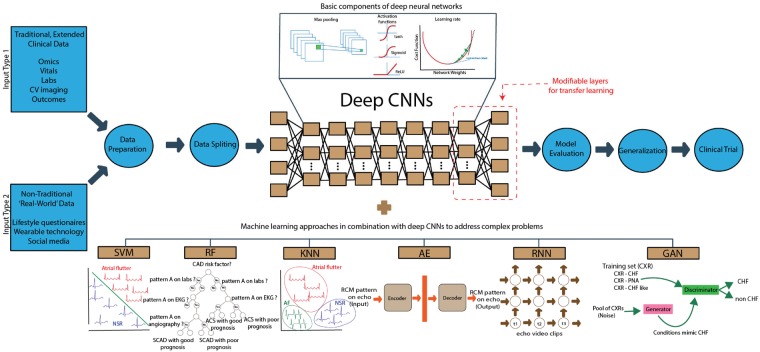
Deep learning (DL) is a branch of machine learning (ML) showing increasing promise in medicine, to assist in data classification, novel disease phenotyping and complex decision making. Deep learning is a form of ML typically implemented via multi-layered neural networks. Deep learning has accelerated by recent advances in computer hardware and algorithms and is increasingly applied in e-commerce, finance, and voice and image recognition to learn and classify complex datasets. The current medical literature shows both strengths and limitations of DL. Strengths of DL include its ability to automate medical image interpretation, enhance clinical decision-making, identify novel phenotypes, and select better treatment pathways in complex diseases. Deep learning may be well-suited to cardiovascular medicine in which haemodynamic and electrophysiological indices are increasingly captured on a continuous basis by wearable devices as well as image segmentation in cardiac imaging. However, DL also has significant weaknesses including difficulties in interpreting its models (the 'black-box' criticism), its need for extensive adjudicated ('labelled') data in training, lack of standardization in design, lack of data-efficiency in training, limited applicability to clinical trials, and other factors. Thus, the optimal clinical application of DL requires careful formulation of solvable problems, selection of most appropriate DL algorithms and data, and balanced interpretation of results. This review synthesizes the current state of DL for cardiovascular clinicians and investigators, and provides technical context to appreciate the promise, pitfalls, near-term challenges, and opportunities for this exciting new area.
深度学习(DL)是机器学习(ML)的一个分支,在医学领域显示出越来越大的应用前景,可用于辅助数据分类、新型疾病表型分析和复杂决策。深度学习是一种通过多层神经网络实现的 ML 形式。随着计算机硬件和算法的最新进展,深度学习得到了加速,并越来越多地应用于电子商务、金融、语音和图像识别领域,以学习和分类复杂数据集。目前的医学文献表明,深度学习具有优势和局限性。DL 的优势包括其自动化医学图像解释、增强临床决策、识别新型表型以及在复杂疾病中选择更好治疗途径的能力。深度学习可能非常适合心血管医学,因为心血管医学中的血流动力学和电生理指标越来越多地通过可穿戴设备连续捕获,以及心脏成像中的图像分割。然而,DL 也存在显著的局限性,包括模型解释困难(即“黑箱”批评)、在训练中需要大量裁决(“标记”)数据、设计缺乏标准化、训练数据效率低下、在临床试验中的应用有限以及其他因素。因此,DL 的最佳临床应用需要仔细制定可解决的问题,选择最合适的 DL 算法和数据,并平衡解释结果。本综述综合了心血管临床医生和研究人员的当前 DL 状态,并提供了技术背景,以了解这个令人兴奋的新领域的前景、陷阱、近期挑战和机遇。