Gao Tianlin, Jiang Menghui, Liu Xiaoqian, You Guoju, Wang Wenyu, Sun Zhaohui, Ma Aiguo, Chen Jie
The College of Medical, Qingdao University, Qingdao 266021, China.
Key Laboratory of Polymer Ecomaterials, Changchun Institute of Applied Chemistry, Chinese Academy of Sciences, Changchun 130022, China.
Polymers (Basel). 2019 Jan 18;11(1):171. doi: 10.3390/polym11010171.
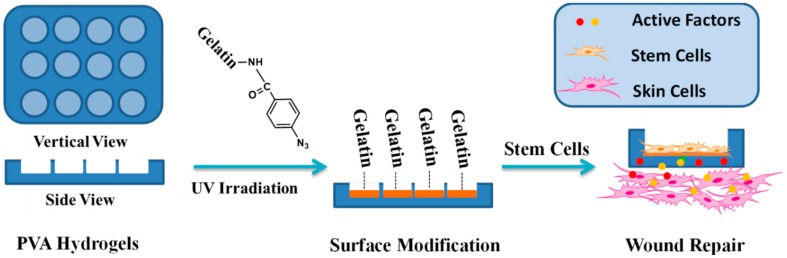
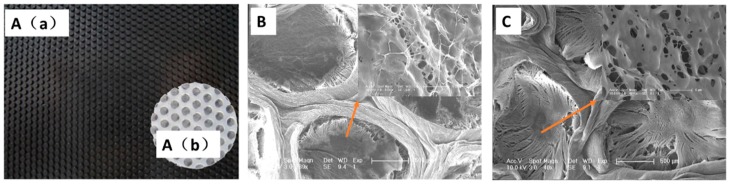
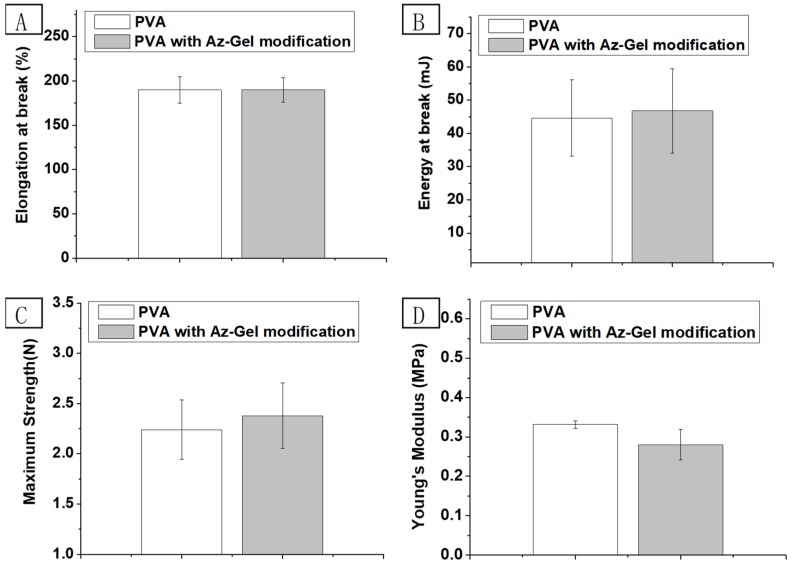
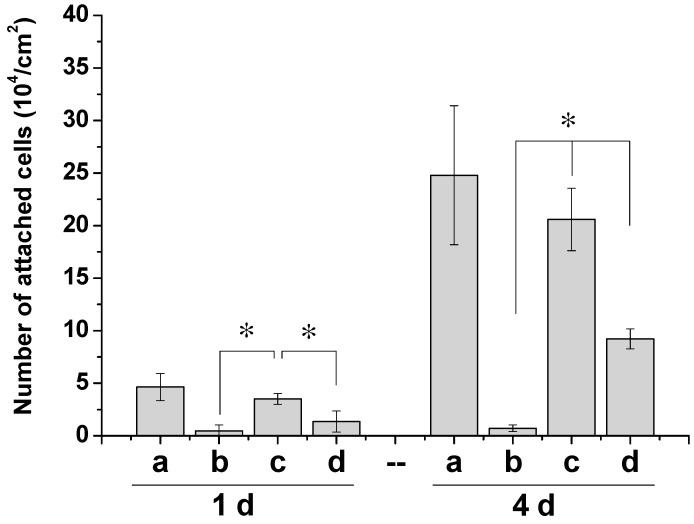
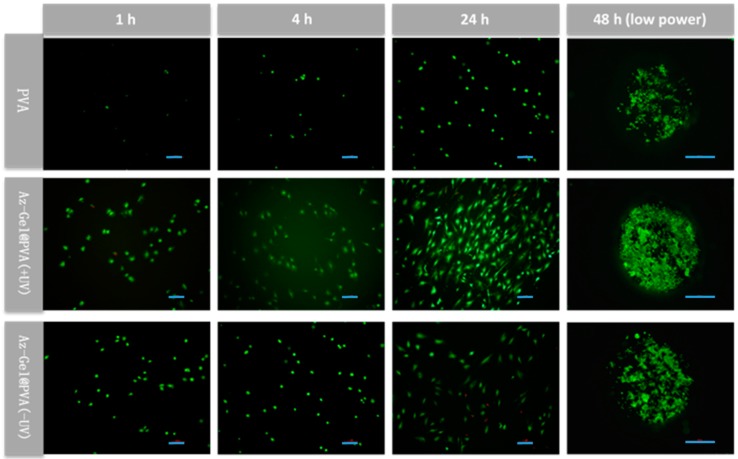
Polyvinyl alcohol (PVA) hydrogel and stem cell therapy have been widely used in wound healing. However, the lack of bioactivity for PVA and security of stem therapy limited their application. In this study, an adipose-derived stem cells (ADSCs)-seeded PVA dressing (ADSCs/PVA) was prepared for wound healing. One side of the PVA dressing was modified with photo-reactive gelatin (Az-Gel) via ultraviolet (UV) irradiation (Az-Gel@PVA), and thus ADSCs could adhere, proliferate on the PVA dressings and keep the other side of the dressings without adhering to the wound. The structure and mechanics of Az-Gel@PVA were determined by scanning electron microscopy (SEM) and material testing instruments. Then, the adhesion and proliferation of ADSCs were observed via cell counts and live-dead staining. Finally, in vitro and in vivo experiments were utilized to confirm the effect of ADSCs/PVA dressing for wound healing. The results showed that Az-Gel was immobilized on the PVA and showed little effect on the mechanical properties of PVA hydrogels. The surface-modified PVA could facilitate ADSCs adhesion and proliferation. Protein released tests indicated that the bioactive factors secreted from ADSCs could penetrated to the wound. Finally, in vitro and in vivo experiments both suggested the ADSCs/PVA could promote the wound healing via secreting bioactive factors from ADSCs. It was speculated that the ADSCs/PVA dressing could not only promote the wound healing, but also provide a new way for the safe application of stem cells, which would be of great potential for skin tissue engineering.
聚乙烯醇(PVA)水凝胶和干细胞疗法已广泛应用于伤口愈合。然而,PVA缺乏生物活性以及干细胞疗法的安全性限制了它们的应用。在本研究中,制备了一种接种脂肪干细胞(ADSCs)的PVA敷料(ADSCs/PVA)用于伤口愈合。通过紫外线(UV)照射,PVA敷料的一侧用光反应性明胶(Az-Gel)进行修饰(Az-Gel@PVA),这样ADSCs可以在PVA敷料上黏附、增殖,同时使敷料的另一侧不黏附伤口。通过扫描电子显微镜(SEM)和材料测试仪器测定Az-Gel@PVA的结构和力学性能。然后,通过细胞计数和活死染色观察ADSCs的黏附与增殖情况。最后,利用体外和体内实验来证实ADSCs/PVA敷料对伤口愈合的作用。结果表明,Az-Gel固定在PVA上,对PVA水凝胶的力学性能影响较小。表面改性的PVA能够促进ADSCs的黏附与增殖。蛋白质释放测试表明,ADSCs分泌的生物活性因子能够渗透到伤口处。最后,体外和体内实验均表明ADSCs/PVA可通过分泌ADSCs的生物活性因子促进伤口愈合。据推测,ADSCs/PVA敷料不仅能够促进伤口愈合,还为干细胞的安全应用提供了一种新途径,这在皮肤组织工程领域具有巨大潜力。