Zeisler Marie-Luise, Bilgic Leman, Schumann Maria, Wengler Annelene, Lemcke Johannes, Gößwald Antje, Lampert Thomas, Santos-Hövener Claudia, Schmich Patrick
Unit 21: Epidemiological Data Centre, Department 2: Epidemiology and Health Monitoring, Robert Koch Institute, 12101 Berlin, Germany.
Charité Berlin, Berlin, Germany.
JMIR Form Res. 2020 Apr 15;4(4):e14747. doi: 10.2196/14747.
Germany is a popular destination for immigrants, and migration has increased in recent years. It is therefore important to collect reliable data on migrants' health. The Robert Koch Institute, Berlin, Germany, has launched the Improving Health Monitoring in Migrant Populations (IMIRA) project to sustainably integrate migrant populations into health monitoring in Germany.
One of IMIRA's objectives is to implement a feasibility study (the IMIRA survey) that focuses on testing various interventions to increase the reachability of migrants with health interview surveys. Possible causes of nonresponse should be identified so as to increase participation in future surveys.
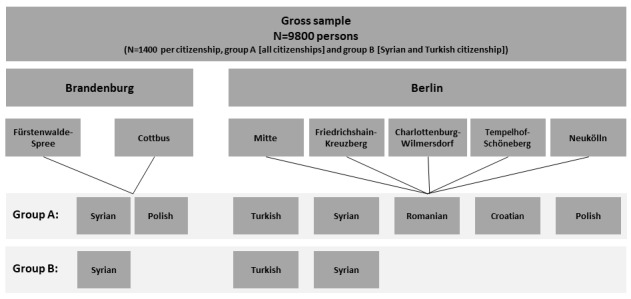
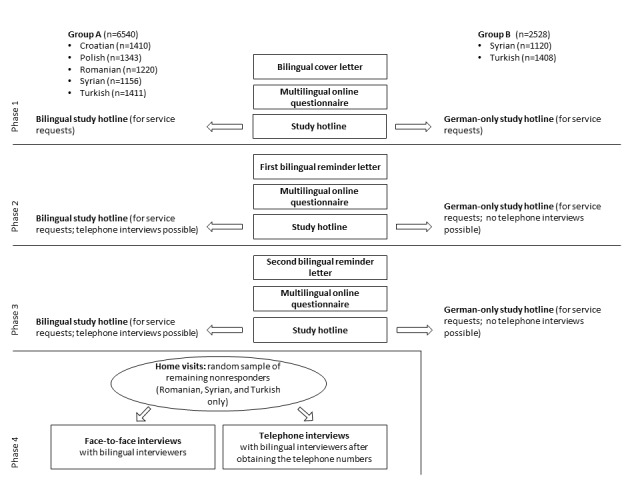
The survey target populations were Turkish, Polish, Romanian, Syrian, and Croatian migrants, who represent the biggest migrant groups living in Germany. We used probability sampling, using data from the registration offices in 2 states (Berlin and Brandenburg); we randomly selected 9068 persons by nationality in 7 sample points. We applied age (3 categories: 18-44, 45-64, and ≥65 years) and sex strata. Modes and methods used to test their usability were culturally sensitive materials, online questionnaires, telephone interviews, personal contact, and personal interviews, using multilingual materials and interviewers. To evaluate the effectiveness of the interventions, we used an intervention group (group A) and a control group (group B). There were also focus groups with the interviewers to get more information about the participants' motivation. We used the European Health Interview Survey, with additional instruments on religious affiliation, experience of discrimination, and subjective social status. We evaluated results according to their final contact result (disposition code).
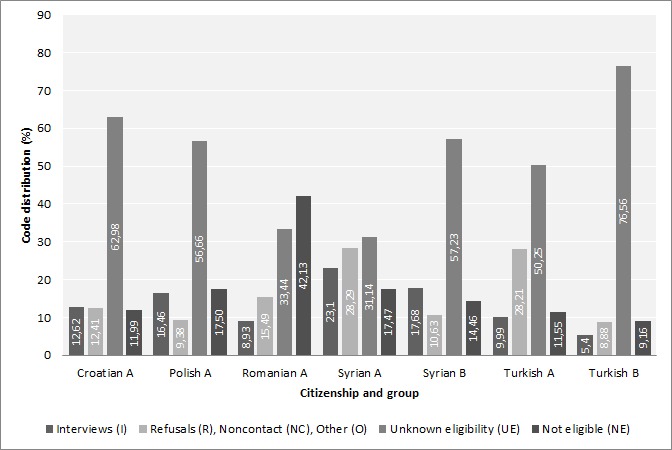
We collected data from January to May 2018 in Berlin and Brandenburg, Germany. The survey had an overall response rate of 15.88% (1190/7494). However, final disposition codes varied greatly with regard to citizenship. In addition to the quantitative results, interviewers reported in the focus groups a "feeling of connectedness" to the participants due to the multilingual interventions. The interviewers were particularly positive about the home visits, because "if you are standing at the front door, you will be let in for sure."
The IMIRA survey appraised the usability of mixed-mode or mixed-method approaches among migrant groups with a probability sample in 2 German states. When conducting the survey, we were confronted with issues regarding the translation of the questionnaire, as well as the validity of some instruments in the survey languages. A major result was that personal face-to-face contact was the most effective intervention to recruit our participants. We will implement the findings in the upcoming health monitoring study at the Robert Koch Institute.
德国是一个受欢迎的移民目的地,近年来移民数量有所增加。因此,收集有关移民健康的可靠数据非常重要。德国柏林的罗伯特·科赫研究所发起了“改善移民人口健康监测”(IMIRA)项目,以将移民人口可持续地纳入德国的健康监测。
IMIRA的目标之一是开展一项可行性研究(IMIRA调查),重点测试各种干预措施,以提高通过健康访谈调查接触移民的可能性。应确定无回应的可能原因,以提高未来调查的参与度。
调查目标人群为土耳其、波兰、罗马尼亚、叙利亚和克罗地亚移民,他们是居住在德国的最大移民群体。我们采用概率抽样,使用来自两个州(柏林和勃兰登堡)登记处的数据;我们在7个采样点按国籍随机选择了9068人。我们应用了年龄(3个类别:18 - 44岁、45 - 64岁和≥65岁)和性别分层。用于测试其可用性的方式和方法包括文化敏感材料、在线问卷、电话访谈、个人联系和个人访谈,使用多语言材料和访谈员。为评估干预措施的有效性,我们设立了一个干预组(A组)和一个对照组(B组)。还与访谈员进行了焦点小组讨论,以获取更多关于参与者动机的信息。我们使用了欧洲健康访谈调查,并增加了关于宗教信仰、歧视经历和主观社会地位的工具。我们根据最终联系结果(处置代码)评估结果。
我们于2018年1月至5月在德国柏林和勃兰登堡收集数据。该调查的总体回应率为15.88%(1190/7494)。然而,最终处置代码在公民身份方面差异很大。除了定量结果外,访谈员在焦点小组中报告称,由于采用了多语言干预措施,他们与参与者有一种“联系感”。访谈员对家访尤其满意,因为“如果你站在前门,肯定会被允许进入”。
IMIRA调查评估了在德国两个州采用概率抽样的混合模式或混合方法在移民群体中的可用性。在进行调查时,我们面临问卷翻译以及调查语言中一些工具的有效性问题。一个主要结果是,个人面对面接触是招募我们参与者的最有效干预措施。我们将在罗伯特·科赫研究所即将开展的健康监测研究中应用这些结果。