Department of Electrical and Computer Engineering, Florida International University, Miami, Florida, USA.
J Neuroeng Rehabil. 2020 Apr 16;17(1):50. doi: 10.1186/s12984-020-00675-5.
Prediction of Gait intention from pre-movement Electroencephalography (EEG) signals is a vital step in developing a real-time Brain-computer Interface (BCI) for a proper neuro-rehabilitation system. In that respect, this paper investigates the feasibility of a fully predictive methodology to detect the intention to start and stop a gait cycle by utilizing EEG signals obtained before the event occurrence.
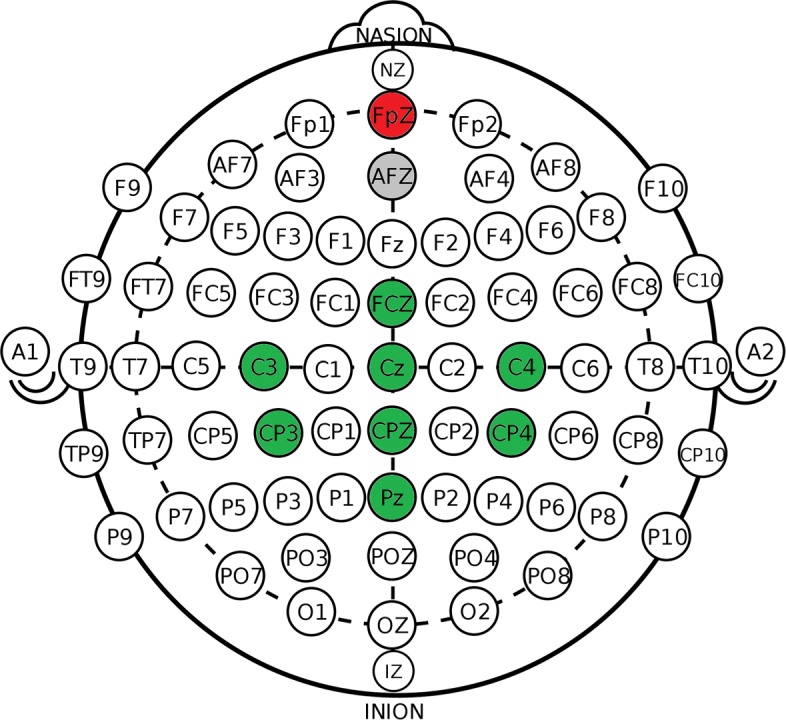
An eight-channel, custom-made, EEG system with electrodes placed around the sensorimotor cortex was used to acquire EEG data from six healthy subjects and two amputees. A discrete wavelet transform-based method was employed to capture event related information in alpha and beta bands in the time-frequency domain. The Hjorth parameters, namely activity, mobility, and complexity, were extracted as features while a two-sample unpaired Wilcoxon test was used to get rid of redundant features for better classification accuracy. The feature set thus obtained was then used to classify between 'walk vs. stop' and 'rest vs. start' classes using support vector machine (SVM) classifier with RBF kernel in a ten-fold cross-validation scheme.
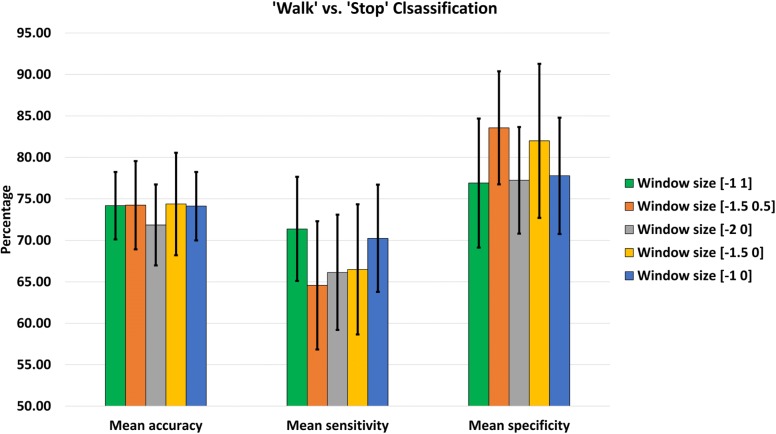
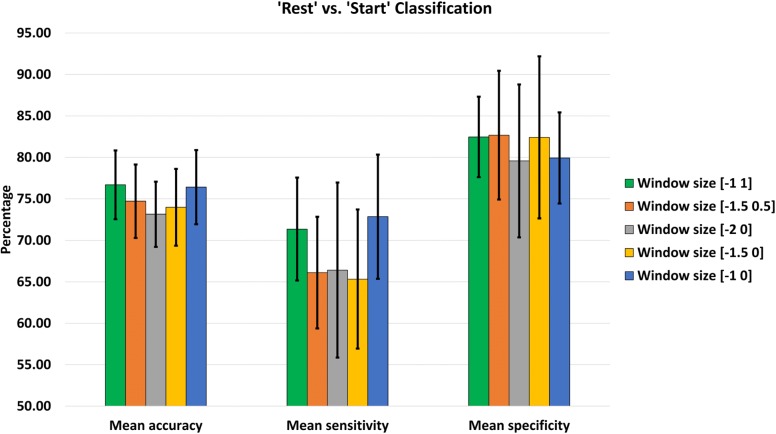
Using a fully predictive intention detection system, 76.41±4.47% accuracy, 72.85±7.48% sensitivity, and 79.93±5.50% specificity were achieved for 'rest vs. start' classification. While for 'walk vs. stop' classification, the obtained mean accuracy, sensitivity, and specificity were 74.12±4.12%, 70.24±6.45%, and 77.78±7.01% respectively. Overall average True Positive Rate achieved by this methodology was 72.06±8.27% with 1.45 False Positives/min.
Extensive simulations and resulting classification results show that it is possible to achieve statistically similar intention detection accuracy using either only pre-movement EEG features or trans-movement EEG features. The classifier performance shows the potential of the proposed methodology to predict human movement intention exclusively from the pre-movement EEG signal to be applied in real-life prosthetic and neuro-rehabilitation systems.
从运动前脑电图(EEG)信号预测步态意图是开发用于适当神经康复系统的实时脑机接口(BCI)的重要步骤。在这方面,本文通过利用事件发生前获得的 EEG 信号,研究了通过利用事件发生前获得的 EEG 信号来检测开始和停止步态周期意图的完全预测方法的可行性。
使用放置在感觉运动皮层周围的八个通道、定制的 EEG 系统,从六位健康受试者和两位截肢者采集 EEG 数据。基于离散小波变换的方法用于在时频域中捕获与事件相关的 alpha 和 beta 波段的信息。霍尔特参数(即活动、移动性和复杂性)被提取为特征,而两个样本非配对 Wilcoxon 检验用于消除冗余特征以提高分类准确性。然后,使用支持向量机(SVM)分类器和 RBF 核在十折交叉验证方案中对特征集进行分类,将“行走与停止”和“休息与开始”两类进行分类。
使用完全预测的意图检测系统,对于“休息与开始”分类,获得了 76.41±4.47%的准确率、72.85±7.48%的灵敏度和 79.93±5.50%的特异性。对于“行走与停止”分类,获得的平均准确率、灵敏度和特异性分别为 74.12±4.12%、70.24±6.45%和 77.78±7.01%。该方法获得的总体平均真阳性率为 72.06±8.27%,假阳性率为 1.45 次/分钟。
广泛的模拟和分类结果表明,使用运动前 EEG 特征或运动中 EEG 特征都可以达到统计学上相似的意图检测准确性。分类器性能表明,所提出的方法具有仅从运动前 EEG 信号预测人类运动意图的潜力,可应用于实际的假肢和神经康复系统。