Lee-Sarwar Kathleen A, Lasky-Su Jessica, Kelly Rachel S, Litonjua Augusto A, Weiss Scott T
Channing Division of Network Medicine, Brigham and Women's Hospital and Harvard Medical School, Boston, MA 02115, USA.
Division of Rheumatology, Immunology and Allergy, Brigham and Women's Hospital and Harvard Medical School, Boston, MA 02115, USA.
Metabolites. 2020 May 1;10(5):181. doi: 10.3390/metabo10050181.
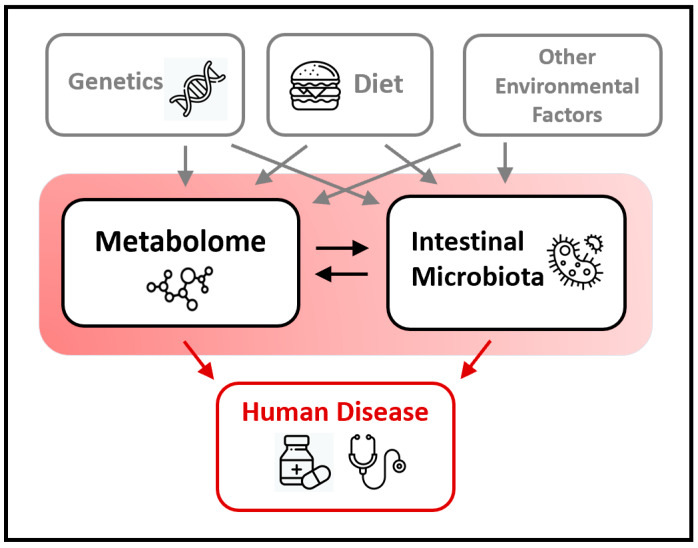
In this review, we discuss the growing literature demonstrating robust and pervasive associations between the microbiome and metabolome. We focus on the gut microbiome, which harbors the taxonomically most diverse and the largest collection of microorganisms in the human body. Methods for integrative analysis of these "omics" are under active investigation and we discuss the advances and challenges in the combined use of metabolomics and microbiome data. Findings from large consortia, including the Human Microbiome Project and Metagenomics of the Human Intestinal Tract (MetaHIT) and others demonstrate the impact of microbiome-metabolome interactions on human health. Mechanisms whereby the microbes residing in the human body interact with metabolites to impact disease risk are beginning to be elucidated, and discoveries in this area will likely be harnessed to develop preventive and treatment strategies for complex diseases.
在本综述中,我们讨论了越来越多的文献,这些文献表明微生物组与代谢组之间存在强大且普遍的关联。我们重点关注肠道微生物组,它拥有人体中分类学上最多样化且数量最大的微生物集合。对这些“组学”进行综合分析的方法正在积极研究中,我们将讨论代谢组学和微生物组数据联合使用方面的进展和挑战。包括人类微生物组计划和人类肠道宏基因组学(MetaHIT)等在内的大型联盟的研究结果表明了微生物组 - 代谢组相互作用对人类健康的影响。人体中微生物与代谢物相互作用以影响疾病风险的机制正开始得到阐明,该领域的发现可能会被用于开发针对复杂疾病的预防和治疗策略。