Department of Cardiology I, University Medical Center of the Johannes Gutenberg-University Mainz, Langenbeckstraße 1, 55131 Mainz, Germany.
German Center for Cardiovascular Research (DZHK), Partner Site Rhine-Main, Mainz, Germany.
Cardiovasc Res. 2021 Apr 23;117(5):1382-1390. doi: 10.1093/cvr/cvaa204.
Nighttime aircraft noise exposure has been associated with increased risk of hypertension and myocardial infarction, mechanistically linked to sleep disturbance, stress, and endothelial dysfunction. It is unclear, whether the most widely used metric to determine noise exposure, equivalent continuous sound level (Leq), is an adequate indicator of the cardiovascular impact induced by different noise patterns.
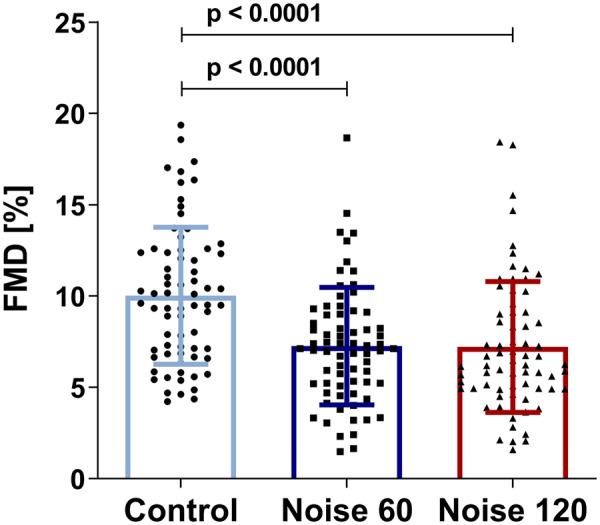
In a randomized crossover study, we exposed 70 individuals with established cardiovascular disease or increased cardiovascular risk to two aircraft noise scenarios and one control scenario. Polygraphic recordings, echocardiography, and flow-mediated dilation (FMD) were determined for three study nights. The noise patterns consisted of 60 (Noise60) and 120 (Noise120) noise events, respectively, but with comparable Leq, corresponding to a mean value of 45 dB. Mean value of noise during control nights was 37 dB. During the control night, FMD was 10.02 ± 3.75%, compared to 7.27 ± 3.21% for Noise60 nights and 7.21 ± 3.58% for Noise120 nights (P < 0.001). Sleep quality was impaired after noise exposure in both noise scenario nights (P < 0.001). Serial echocardiographic assessment demonstrated an increase in the E/E' ratio, a measure of diastolic function, within the three exposure nights, with a ratio of 6.83 ± 2.26 for the control night, 7.21 ± 2.33 for Noise60 and 7.83 ± 3.07 for Noise120 (P = 0.043).
Nighttime exposure to aircraft noise with similar Leq, but different number of noise events, results in a comparable worsening of vascular function. Adverse effects of nighttime aircraft noise exposure on cardiac function (diastolic dysfunction) seemed stronger the higher number of noise events.
夜间飞机噪声暴露与高血压和心肌梗死风险增加有关,其机制与睡眠障碍、应激和内皮功能障碍有关。目前尚不清楚,用于确定噪声暴露的最常用指标——等效连续声级(Leq),是否是不同噪声模式引起心血管影响的一个充分指标。
在一项随机交叉研究中,我们将 70 名患有已确诊心血管疾病或心血管风险增加的患者暴露于两种飞机噪声情况和一种对照噪声情况中。在三个研究夜间进行了多导睡眠图记录、超声心动图和血流介导的舒张功能(FMD)的测定。噪声模式分别由 60 个(Noise60)和 120 个(Noise120)噪声事件组成,但 Leq 相当,对应的平均值为 45dB。对照夜间的噪声平均值为 37dB。在对照夜间,FMD 为 10.02±3.75%,而 Noise60 夜间为 7.27±3.21%,Noise120 夜间为 7.21±3.58%(P<0.001)。在两个噪声场景夜间,噪声暴露后睡眠质量均受到损害(P<0.001)。连续超声心动图评估显示,在三个暴露夜间,舒张功能的 E/E'比值均升高,对照夜间为 6.83±2.26,Noise60 夜间为 7.21±2.33,Noise120 夜间为 7.83±3.07(P=0.043)。
夜间暴露于 Leq 相似但噪声事件数量不同的飞机噪声会导致血管功能同样恶化。夜间飞机噪声暴露对心脏功能(舒张功能障碍)的不良影响似乎与噪声事件数量的增加有关。