Li Ziyun, Shi Mingfei, Li Ning, Xu Ruodan
Institute of Basic Theory for Chinese Medicine, China Academy of Chinese Medical Sciences, Beijing, China.
The Third School of Clinical Medicine, Nanjing University of Chinese Medicine, Nanjing, China.
Front Chem. 2020 Oct 6;8:589957. doi: 10.3389/fchem.2020.589957. eCollection 2020.
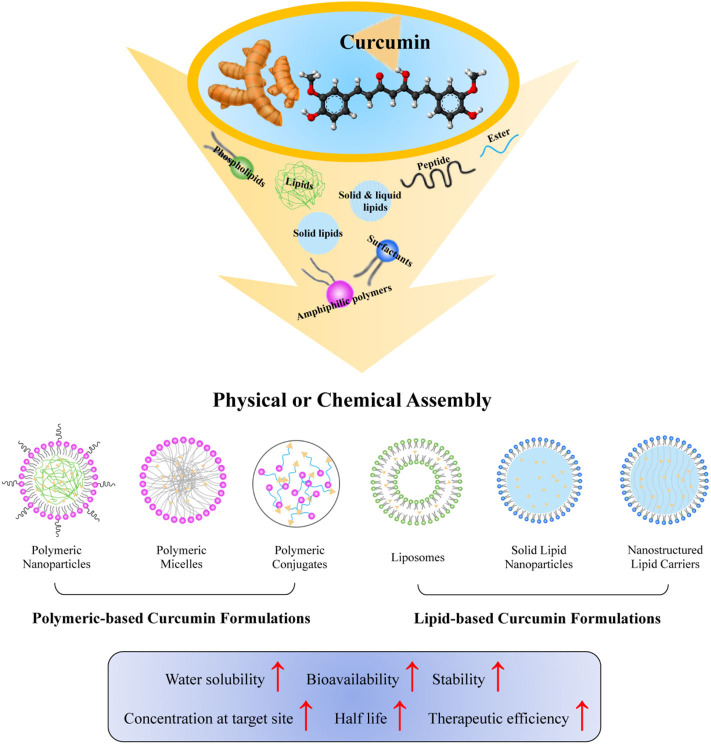
Curcumin is a lipophilic natural product extracted from turmeric and commonly used as a dietary spice. Being multi-functional, curcumin has been proposed in the prevention and treatment of a broad spectrum of diseases. However, due to unsatisfactory aqueous solubility and hence low bioavailability, clinical application of curcumin has been greatly restrained. To break these limitations, biocompatible nanoformulation, such as liposomes, nanoparticles, micelles, nanoemulsions and conjugates has been employed as alternatives to improve delivery of curcumin. In this scenario, in order to enhance bioavailability of curcumin, the choice of effective molecules as facilitators is of prominence. In this review, we focus on functional biocompatible materials, including polymers, protein molecules, polysaccharide, surface stabilizers and phospholipid complexes, and decipher their potential applications as how they assist to promote medicinal performance of curcumin.
姜黄素是一种从姜黄中提取的亲脂性天然产物,常用作食用香料。姜黄素具有多种功能,已被提出用于预防和治疗多种疾病。然而,由于姜黄素的水溶性不理想,因此生物利用度较低,其临床应用受到了极大的限制。为了突破这些限制,已采用生物相容性纳米制剂,如脂质体、纳米颗粒、胶束、纳米乳液和缀合物作为替代方案,以改善姜黄素的递送。在这种情况下,为了提高姜黄素的生物利用度,选择有效的分子作为促进剂至关重要。在本综述中,我们重点关注功能性生物相容性材料,包括聚合物、蛋白质分子、多糖、表面稳定剂和磷脂复合物,并解读它们作为促进姜黄素药用性能的潜在应用。