Aldayel Mashael, Ykhlef Mourad, Al-Nafjan Abeer
Information Technology Department, College of Computer and Information Sciences, King Saud University, Riyadh, Saudi Arabia.
Information System Department, College of Computer and Information Sciences, King Saud University, Riyadh, Saudi Arabia.
Front Hum Neurosci. 2021 Jan 13;14:604639. doi: 10.3389/fnhum.2020.604639. eCollection 2020.
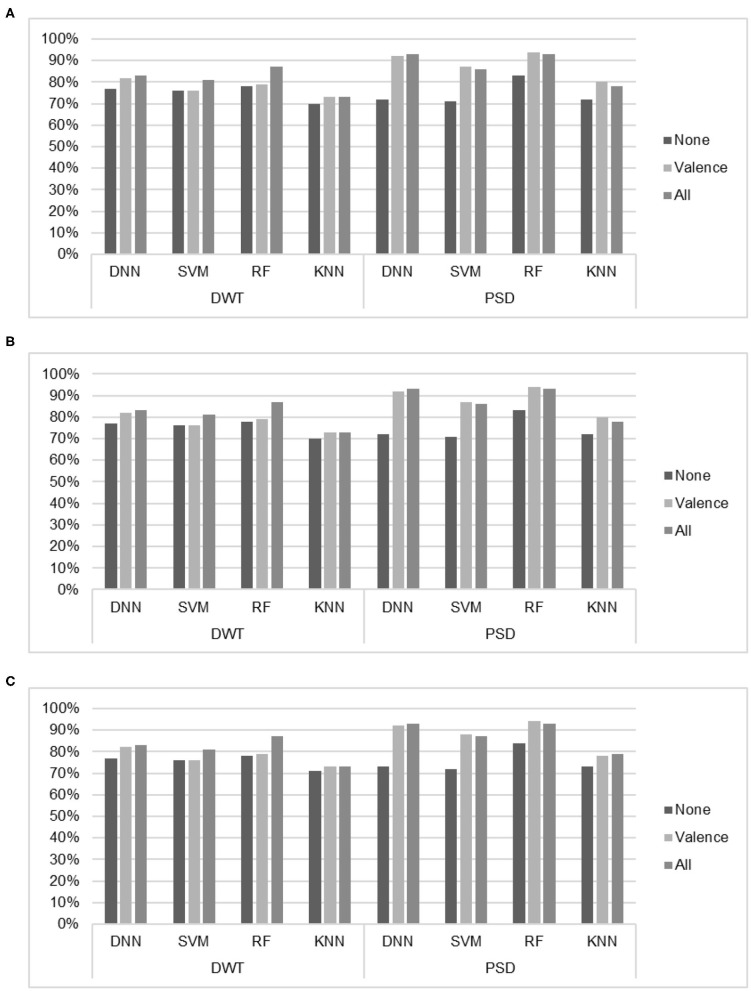
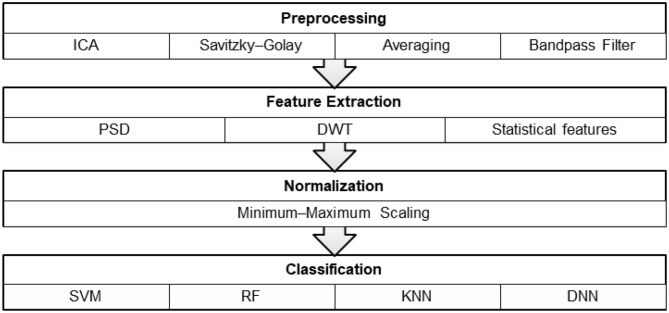
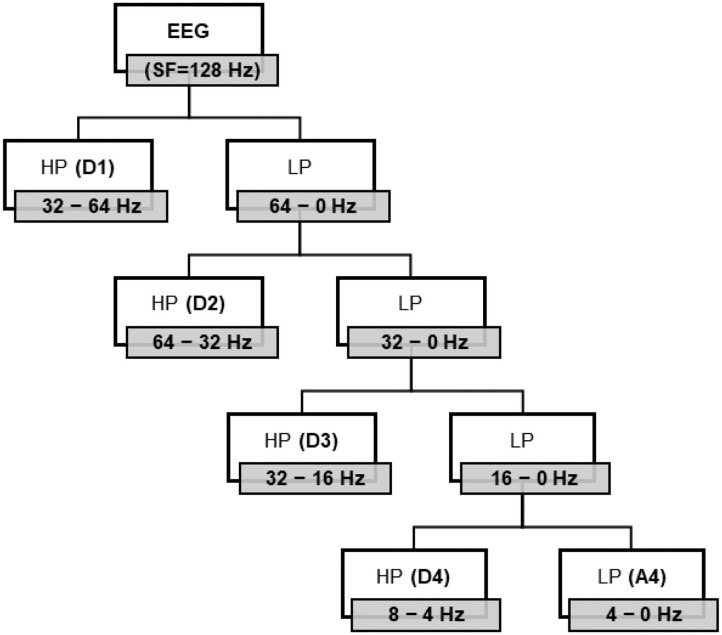
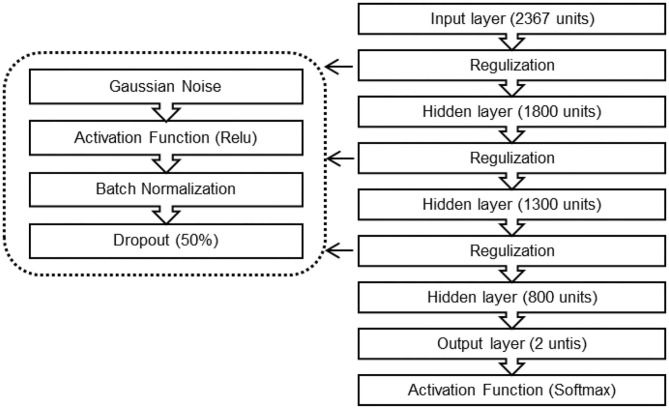
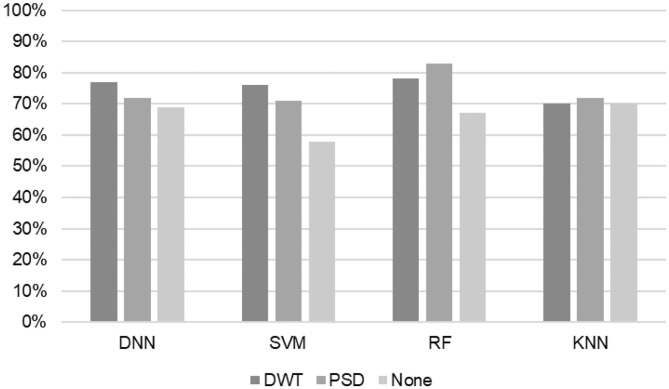
Neuromarketing has gained attention to bridge the gap between conventional marketing studies and electroencephalography (EEG)-based brain-computer interface (BCI) research. It determines what customers actually want through preference prediction. The performance of EEG-based preference detection systems depends on a suitable selection of feature extraction techniques and machine learning algorithms. In this study, We examined preference detection of neuromarketing dataset using different feature combinations of EEG indices and different algorithms for feature extraction and classification. For EEG feature extraction, we employed discrete wavelet transform (DWT) and power spectral density (PSD), which were utilized to measure the EEG-based preference indices that enhance the accuracy of preference detection. Moreover, we compared deep learning with other traditional classifiers, such as k-nearest neighbor (KNN), support vector machine (SVM), and random forest (RF). We also studied the effect of preference indicators on the performance of classification algorithms. Through rigorous offline analysis, we investigated the computational intelligence for preference detection and classification. The performance of the proposed deep neural network (DNN) outperforms KNN and SVM in accuracy, precision, and recall; however, RF achieved results similar to those of the DNN for the same dataset.
神经营销学已受到关注,旨在弥合传统营销研究与基于脑电图(EEG)的脑机接口(BCI)研究之间的差距。它通过偏好预测来确定客户真正想要的东西。基于EEG的偏好检测系统的性能取决于特征提取技术和机器学习算法的合适选择。在本研究中,我们使用EEG指标的不同特征组合以及不同的特征提取和分类算法,研究了神经营销数据集的偏好检测。对于EEG特征提取,我们采用了离散小波变换(DWT)和功率谱密度(PSD),它们被用于测量基于EEG的偏好指标,以提高偏好检测的准确性。此外,我们将深度学习与其他传统分类器进行了比较,如k近邻(KNN)、支持向量机(SVM)和随机森林(RF)。我们还研究了偏好指标对分类算法性能的影响。通过严格的离线分析,我们研究了用于偏好检测和分类的计算智能。所提出的深度神经网络(DNN)在准确率、精确率和召回率方面的性能优于KNN和SVM;然而,对于相同的数据集,RF取得了与DNN相似的结果。