Global Health Labs (formerly at Intellectual Ventures Laboratory/Global Good), 14360 SE Eastgate Way, Bellevue, WA, 98007, USA.
Applied Math Department, University of Washington, Seattle, WA, 98195, USA.
Malar J. 2021 Feb 25;20(1):110. doi: 10.1186/s12936-021-03631-3.
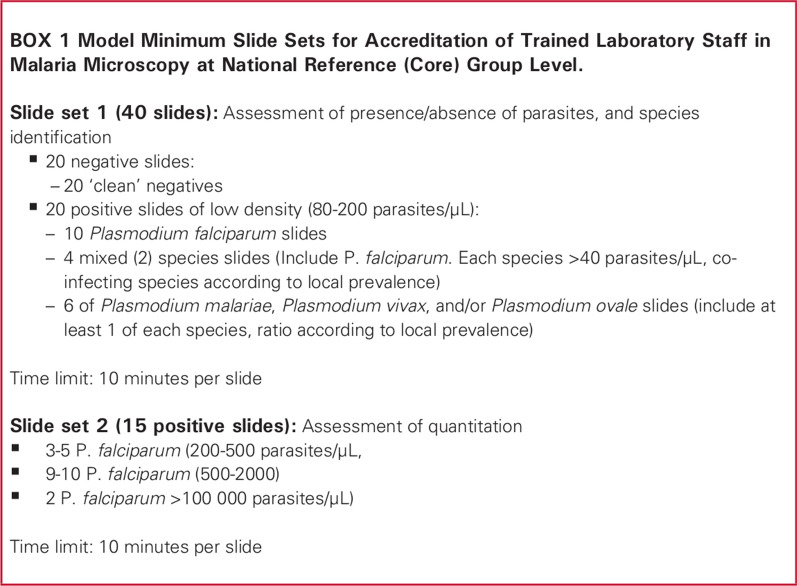
Manual microscopy remains a widely-used tool for malaria diagnosis and clinical studies, but it has inconsistent quality in the field due to variability in training and field practices. Automated diagnostic systems based on machine learning hold promise to improve quality and reproducibility of field microscopy. The World Health Organization (WHO) has designed a 55-slide set (WHO 55) for their External Competence Assessment of Malaria Microscopists (ECAMM) programme, which can also serve as a valuable benchmark for automated systems. The performance of a fully-automated malaria diagnostic system, EasyScan GO, on a WHO 55 slide set was evaluated.
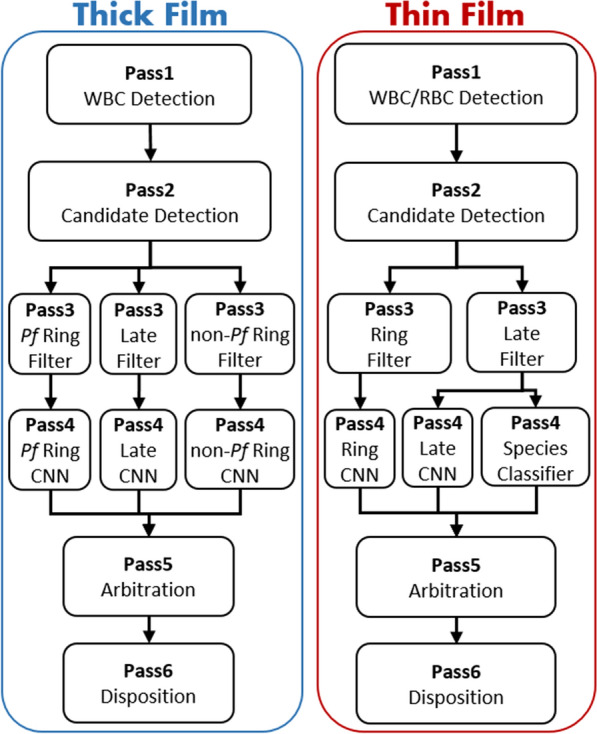
The WHO 55 slide set is designed to evaluate microscopist competence in three areas of malaria diagnosis using Giemsa-stained blood films, focused on crucial field needs: malaria parasite detection, malaria parasite species identification (ID), and malaria parasite quantitation. The EasyScan GO is a fully-automated system that combines scanning of Giemsa-stained blood films with assessment algorithms to deliver malaria diagnoses. This system was tested on a WHO 55 slide set.
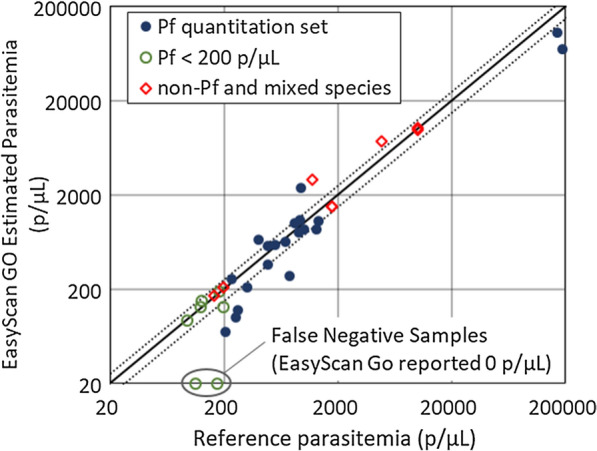
The EasyScan GO achieved 94.3 % detection accuracy, 82.9 % species ID accuracy, and 50 % quantitation accuracy, corresponding to WHO microscopy competence Levels 1, 2, and 1, respectively. This is, to our knowledge, the best performance of a fully-automated system on a WHO 55 set.
EasyScan GO's expert ratings in detection and quantitation on the WHO 55 slide set point towards its potential value in drug efficacy use-cases, as well as in some case management situations with less stringent species ID needs. Improved runtime may enable use in general case management settings.
手动显微镜仍然是疟疾诊断和临床研究的广泛使用工具,但由于培训和现场实践的可变性,其在现场的质量不一致。基于机器学习的自动诊断系统有望提高现场显微镜的质量和重现性。世界卫生组织 (WHO) 为其外部疟疾显微镜检查师能力评估 (ECAMM) 计划设计了一个 55 张幻灯片集 (WHO 55),该幻灯片集也可以作为自动化系统的有价值的基准。评估了全自动疟疾诊断系统 EasyScan GO 在 WHO 55 幻灯片集上的性能。
WHO 55 幻灯片集旨在使用吉姆萨染色血片评估显微镜检查师在疟疾诊断的三个领域的能力,重点关注关键的现场需求:疟原虫检测、疟原虫种鉴定 (ID) 和疟原虫定量。EasyScan GO 是一种全自动系统,它将吉姆萨染色血片扫描与评估算法相结合,提供疟疾诊断。该系统在 WHO 55 幻灯片集上进行了测试。
EasyScan GO 的检测准确率为 94.3%,种 ID 准确率为 82.9%,定量准确率为 50%,分别对应 WHO 显微镜检查能力水平 1、2 和 1。据我们所知,这是全自动系统在 WHO 55 套上的最佳性能。
EasyScan GO 在 WHO 55 幻灯片集上的检测和定量的专家评级表明,它在药物疗效应用中以及在某些对种 ID 需求较低的病例管理情况下具有潜在价值。改进的运行时间可能使其能够在一般病例管理环境中使用。