Ning Siqi, Hayakawa Sayuri, Bartolotti James, Marian Viorica
Department of Communication Sciences and Disorders, Northwestern University, 2240 Campus Drive, Evanston, IL 60208.
J Neurolinguistics. 2020 Nov;56. doi: 10.1016/j.jneuroling.2020.100932. Epub 2020 Aug 4.
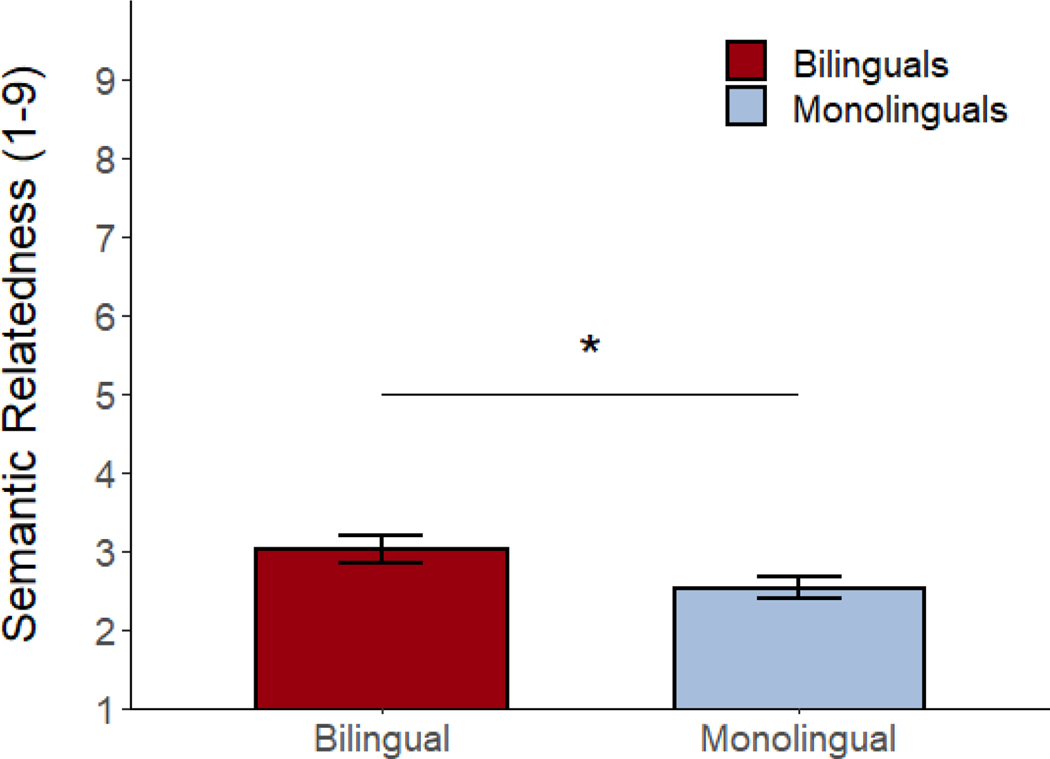
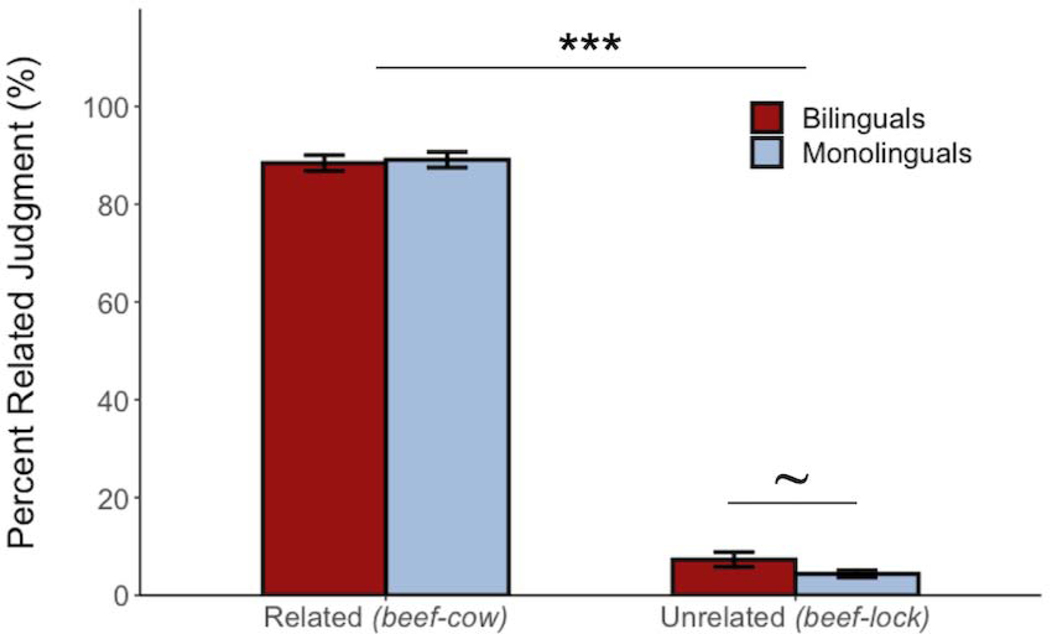
Language can influence cognition in domains as varied as temporal processing, spatial categorization, and color perception (Casasanto & Boroditsky, 2008; Levinson & Wilkins, 2006; Winawer et al., 2007). Here, we provide converging behavioral and neural evidence that bilingual experience can change semantic associations. In Experiment 1, Spanish- and English-speaking bilinguals rated semantically unrelated picture pairs (e.g., ) as significantly more related in meaning than English monolinguals. Experiment 2 demonstrated that bilinguals who were highly proficient in Spanish and English rated both semantically related (e.g., ) and unrelated picture pairs (e.g., ) as more related than monolinguals and low-proficiency bilinguals. Experiment 3 added ERP measures to provide a more sensitive test of the bilingual effect on semantic ratings, which was assessed through the use of linguistic stimuli (related and unrelated words instead of pictures) and a different bilingual population (Korean-English bilinguals). Bilingualism was associated with a significantly smaller N400 effect (i.e., N400 for unrelated - related), suggesting that bilinguals processed related and unrelated pairs more similarly than monolinguals; this result was coupled with a non-significant behavioral trend of bilinguals judging unrelated words as more related than monolinguals did. Across the three experiments, results show that bilingual experience can influence perceived semantic associations. We propose that bilinguals' denser and more interconnected phonological, orthographic and lexical systems may change the links between semantic concepts. Such an account is consistent with connectionist models of language that allow for phonological and lexical influences on conceptual representations, with implications for models of bilingual language processing.
语言能够在诸如时间处理、空间分类和颜色感知等各种不同领域影响认知(卡萨桑托和博罗迪茨基,2008;莱文森和威尔金斯,2006;维纳韦尔等人,2007)。在此,我们提供了一致的行为和神经证据,表明双语经历能够改变语义联想。在实验1中,说西班牙语和英语的双语者认为语义不相关的图片对(例如, )在意义上比只说英语的单语者认为的显著更相关。实验2表明,西班牙语和英语都非常熟练的双语者认为语义相关的(例如, )和不相关的图片对(例如, )都比单语者和低熟练度的双语者认为的更相关。实验3增加了事件相关电位(ERP)测量,以对双语对语义评级的影响进行更敏感的测试,该测试通过使用语言刺激(相关和不相关的单词而非图片)以及不同的双语群体(韩英双语者)来评估。双语与显著更小的N400效应相关(即不相关 - 相关的N400),这表明双语者处理相关和不相关对的方式比单语者更相似;这一结果伴随着双语者将不相关单词判断为比单语者认为的更相关这一不显著的行为趋势。在这三个实验中,结果表明双语经历能够影响感知到的语义联想。我们提出,双语者更密集且相互联系更紧密的语音、正字法和词汇系统可能会改变语义概念之间的联系。这样一种解释与允许语音和词汇对概念表征产生影响的语言联结主义模型相一致,对双语语言处理模型具有启示意义。