Wan Fen, Draz Mohamed S, Gu Mengjie, Yu Wei, Ruan Zhi, Luo Qixia
State Key Laboratory for Diagnosis and Treatment of Infectious Diseases, Collaborative Innovation Center for Diagnosis and Treatment of Infectious Diseases, The First Affiliated Hospital, Zhejiang University School of Medicine, Hangzhou 310003, China.
College of Laboratory Medicine, Hangzhou Medical College, Hangzhou 310003, China.
Pharmaceutics. 2021 Mar 8;13(3):352. doi: 10.3390/pharmaceutics13030352.
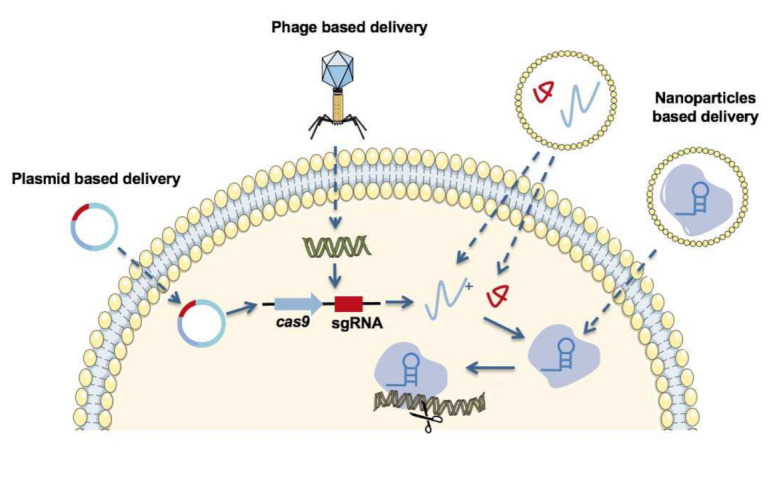
Antibiotic resistance is a significant crisis that threatens human health and safety worldwide. There is an urgent need for new strategies to control multidrug-resistant (MDR) bacterial infections. The latest breakthrough in gene-editing tools based on CRISPR/Cas9 has potential application in combating MDR bacterial infections because of their high targeting ability to specifically disrupt the drug resistance genes that microbes use for infection or to kill the pathogen directly. Despite the potential that CRISPR/Cas9 showed, its further utilization has been hampered by undesirable delivery efficiency in vivo. Nanotechnology offers an alternative way to overcome the shortcomings of traditional delivery methods of therapeutic agents. Advances in nanotechnology can improve the efficacy and safety of CRISPR/Cas9 components by using customized nanoparticle delivery systems. The combination of CRISPR/Cas9 and nanotechnology has the potential to open new avenues in the therapy of MDR bacterial infections. This review describes the recent advances related to CRISPR/Cas9 and nanoparticles for antimicrobial therapy and gene delivery, including the improvement in the packaging and localizing efficiency of the CRISPR/Cas9 components in the NP (nanoparticle)/CRISPR system. We pay particular attention to the strengths and limitations of the nanotechnology-based CRISPR/Cas9 delivery system to fight nosocomial pathogens.We highlight the need for more scientific research to explore the combinatorial efficacy of various nanoparticles and CRISPR technology to control and prevent antimicrobial resistance.
抗生素耐药性是一场严重危机,威胁着全球人类健康与安全。迫切需要新策略来控制多重耐药(MDR)细菌感染。基于CRISPR/Cas9的基因编辑工具的最新突破在对抗MDR细菌感染方面具有潜在应用价值,因为它们具有高度靶向能力,能够特异性破坏微生物用于感染的耐药基因或直接杀死病原体。尽管CRISPR/Cas9展现出了潜力,但其在体内的递送效率不理想,阻碍了其进一步应用。纳米技术提供了一种替代方法来克服治疗剂传统递送方法的缺点。纳米技术的进展可以通过使用定制的纳米颗粒递送系统来提高CRISPR/Cas9组件的疗效和安全性。CRISPR/Cas9与纳米技术的结合有可能为MDR细菌感染的治疗开辟新途径。本文综述了CRISPR/Cas9和纳米颗粒在抗菌治疗和基因递送方面的最新进展,包括NP(纳米颗粒)/CRISPR系统中CRISPR/Cas9组件的包装和定位效率的提高。我们特别关注基于纳米技术的CRISPR/Cas9递送系统对抗医院病原体的优势和局限性。我们强调需要更多科学研究来探索各种纳米颗粒与CRISPR技术的联合疗效,以控制和预防抗菌药物耐药性。