Zhao Xin-Xin, Lin Fang-Jun, Li Hang, Li Hua-Bin, Wu Ding-Tao, Geng Fang, Ma Wei, Wang Yu, Miao Bao-He, Gan Ren-You
Institute of Urban Agriculture, Chinese Academy of Agricultural Sciences, Chengdu, China.
Chengdu National Agricultural Science and Technology Center, Chengdu, China.
Front Nutr. 2021 Jul 22;8:669805. doi: 10.3389/fnut.2021.669805. eCollection 2021.
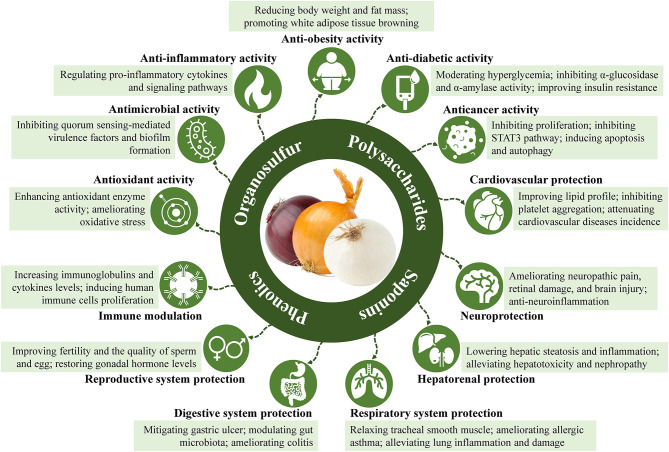
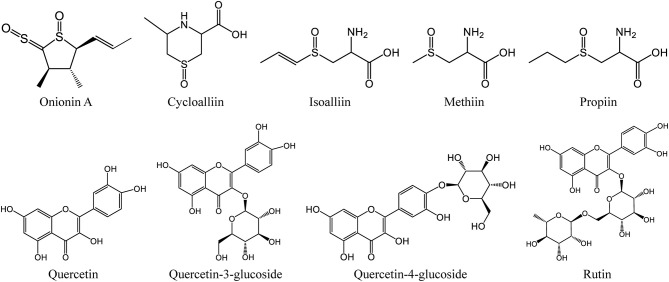
Onion ( L.) is a common vegetable, widely consumed all over the world. Onion contains diverse phytochemicals, including organosulfur compounds, phenolic compounds, polysaccharides, and saponins. The phenolic and sulfur-containing compounds, including onionin A, cysteine sulfoxides, quercetin, and quercetin glucosides, are the major bioactive constituents of onion. Accumulated studies have revealed that onion and its bioactive compounds possess various health functions, such as antioxidant, antimicrobial, anti-inflammatory, anti-obesity, anti-diabetic, anticancer, cardiovascular protective, neuroprotective, hepatorenal protective, respiratory protective, digestive system protective, reproductive protective, and immunomodulatory properties. Herein, the main bioactive compounds in onion are summarized, followed by intensively discussing its major health functions as well as relevant molecular mechanisms. Moreover, the potential safety concerns about onion contamination and the ways to mitigate these issues are also discussed. We hope that this paper can attract broader attention to onion and its bioactive compounds, which are promising ingredients in the development of functional foods and nutraceuticals for preventing and managing certain chronic diseases.
洋葱(L.)是一种常见蔬菜,在全球被广泛食用。洋葱含有多种植物化学物质,包括有机硫化合物、酚类化合物、多糖和皂苷。酚类和含硫化合物,如洋葱素A、半胱氨酸亚砜、槲皮素和槲皮素糖苷,是洋葱的主要生物活性成分。大量研究表明,洋葱及其生物活性化合物具有多种健康功能,如抗氧化、抗菌、抗炎、抗肥胖、抗糖尿病、抗癌、心血管保护、神经保护、肝肾保护、呼吸保护、消化系统保护、生殖保护和免疫调节特性。本文总结了洋葱中的主要生物活性化合物,随后深入讨论了其主要健康功能以及相关分子机制。此外,还讨论了洋葱污染的潜在安全问题以及缓解这些问题的方法。我们希望本文能吸引更广泛关注洋葱及其生物活性化合物,它们是开发预防和管理某些慢性病的功能性食品和营养保健品的有前景的成分。