Department of Food Science, Cornell University, Stocking Hall, Ithaca, NY 14853, USA.
Department of Statistics, University of Connecticut, Philip E. Austin Building, Storrs, CT 06269, USA.
Nutrients. 2021 Sep 27;13(10):3399. doi: 10.3390/nu13103399.
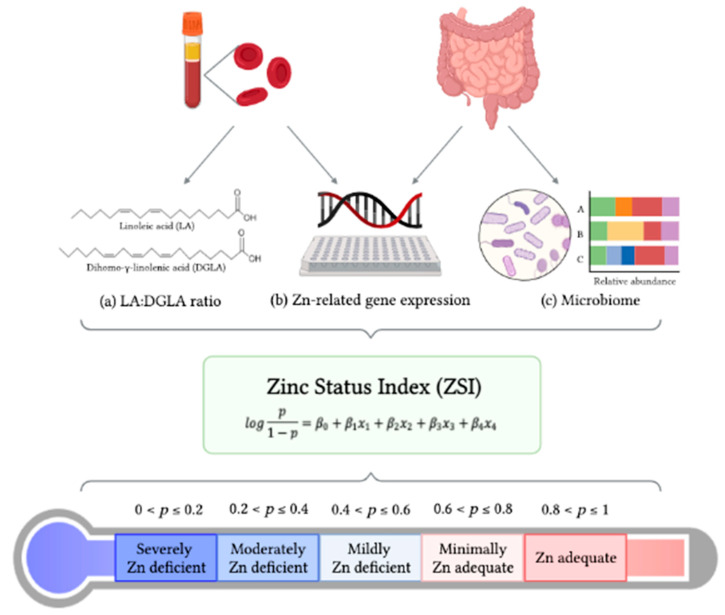
Zinc (Zn) deficiency is estimated to affect over one billion (17%) of the world's population. Zn plays a key role in various cellular processes such as differentiation, apoptosis, and proliferation, and is used for vital biochemical and structural processes in the body. Widely used biomarkers of Zn status include plasma, whole blood, and urine Zn, which decrease in severe Zn deficiency; however, accurate assessment of Zn status, especially in mild to moderate deficiency, is difficult, as studies with these biomarkers are often contradictory and inconsistent. Thus, sensitive and specific biological markers of Zn physiological status are still needed. In this communication, we provide the Zn status index (ZSI) concept, which consists of a three-pillar formula: (1) the LA:DGLA ratio, (2) mRNA gene expression of Zn-related proteins, and (3) gut microbiome profiling to provide a clear assessment of Zn physiological status and degree of Zn deficiency with respect to assessing dietary Zn manipulation. Analysis of five selected studies found that with lower dietary Zn intake, erythrocyte LA:DGLA ratio increased, mRNA gene expression of Zn-related proteins in duodenal and liver tissues was altered, and gut microbiota populations differed, where the ZSI, a statistical model trained on data from these studies, was built to give an accurate estimation of Zn physiological status. However, the ZSI needs to be tested and refined further to determine its full potential.
锌(Zn)缺乏症估计影响了全球超过 10 亿(17%)人口。Zn 在各种细胞过程中发挥着关键作用,如分化、凋亡和增殖,并用于体内重要的生化和结构过程。广泛使用的 Zn 状态生物标志物包括血浆、全血和尿 Zn,在严重 Zn 缺乏症中会减少;然而,由于这些生物标志物的研究往往相互矛盾和不一致,因此准确评估 Zn 状态,特别是在轻度至中度缺乏症中,是困难的。因此,仍然需要灵敏和特异的 Zn 生理状态的生物标志物。在本通讯中,我们提出了 Zn 状态指数(ZSI)的概念,它由三个支柱公式组成:(1)LA:DGLA 比值,(2)Zn 相关蛋白的 mRNA 基因表达,(3)肠道微生物组谱,以提供对 Zn 生理状态和 Zn 缺乏程度的清晰评估,以及评估膳食 Zn 干预的效果。对五项选定研究的分析发现,随着膳食 Zn 摄入的减少,红细胞 LA:DGLA 比值增加,十二指肠和肝脏组织中 Zn 相关蛋白的 mRNA 基因表达发生改变,肠道微生物群也有所不同,其中,ZSI 是一个基于这些研究数据训练的统计模型,用于准确估计 Zn 生理状态。然而,ZSI 需要进一步测试和完善,以确定其全部潜力。