• 文献检索
  • 文档翻译
  • 深度研究
  • 学术资讯
  • Suppr Zotero 插件Zotero 插件
  • 邀请有礼
  • 套餐&价格
  • 历史记录
应用&插件
Suppr Zotero 插件Zotero 插件浏览器插件Mac 客户端Windows 客户端微信小程序
定价
高级版会员购买积分包购买API积分包
服务
文献检索文档翻译深度研究API 文档MCP 服务
关于我们
关于 Suppr公司介绍联系我们用户协议隐私条款
关注我们

Suppr 超能文献

核心技术专利:CN118964589B侵权必究
粤ICP备2023148730 号-1Suppr @ 2026

文献检索

告别复杂PubMed语法,用中文像聊天一样搜索,搜遍4000万医学文献。AI智能推荐,让科研检索更轻松。

立即免费搜索

文件翻译

保留排版,准确专业,支持PDF/Word/PPT等文件格式,支持 12+语言互译。

免费翻译文档

深度研究

AI帮你快速写综述,25分钟生成高质量综述,智能提取关键信息,辅助科研写作。

立即免费体验

用于脑肿瘤定位中人机交互的可解释人工智能

Explainable Artificial Intelligence for Human-Machine Interaction in Brain Tumor Localization.

作者信息

Esmaeili Morteza, Vettukattil Riyas, Banitalebi Hasan, Krogh Nina R, Geitung Jonn Terje

机构信息

Department of Diagnostic Imaging, Akershus University Hospital, 1478 Lørenskog, Norway.

Department of Electrical Engineering and Computer Science, Faculty of Science and Technology, University of Stavanger, 4021 Stavanger, Norway.

出版信息

J Pers Med. 2021 Nov 16;11(11):1213. doi: 10.3390/jpm11111213.

DOI:10.3390/jpm11111213
PMID:34834566
原文链接:https://pmc.ncbi.nlm.nih.gov/articles/PMC8618183/
Abstract

Primary malignancies in adult brains are globally fatal. Computer vision, especially recent developments in artificial intelligence (AI), have created opportunities to automatically characterize and diagnose tumor lesions in the brain. AI approaches have provided scores of unprecedented accuracy in different image analysis tasks, including differentiating tumor-containing brains from healthy brains. AI models, however, perform as a black box, concealing the rational interpretations that are an essential step towards translating AI imaging tools into clinical routine. An explainable AI approach aims to visualize the high-level features of trained models or integrate into the training process. This study aims to evaluate the performance of selected deep-learning algorithms on localizing tumor lesions and distinguishing the lesion from healthy regions in magnetic resonance imaging contrasts. Despite a significant correlation between classification and lesion localization accuracy ( = 0.46, = 0.005), the known AI algorithms, examined in this study, classify some tumor brains based on other non-relevant features. The results suggest that explainable AI approaches can develop an intuition for model interpretability and may play an important role in the performance evaluation of deep learning models. Developing explainable AI approaches will be an essential tool to improve human-machine interactions and assist in the selection of optimal training methods.

摘要

成人大脑的原发性恶性肿瘤是全球性的致命疾病。计算机视觉,尤其是人工智能(AI)的最新发展,为自动表征和诊断脑肿瘤病变创造了机会。人工智能方法在不同的图像分析任务中提供了前所未有的准确性,包括区分含肿瘤的大脑和健康大脑。然而,人工智能模型的运行方式如同一个黑箱,隐藏了合理的解释,而这是将人工智能成像工具转化为临床常规操作的关键步骤。可解释人工智能方法旨在可视化训练模型的高级特征或融入训练过程。本研究旨在评估所选深度学习算法在磁共振成像对比中定位肿瘤病变以及区分病变与健康区域的性能。尽管分类与病变定位准确性之间存在显著相关性(= 0.46,= 0.005),但本研究中所考察的已知人工智能算法基于其他不相关特征对一些肿瘤大脑进行分类。结果表明,可解释人工智能方法可以培养对模型可解释性的直观认识,并且可能在深度学习模型的性能评估中发挥重要作用。开发可解释人工智能方法将是改善人机交互并协助选择最佳训练方法的重要工具。
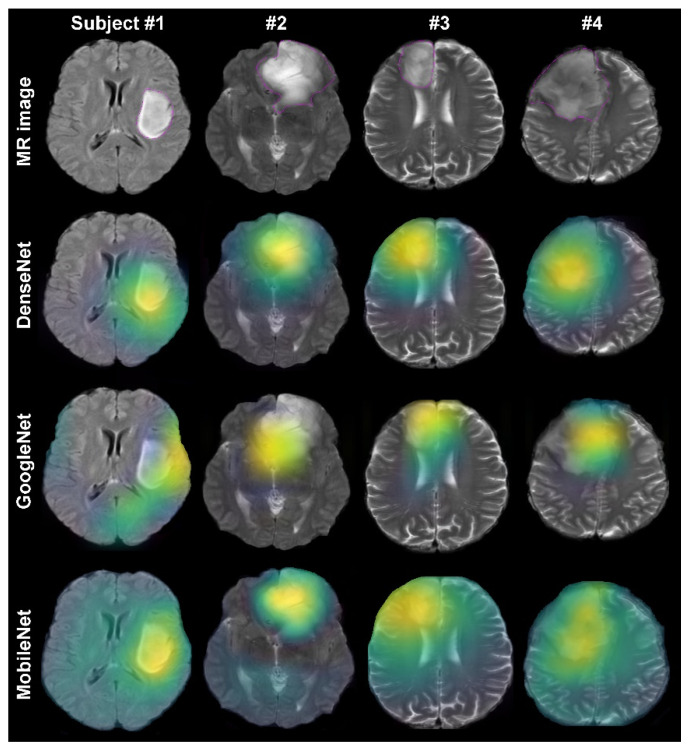
https://cdn.ncbi.nlm.nih.gov/pmc/blobs/1d5e/8618183/abd849f8fa11/jpm-11-01213-g001.jpg

相似文献

1
Explainable Artificial Intelligence for Human-Machine Interaction in Brain Tumor Localization.用于脑肿瘤定位中人机交互的可解释人工智能
J Pers Med. 2021 Nov 16;11(11):1213. doi: 10.3390/jpm11111213.
2
[Artificial intelligence in image analysis-fundamentals and new developments].[图像分析中的人工智能——基础与新进展]
Hautarzt. 2020 Sep;71(9):660-668. doi: 10.1007/s00105-020-04663-7.
3
Explainable Artificial Intelligence (XAI) for Deep Learning Based Medical Imaging Classification.用于基于深度学习的医学影像分类的可解释人工智能(XAI)
J Imaging. 2023 Aug 30;9(9):177. doi: 10.3390/jimaging9090177.
4
Artificial intelligence: Deep learning in oncological radiomics and challenges of interpretability and data harmonization.人工智能:肿瘤放射组学中的深度学习及其可解释性和数据协调的挑战。
Phys Med. 2021 Mar;83:108-121. doi: 10.1016/j.ejmp.2021.03.009. Epub 2021 Mar 22.
5
Explainable deep learning diagnostic system for prediction of lung disease from medical images.基于深度学习的医学图像肺部疾病诊断系统的可解释性研究
Comput Biol Med. 2024 Mar;170:108012. doi: 10.1016/j.compbiomed.2024.108012. Epub 2024 Jan 19.
6
Explainable AI: A Review of Machine Learning Interpretability Methods.可解释人工智能:机器学习可解释性方法综述
Entropy (Basel). 2020 Dec 25;23(1):18. doi: 10.3390/e23010018.
7
Improvement of a prediction model for heart failure survival through explainable artificial intelligence.通过可解释人工智能改进心力衰竭生存预测模型。
Front Cardiovasc Med. 2023 Aug 1;10:1219586. doi: 10.3389/fcvm.2023.1219586. eCollection 2023.
8
Survey of Explainable AI Techniques in Healthcare.医疗保健领域可解释人工智能技术调查。
Sensors (Basel). 2023 Jan 5;23(2):634. doi: 10.3390/s23020634.
9
Explainable AI: A review of applications to neuroimaging data.可解释人工智能:神经影像数据应用综述
Front Neurosci. 2022 Dec 1;16:906290. doi: 10.3389/fnins.2022.906290. eCollection 2022.
10
Artificial Intelligence Algorithms to Diagnose Glaucoma and Detect Glaucoma Progression: Translation to Clinical Practice.用于诊断青光眼和检测青光眼病情进展的人工智能算法:向临床实践的转化
Transl Vis Sci Technol. 2020 Oct 15;9(2):55. doi: 10.1167/tvst.9.2.55. eCollection 2020 Oct.

引用本文的文献

1
Could a New Method of Acromiohumeral Distance Measurement Emerge? Artificial Intelligence vs. Physician.能否出现一种新的肩峰肱骨距离测量方法?人工智能与医生的较量。
J Imaging Inform Med. 2025 Jul 25. doi: 10.1007/s10278-025-01614-3.
2
Integrating artificial intelligence in healthcare: applications, challenges, and future directions.将人工智能整合到医疗保健中:应用、挑战及未来方向。
Future Sci OA. 2025 Dec;11(1):2527505. doi: 10.1080/20565623.2025.2527505. Epub 2025 Jul 4.
3
Artificial Intelligence for Neuroimaging in Pediatric Cancer.

本文引用的文献

1
Visual interpretability in 3D brain tumor segmentation network.三维脑肿瘤分割网络中的可视化可解释性。
Comput Biol Med. 2021 Jun;133:104410. doi: 10.1016/j.compbiomed.2021.104410. Epub 2021 Apr 19.
2
Grad-CAM helps interpret the deep learning models trained to classify multiple sclerosis types using clinical brain magnetic resonance imaging.Grad-CAM 有助于解释使用临床脑磁共振成像对多发性硬化症类型进行分类的深度学习模型。
J Neurosci Methods. 2021 Apr 1;353:109098. doi: 10.1016/j.jneumeth.2021.109098. Epub 2021 Feb 11.
3
NSCR-Based DenseNet for Lung Tumor Recognition Using Chest CT Image.
用于儿科癌症神经成像的人工智能
Cancers (Basel). 2025 Feb 12;17(4):622. doi: 10.3390/cancers17040622.
4
Explainable AI in Diagnostic Radiology for Neurological Disorders: A Systematic Review, and What Doctors Think About It.用于神经系统疾病诊断放射学的可解释人工智能:系统评价及医生对此的看法。
Diagnostics (Basel). 2025 Jan 13;15(2):168. doi: 10.3390/diagnostics15020168.
5
Utilizing customized CNN for brain tumor prediction with explainable AI.利用定制的卷积神经网络结合可解释人工智能进行脑肿瘤预测。
Heliyon. 2024 Oct 9;10(20):e38997. doi: 10.1016/j.heliyon.2024.e38997. eCollection 2024 Oct 30.
6
The grading detection model for fingered citron slices (citrus medica 'fingered') based on YOLOv8-FCS.基于YOLOv8-FCS的佛手切片(柑橘属植物“佛手”)分级检测模型
Front Plant Sci. 2024 Jun 5;15:1411178. doi: 10.3389/fpls.2024.1411178. eCollection 2024.
7
Artificial intelligence in neuro-oncology: advances and challenges in brain tumor diagnosis, prognosis, and precision treatment.神经肿瘤学中的人工智能:脑肿瘤诊断、预后及精准治疗的进展与挑战
NPJ Precis Oncol. 2024 Mar 29;8(1):80. doi: 10.1038/s41698-024-00575-0.
8
Assessing the Capability of ChatGPT, Google Bard, and Microsoft Bing in Solving Radiology Case Vignettes.评估ChatGPT、谷歌巴德和微软必应解决放射学病例 vignettes的能力。
Indian J Radiol Imaging. 2023 Dec 29;34(2):276-282. doi: 10.1055/s-0043-1777746. eCollection 2024 Apr.
9
A fusion model integrating magnetic resonance imaging radiomics and deep learning features for predicting alpha-thalassemia X-linked intellectual disability mutation status in isocitrate dehydrogenase-mutant high-grade astrocytoma: a multicenter study.一种整合磁共振成像放射组学和深度学习特征的融合模型,用于预测异柠檬酸脱氢酶突变型高级别星形细胞瘤中的α地中海贫血X连锁智力障碍突变状态:一项多中心研究。
Quant Imaging Med Surg. 2024 Jan 3;14(1):251-263. doi: 10.21037/qims-23-807. Epub 2024 Jan 2.
10
Optimizing Inference Distribution for Efficient Kidney Tumor Segmentation Using a UNet-PWP Deep-Learning Model with XAI on CT Scan Images.使用带有可解释人工智能的UNet-PWP深度学习模型在CT扫描图像上优化推理分布以实现高效肾肿瘤分割
Diagnostics (Basel). 2023 Oct 18;13(20):3244. doi: 10.3390/diagnostics13203244.
基于 NSCR 的胸部 CT 图像肺肿瘤识别的密集网络
Biomed Res Int. 2020 Dec 16;2020:6636321. doi: 10.1155/2020/6636321. eCollection 2020.
4
Survival prediction of patients suffering from glioblastoma based on two-branch DenseNet using multi-channel features.基于使用多通道特征的双分支密集神经网络对胶质母细胞瘤患者的生存预测
Int J Comput Assist Radiol Surg. 2021 Feb;16(2):207-217. doi: 10.1007/s11548-021-02313-4. Epub 2021 Jan 18.
5
Explainable AI: A Review of Machine Learning Interpretability Methods.可解释人工智能:机器学习可解释性方法综述
Entropy (Basel). 2020 Dec 25;23(1):18. doi: 10.3390/e23010018.
6
A Convolutional Neural Network to Perform Object Detection and Identification in Visual Large-Scale Data.一种在视觉大规模数据中进行目标检测和识别的卷积神经网络。
Big Data. 2021 Feb;9(1):41-52. doi: 10.1089/big.2019.0093. Epub 2020 Sep 29.
7
Automatic prostate and prostate zones segmentation of magnetic resonance images using DenseNet-like U-net.基于 DenseNet 结构的 U-Net 模型自动分割磁共振图像中的前列腺及前列腺区域。
Sci Rep. 2020 Aug 31;10(1):14315. doi: 10.1038/s41598-020-71080-0.
8
Deep Learning for Multigrade Brain Tumor Classification in Smart Healthcare Systems: A Prospective Survey.深度学习在智能医疗系统中多等级脑肿瘤分类中的应用:前瞻性调查。
IEEE Trans Neural Netw Learn Syst. 2021 Feb;32(2):507-522. doi: 10.1109/TNNLS.2020.2995800. Epub 2021 Feb 4.
9
Deep learning in rare disease. Detection of tubers in tuberous sclerosis complex.深度学习在罕见病中的应用。结节性硬化症中结节的检测。
PLoS One. 2020 Apr 29;15(4):e0232376. doi: 10.1371/journal.pone.0232376. eCollection 2020.
10
Applications of Machine Learning Predictive Models in the Chronic Disease Diagnosis.机器学习预测模型在慢性病诊断中的应用。
J Pers Med. 2020 Mar 31;10(2):21. doi: 10.3390/jpm10020021.