School of Pharmacy, Monash University Malaysia, Bandar Sunway, Selangor, Malaysia.
School of Pharmacy, Taylor's University Lakeside Campus, Subang Jaya, Malaysia.
BMJ Open. 2022 Jan 4;12(1):e049618. doi: 10.1136/bmjopen-2021-049618.
Little is known about the economic burden of herpes simplex virus (HSV) across countries. This article aims to summarise existing evidence on estimates of costs and healthcare resource utilisation associated with genital and neonatal HSV infection.
Systematic literature review.
Seven databases were searched from inception to 31 August 2020. A focused search was performed to supplement the results.
Studies which reported either healthcare resource utilisation or costs associated with HSV-related healthcare, including screening, diagnosis and treatment of genital HSV infection and neonatal herpes prevention and treatment.
Two independent reviewers extracted data and assessed the risk of bias using the Larg and Moss's checklist. All data were summarised narratively.
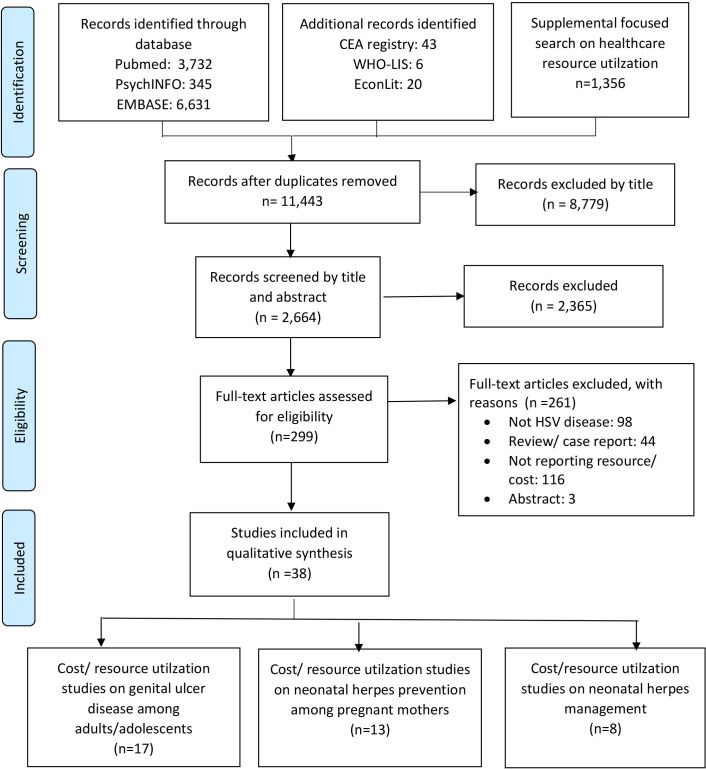
Out of 11 443 articles, 38 were included. Most studies (35/38, 94.6%) were conducted in high-income countries, primarily the United States, and were more often related to the prevention or management of neonatal herpes (n=21) than HSV genital ulcer disease (n=17). Most analyses were conducted before 2010. There was substantial heterogeneity in the reporting of HSV-related healthcare resource utilisation, with 74%-93% individuals who sought care for HSV, 11.6%-68.4% individuals who received care, while neonates with herpes required a median of 6-34 hospitalisation days. The costs reported were similarly heterogeneous, with wide variation in methodology, assumptions and outcome measures between studies. Cost for screening ranged from US$7-100, treatment ranged from US$0.53-35 for an episodic therapy, US$240-2580 yearly for suppressive therapy, while hospitalisation for neonatal care ranged from US$5321-32 683.
A paucity of evidence exists on healthcare resource utilisation and costs associated with HSV infection, especially among low-income and middle-income countries. Future research is needed on costs and healthcare utilisation patterns to improve overall understanding of the global economic burden of HSV.
关于各国单纯疱疹病毒(HSV)的经济负担,人们知之甚少。本文旨在总结现有关于生殖器和新生儿单纯疱疹病毒感染相关成本和医疗资源利用的估计的证据。
系统文献综述。
从创建到 2020 年 8 月 31 日,七个数据库被搜索。进行了重点搜索以补充结果。
报告与 HSV 相关的医疗保健(包括生殖器 HSV 感染的筛查、诊断和治疗以及新生儿疱疹的预防和治疗)相关的医疗资源利用或成本的研究。
两名独立审查员使用 Larg 和 Moss 的清单提取数据并评估偏倚风险。所有数据均以叙述性方式进行总结。
在 11443 篇文章中,有 38 篇被纳入。大多数研究(38/38,94.6%)在高收入国家进行,主要是在美国,其中更多的研究与新生儿疱疹的预防或管理有关(n=21),而不是生殖器 HSV 溃疡病(n=17)。大多数分析是在 2010 年之前进行的。HSV 相关医疗资源利用的报告存在很大的异质性,有 74%-93%寻求 HSV 治疗的人,11.6%-68.4%接受治疗的人,而患有疱疹的新生儿平均需要 6-34 天的住院治疗。报告的成本也同样存在异质性,研究之间在方法、假设和结果测量方面存在广泛差异。筛查费用从 7-100 美元不等,治疗费用从 0.53-35 美元不等(发作性治疗),每年 240-2580 美元(抑制性治疗),而新生儿护理的住院费用从 5321-32683 美元不等。
关于 HSV 感染相关的医疗资源利用和成本的证据很少,特别是在低收入和中等收入国家。需要对成本和医疗资源利用模式进行未来研究,以提高对 HSV 全球经济负担的总体认识。