Department of Human Geography and Spatial Planning, Faculty of Geosciences, Utrecht University, Utrecht, The Netherlands.
Department of Interdisciplinary Social Science, Faculty of Social and Behavioural Sciences, Utrecht University, Utrecht, The Netherlands.
Eur J Public Health. 2022 Jun 1;32(3):504-511. doi: 10.1093/eurpub/ckac010.
Food environments impact on diets, obesity and non-communicable diseases (NCDs). Government policies are essential to create healthy food environments. This study aimed to assess the strength of European Union (EU)-level policies, and identify and prioritize actions for the EU to create healthy food environments.
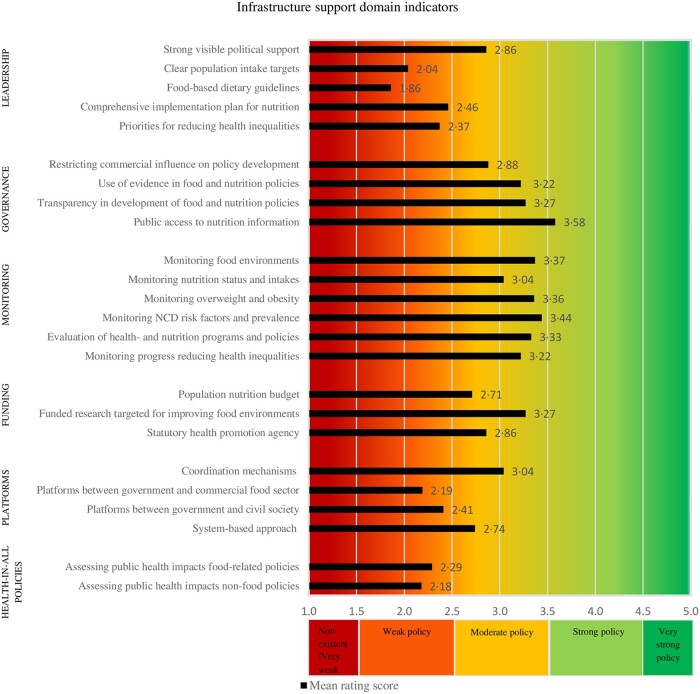
The Healthy Food Environment Policy Index (Food-EPI) was applied. The Food-EPI included 26 policy and 24 infrastructure support indicators. Independent experts (n = 31) rated the strength of EU-level policies and infrastructure support for each of these indicators (on a 5-point scale, from very weak to very strong) and identified and prioritized actions to improve food environments.
For 65% of the 26 policy indicators, EU-level policies were rated as weak and for 23% as very weak. For 63% of the 24 infrastructure support indicators, EU-level policies were rated as moderate and for 33% as weak. The experts recommended 18 policy and 19 infrastructure support actions to the EU. The Top 5 prioritized policy actions included three actions in the food composition domain (e.g. setting mandatory food composition targets), one action in the food prices domain and one action in the food promotion domain. The Top 5 prioritized infrastructure support actions included three actions in the leadership domain (e.g. developing a high-level NCDs Prevention Strategy) and two actions in the monitoring domain.
There is large potential for the EU to strengthen its policies and infrastructure support in order to improve food environments. This study specifies priority actions for the EU to create healthy food environments.
食品环境会影响饮食、肥胖和非传染性疾病(NCD)。政府政策对于创建健康的食品环境至关重要。本研究旨在评估欧盟(EU)层面政策的力度,并确定和优先考虑欧盟为创建健康食品环境而采取的行动。
应用了健康食品环境政策指数(Food-EPI)。Food-EPI 包括 26 项政策和 24 项基础设施支持指标。独立专家(n=31)对这些指标中的每一项(5 分制,从非常弱到非常强)的欧盟层面政策和基础设施支持力度进行了评分,并确定和优先考虑了改善食品环境的行动。
对于 26 项政策指标中的 65%,欧盟层面的政策被评为薄弱,23%被评为非常薄弱。对于 24 项基础设施支持指标中的 63%,欧盟层面的政策被评为中等,33%被评为薄弱。专家向欧盟推荐了 18 项政策和 19 项基础设施支持行动。排名前五的优先政策行动包括三个食品成分领域的行动(例如,设定强制性食品成分目标)、一个食品价格领域的行动和一个食品推广领域的行动。排名前五的优先基础设施支持行动包括三个领导力领域的行动(例如,制定高水平的非传染性疾病预防战略)和两个监测领域的行动。
欧盟有很大的潜力加强其政策和基础设施支持,以改善食品环境。本研究为欧盟创建健康食品环境确定了优先行动。