Mulrenan Ciara, Rhode Kawal, Fischer Barbara Malene
School of Biomedical Engineering & Imaging Sciences, Kings College London, London WC2R 2LS, UK.
Rigshospitalet, Department of Clinical Physiology and Nuclear Medicine, Blegdamsvej 9, 2100 Copenhagen, Denmark.
Diagnostics (Basel). 2022 Mar 31;12(4):869. doi: 10.3390/diagnostics12040869.
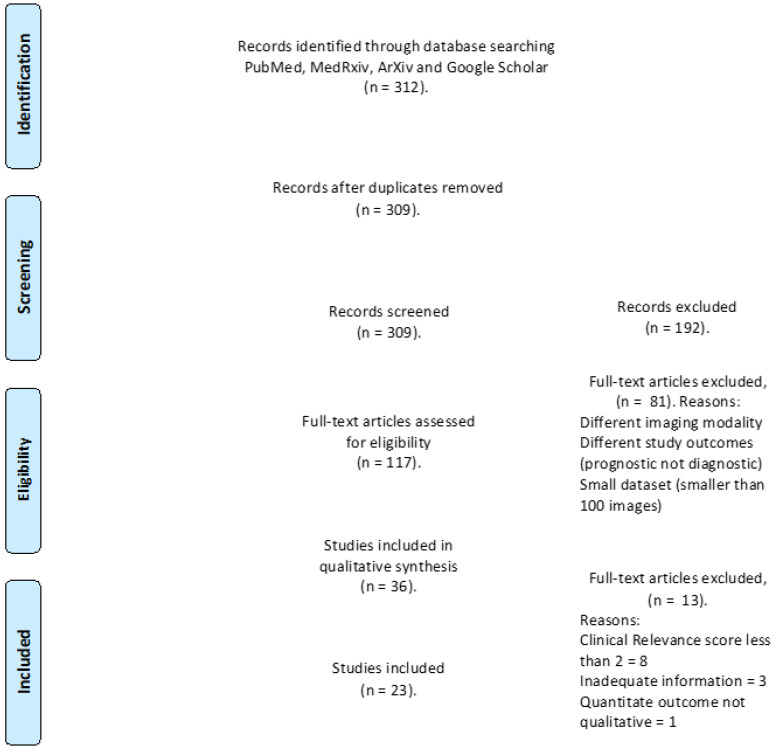
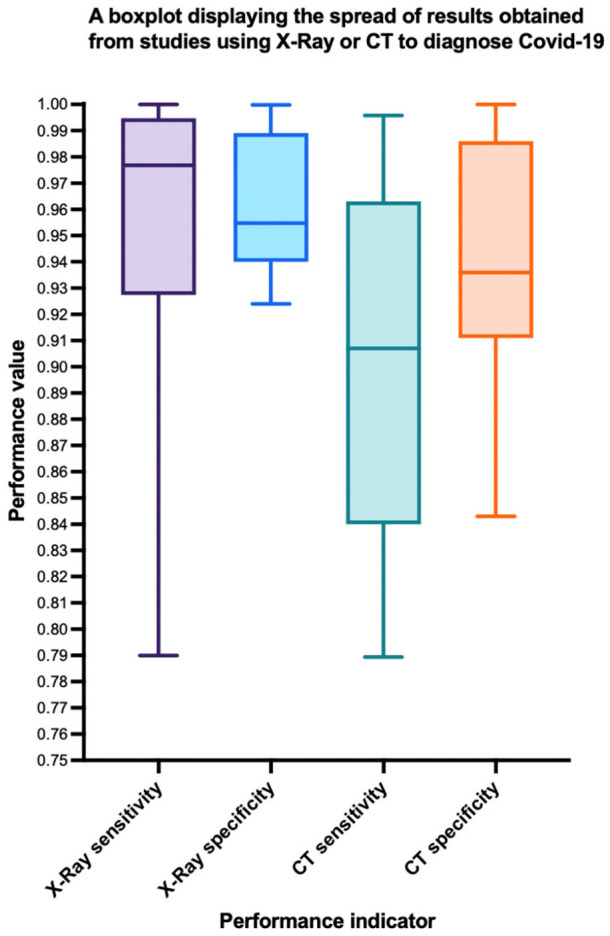
A COVID-19 diagnosis is primarily determined by RT-PCR or rapid lateral-flow testing, although chest imaging has been shown to detect manifestations of the virus. This article reviews the role of imaging (CT and X-ray), in the diagnosis of COVID-19, focusing on the published studies that have applied artificial intelligence with the purpose of detecting COVID-19 or reaching a differential diagnosis between various respiratory infections. In this study, ArXiv, MedRxiv, PubMed, and Google Scholar were searched for studies using the criteria terms 'deep learning', 'artificial intelligence', 'medical imaging', 'COVID-19' and 'SARS-CoV-2'. The identified studies were assessed using a modified version of the Transparent Reporting of a Multivariable Prediction Model for Individual Prognosis or Diagnosis (TRIPOD). Twenty studies fulfilled the inclusion criteria for this review. Out of those selected, 11 papers evaluated the use of artificial intelligence (AI) for chest X-ray and 12 for CT. The size of datasets ranged from 239 to 19,250 images, with sensitivities, specificities and AUCs ranging from 0.789-1.00, 0.843-1.00 and 0.850-1.00. While AI demonstrates excellent diagnostic potential, broader application of this method is hindered by the lack of relevant comparators in studies, sufficiently sized datasets, and independent testing.
新冠病毒病的诊断主要通过逆转录聚合酶链反应(RT-PCR)或快速侧向流动检测来确定,尽管胸部成像已被证明可检测到该病毒的表现。本文综述了成像(CT和X线)在新冠病毒病诊断中的作用,重点关注已发表的应用人工智能以检测新冠病毒病或对各种呼吸道感染进行鉴别诊断的研究。在本研究中,在ArXiv、MedRxiv、PubMed和谷歌学术上搜索使用“深度学习”“人工智能”“医学成像”“新冠病毒病”和“严重急性呼吸综合征冠状病毒2(SARS-CoV-2)”等标准术语的研究。使用个体预后或诊断多变量预测模型透明报告(TRIPOD)的修改版对纳入的研究进行评估。20项研究符合本综述的纳入标准。在这些入选研究中,11篇论文评估了人工智能在胸部X线检查中的应用,12篇评估了在CT检查中的应用。数据集的规模从239张到19250张图像不等,敏感性、特异性和曲线下面积(AUC)范围分别为0.789 - 1.00、0.843 - 1.00和0.850 - 1.00。虽然人工智能显示出出色的诊断潜力,但由于研究中缺乏相关对照、数据集规模不足以及缺乏独立测试,该方法的更广泛应用受到阻碍。