• 文献检索
  • 文档翻译
  • 深度研究
  • 学术资讯
  • Suppr Zotero 插件Zotero 插件
  • 邀请有礼
  • 套餐&价格
  • 历史记录
应用&插件
Suppr Zotero 插件Zotero 插件浏览器插件Mac 客户端Windows 客户端微信小程序
定价
高级版会员购买积分包购买API积分包
服务
文献检索文档翻译深度研究API 文档MCP 服务
关于我们
关于 Suppr公司介绍联系我们用户协议隐私条款
关注我们

Suppr 超能文献

核心技术专利:CN118964589B侵权必究
粤ICP备2023148730 号-1Suppr @ 2026

文献检索

告别复杂PubMed语法,用中文像聊天一样搜索,搜遍4000万医学文献。AI智能推荐,让科研检索更轻松。

立即免费搜索

文件翻译

保留排版,准确专业,支持PDF/Word/PPT等文件格式,支持 12+语言互译。

免费翻译文档

深度研究

AI帮你快速写综述,25分钟生成高质量综述,智能提取关键信息,辅助科研写作。

立即免费体验

基于主邻域聚合的图卷积网络用于肺炎检测。

A Principal Neighborhood Aggregation-Based Graph Convolutional Network for Pneumonia Detection.

机构信息

School of Computer Science and Engineering, Central South University, Changsha 410083, China.

出版信息

Sensors (Basel). 2022 Apr 15;22(8):3049. doi: 10.3390/s22083049.

DOI:10.3390/s22083049
PMID:35459035
原文链接:https://pmc.ncbi.nlm.nih.gov/articles/PMC9026930/
Abstract

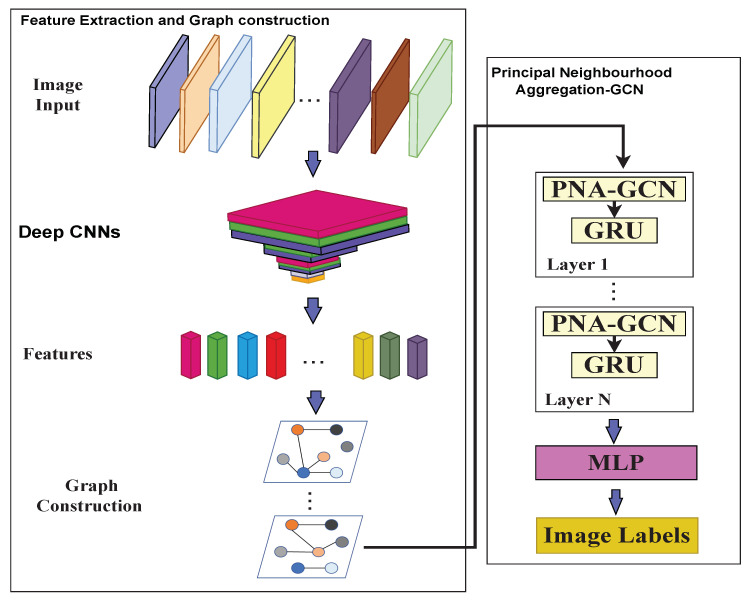
Pneumonia is one of the main causes of child mortality in the world and has been reported by the World Health Organization (WHO) to be the cause of one-third of child deaths in India. Designing an automated classification system to detect pneumonia has become a worthwhile research topic. Numerous deep learning models have attempted to detect pneumonia by applying convolutional neural networks (CNNs) to X-ray radiographs, as they are essentially images and have achieved great performances. However, they failed to capture higher-order feature information of all objects based on the X-ray images because the topology of the X-ray images' dimensions does not always come with some spatially regular locality properties, which makes defining a spatial kernel filter in X-ray images non-trivial. This paper proposes a principal neighborhood aggregation-based graph convolutional network (PNA-GCN) for pneumonia detection. In PNA-GCN, we propose a new graph-based feature construction utilizing the transfer learning technique to extract features and then construct the graph from images. Then, we propose a graph convolutional network with principal neighborhood aggregation. We integrate multiple aggregation functions in a single layer with degree-scalers to capture more effective information in a single layer to exploit the underlying properties of the graph structure. The experimental results show that PNA-GCN can perform best in the pneumonia detection task on a real-world dataset against the state-of-the-art baseline methods.

摘要

肺炎是世界范围内导致儿童死亡的主要原因之一,世界卫生组织(WHO)报告称,印度三分之一的儿童死亡是由肺炎引起的。设计一个自动分类系统来检测肺炎已经成为一个有价值的研究课题。许多深度学习模型试图通过将卷积神经网络(CNNs)应用于 X 射线图像来检测肺炎,因为 X 射线图像本质上是图像,并且已经取得了很好的效果。然而,它们无法根据 X 射线图像捕获所有物体的更高阶特征信息,因为 X 射线图像的维度拓扑并不总是具有一些空间规则局部性质,这使得在 X 射线图像中定义空间核滤波器变得很复杂。本文提出了一种基于主近邻聚合的图卷积网络(PNA-GCN)用于肺炎检测。在 PNA-GCN 中,我们提出了一种新的基于图的特征构建方法,利用迁移学习技术提取特征,然后从图像中构建图。然后,我们提出了一种具有主近邻聚合的图卷积网络。我们在单个层中集成了多个聚合函数和度标度器,以在单个层中捕获更有效的信息,从而利用图结构的潜在特性。实验结果表明,PNA-GCN 在真实数据集上的肺炎检测任务中表现优于最先进的基线方法。

https://cdn.ncbi.nlm.nih.gov/pmc/blobs/a43b/9026930/8a58326754e8/sensors-22-03049-g011.jpg
https://cdn.ncbi.nlm.nih.gov/pmc/blobs/a43b/9026930/79028ff0df64/sensors-22-03049-g001.jpg
https://cdn.ncbi.nlm.nih.gov/pmc/blobs/a43b/9026930/8b2d4635065c/sensors-22-03049-g002.jpg
https://cdn.ncbi.nlm.nih.gov/pmc/blobs/a43b/9026930/e5b04c25947e/sensors-22-03049-g003.jpg
https://cdn.ncbi.nlm.nih.gov/pmc/blobs/a43b/9026930/cfa9d76c72c5/sensors-22-03049-g004.jpg
https://cdn.ncbi.nlm.nih.gov/pmc/blobs/a43b/9026930/896991e7e579/sensors-22-03049-g005.jpg
https://cdn.ncbi.nlm.nih.gov/pmc/blobs/a43b/9026930/cd9f874f5c7c/sensors-22-03049-g006.jpg
https://cdn.ncbi.nlm.nih.gov/pmc/blobs/a43b/9026930/34e2943b4bed/sensors-22-03049-g007.jpg
https://cdn.ncbi.nlm.nih.gov/pmc/blobs/a43b/9026930/17f3f3ae275b/sensors-22-03049-g008.jpg
https://cdn.ncbi.nlm.nih.gov/pmc/blobs/a43b/9026930/aa829a590855/sensors-22-03049-g009.jpg
https://cdn.ncbi.nlm.nih.gov/pmc/blobs/a43b/9026930/21dae0ac5ac1/sensors-22-03049-g010.jpg
https://cdn.ncbi.nlm.nih.gov/pmc/blobs/a43b/9026930/8a58326754e8/sensors-22-03049-g011.jpg
https://cdn.ncbi.nlm.nih.gov/pmc/blobs/a43b/9026930/79028ff0df64/sensors-22-03049-g001.jpg
https://cdn.ncbi.nlm.nih.gov/pmc/blobs/a43b/9026930/8b2d4635065c/sensors-22-03049-g002.jpg
https://cdn.ncbi.nlm.nih.gov/pmc/blobs/a43b/9026930/e5b04c25947e/sensors-22-03049-g003.jpg
https://cdn.ncbi.nlm.nih.gov/pmc/blobs/a43b/9026930/cfa9d76c72c5/sensors-22-03049-g004.jpg
https://cdn.ncbi.nlm.nih.gov/pmc/blobs/a43b/9026930/896991e7e579/sensors-22-03049-g005.jpg
https://cdn.ncbi.nlm.nih.gov/pmc/blobs/a43b/9026930/cd9f874f5c7c/sensors-22-03049-g006.jpg
https://cdn.ncbi.nlm.nih.gov/pmc/blobs/a43b/9026930/34e2943b4bed/sensors-22-03049-g007.jpg
https://cdn.ncbi.nlm.nih.gov/pmc/blobs/a43b/9026930/17f3f3ae275b/sensors-22-03049-g008.jpg
https://cdn.ncbi.nlm.nih.gov/pmc/blobs/a43b/9026930/aa829a590855/sensors-22-03049-g009.jpg
https://cdn.ncbi.nlm.nih.gov/pmc/blobs/a43b/9026930/21dae0ac5ac1/sensors-22-03049-g010.jpg
https://cdn.ncbi.nlm.nih.gov/pmc/blobs/a43b/9026930/8a58326754e8/sensors-22-03049-g011.jpg

相似文献

1
A Principal Neighborhood Aggregation-Based Graph Convolutional Network for Pneumonia Detection.基于主邻域聚合的图卷积网络用于肺炎检测。
Sensors (Basel). 2022 Apr 15;22(8):3049. doi: 10.3390/s22083049.
2
NSCGCN: A novel deep GCN model to diagnosis COVID-19.NSCGCN:一种用于诊断 COVID-19 的新型深度 GCN 模型。
Comput Biol Med. 2022 Nov;150:106151. doi: 10.1016/j.compbiomed.2022.106151. Epub 2022 Sep 30.
3
A Convolutional Neural Network and Graph Convolutional Network Based Framework for Classification of Breast Histopathological Images.基于卷积神经网络和图卷积网络的乳腺组织病理图像分类框架。
IEEE J Biomed Health Inform. 2022 Jul;26(7):3163-3173. doi: 10.1109/JBHI.2022.3153671. Epub 2022 Jul 1.
4
MAMF-GCN: Multi-scale adaptive multi-channel fusion deep graph convolutional network for predicting mental disorder.MAMF-GCN:用于预测精神障碍的多尺度自适应多通道融合深度图卷积网络。
Comput Biol Med. 2022 Sep;148:105823. doi: 10.1016/j.compbiomed.2022.105823. Epub 2022 Jul 6.
5
CGNet: A graph-knowledge embedded convolutional neural network for detection of pneumonia.CGNet:一种用于肺炎检测的图知识嵌入卷积神经网络。
Inf Process Manag. 2021 Jan;58(1):102411. doi: 10.1016/j.ipm.2020.102411. Epub 2020 Oct 19.
6
PND-Net: plant nutrition deficiency and disease classification using graph convolutional network.PND-Net:基于图卷积网络的植物营养缺乏与病害分类
Sci Rep. 2024 Jul 5;14(1):15537. doi: 10.1038/s41598-024-66543-7.
7
A deep graph convolutional neural network architecture for graph classification.一种用于图分类的深度图卷积神经网络架构。
PLoS One. 2023 Mar 10;18(3):e0279604. doi: 10.1371/journal.pone.0279604. eCollection 2023.
8
Dual-Coupled CNN-GCN-Based Classification for Hyperspectral and LiDAR Data.基于双耦合 CNN-GCN 的高光谱和 LiDAR 数据分类。
Sensors (Basel). 2022 Jul 31;22(15):5735. doi: 10.3390/s22155735.
9
MVS-GCN: A prior brain structure learning-guided multi-view graph convolution network for autism spectrum disorder diagnosis.MVS-GCN:一种基于先验脑结构学习的多视图图卷积网络自闭症谱系障碍诊断方法。
Comput Biol Med. 2022 Mar;142:105239. doi: 10.1016/j.compbiomed.2022.105239. Epub 2022 Jan 19.
10
Automated freezing of gait assessment with marker-based motion capture and multi-stage spatial-temporal graph convolutional neural networks.基于标记的运动捕捉和多阶段时空图卷积神经网络的自动化冻结步态评估。
J Neuroeng Rehabil. 2022 May 21;19(1):48. doi: 10.1186/s12984-022-01025-3.

引用本文的文献

1
ZooCNN: A Zero-Order Optimized Convolutional Neural Network for Pneumonia Classification Using Chest Radiographs.ZooCNN:一种用于使用胸部X光片进行肺炎分类的零阶优化卷积神经网络。
J Imaging. 2025 Jan 13;11(1):22. doi: 10.3390/jimaging11010022.
2
DeepChestGNN: A Comprehensive Framework for Enhanced Lung Disease Identification through Advanced Graphical Deep Features.深胸图神经网络:通过先进的图形深度学习特征增强肺病识别的综合框架。
Sensors (Basel). 2024 Apr 29;24(9):2830. doi: 10.3390/s24092830.
3
Interference recommendation for the pump sizing process in progressive cavity pumps using graph neural networks.

本文引用的文献

1
Multimodal graph attention network for COVID-19 outcome prediction.多模态图注意力网络用于 COVID-19 结局预测。
Sci Rep. 2023 Nov 9;13(1):19539. doi: 10.1038/s41598-023-46625-8.
2
Diagnosis of COVID-19 Pneumonia Based on Graph Convolutional Network.基于图卷积网络的新型冠状病毒肺炎诊断
Front Med (Lausanne). 2021 Jan 21;7:612962. doi: 10.3389/fmed.2020.612962. eCollection 2020.
3
CGNet: A graph-knowledge embedded convolutional neural network for detection of pneumonia.CGNet:一种用于肺炎检测的图知识嵌入卷积神经网络。
基于图神经网络的螺杆泵选型过程中的干扰推荐
Sci Rep. 2023 Oct 6;13(1):16884. doi: 10.1038/s41598-023-43972-4.
Inf Process Manag. 2021 Jan;58(1):102411. doi: 10.1016/j.ipm.2020.102411. Epub 2020 Oct 19.
4
Visualization and Interpretation of Convolutional Neural Network Predictions in Detecting Pneumonia in Pediatric Chest Radiographs.卷积神经网络预测在小儿胸部X光片中检测肺炎的可视化与解读
Appl Sci (Basel). 2018 Oct;8(10). doi: 10.3390/app8101715. Epub 2018 Sep 20.
5
A Comprehensive Survey on Graph Neural Networks.图神经网络综述。
IEEE Trans Neural Netw Learn Syst. 2021 Jan;32(1):4-24. doi: 10.1109/TNNLS.2020.2978386. Epub 2021 Jan 4.
6
Automated Lung Nodule Detection and Classification Using Deep Learning Combined with Multiple Strategies.基于深度学习结合多种策略的肺结节自动检测与分类
Sensors (Basel). 2019 Aug 28;19(17):3722. doi: 10.3390/s19173722.
7
Reproduction study using public data of: Development and validation of a deep learning algorithm for detection of diabetic retinopathy in retinal fundus photographs.使用公共数据进行生殖研究:开发和验证一种用于眼底照片中糖尿病性视网膜病变检测的深度学习算法。
PLoS One. 2019 Jun 6;14(6):e0217541. doi: 10.1371/journal.pone.0217541. eCollection 2019.
8
An Efficient Deep Learning Approach to Pneumonia Classification in Healthcare.一种在医疗保健中进行肺炎分类的高效深度学习方法。
J Healthc Eng. 2019 Mar 27;2019:4180949. doi: 10.1155/2019/4180949. eCollection 2019.
9
Classification of lung nodules in CT scans using three-dimensional deep convolutional neural networks with a checkpoint ensemble method.使用带有检查点集成方法的三维深度卷积神经网络对CT扫描中的肺结节进行分类。
BMC Med Imaging. 2018 Dec 3;18(1):48. doi: 10.1186/s12880-018-0286-0.
10
Deep learning for chest radiograph diagnosis: A retrospective comparison of the CheXNeXt algorithm to practicing radiologists.深度学习在胸片诊断中的应用:CheXNeXt 算法与临床放射科医生的回顾性比较。
PLoS Med. 2018 Nov 20;15(11):e1002686. doi: 10.1371/journal.pmed.1002686. eCollection 2018 Nov.