Center for Clinical Big Data and Analytics of the Second Affiliated Hospital and Department of Big Data in Health Science School of Public Health, Zhejiang University School of Medicine, Zhejiang, Hangzhou, China.
China CDC Key Laboratory of Environment and Population Health, National Institute of Environmental Health; National Center for AIDS/STD Control and Prevention, Chinese Center for Disease Control and Prevention, Beijing, China.
BMC Geriatr. 2022 Apr 28;22(1):378. doi: 10.1186/s12877-022-02913-y.
Aging metrics incorporating cognitive and physical function are not fully understood, hampering their utility in research and clinical practice. This study aimed to determine the proportions of vulnerable persons identified by three existing aging metrics that incorporate cognitive and physical function and the associations of the three metrics with mortality.
We considered three existing aging metrics including the combined presence of cognitive impairment and physical frailty (CI-PF), the frailty index (FI), and the motoric cognitive risk syndrome (MCR). We operationalized them using data from the China Health and Retirement Longitudinal Study (CHARLS) and the US National Health and Nutrition Examination Survey (NHANES). Logistic regression models or Cox proportional hazards regression models, and receiver operating characteristic curves were used to examine the associations of the three metrics with mortality.
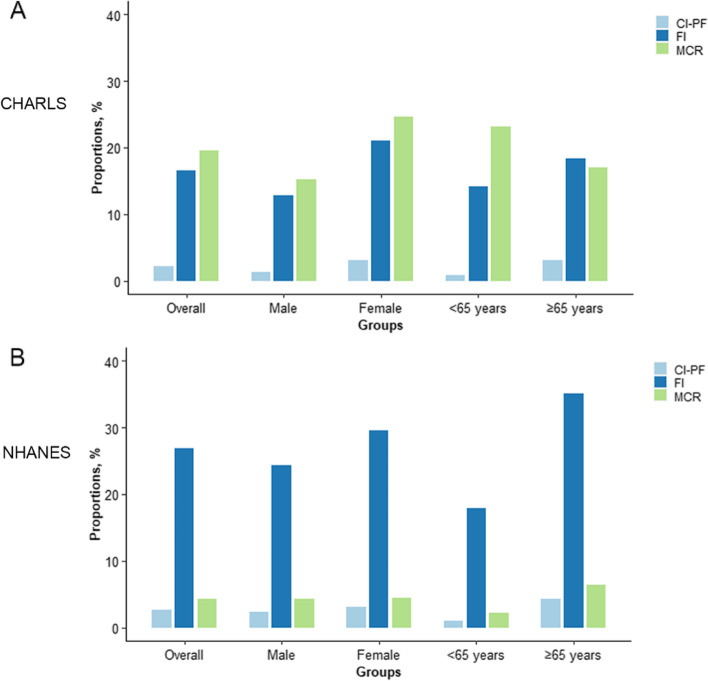
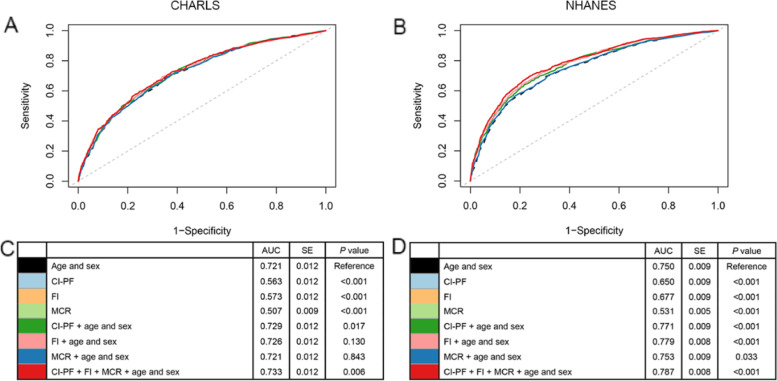
In CHARLS, the proportions of vulnerable persons identified by CI-PF, FI, and MCR were 2.2, 16.6, and 19.6%, respectively. Each metric predicted mortality after adjustment for age and sex, with some variations in the strength of the associations (CI-PF, odds ratio (OR) (95% confidence interval (CI)) 2.87 (1.74-4.74); FI, OR (95% CI) 1.94 (1.50-2.50); MCR, OR (95% CI) 1.27 (1.00-1.62)). CI-PF and FI had additional predictive utility beyond age and sex, as demonstrated by integrated discrimination improvement and continuous net reclassification improvement (all P < 0.001). These results were replicated in NHANES.
Despite the inherent differences in the aging metrics incorporating cognitive and physical function, they consistently capture mortality risk. The findings support the incorporation of cognitive and physical function for risk stratification in both Chinese and US persons, but call for caution when applying them in specific study settings.
结合认知和身体功能的衰老指标尚未完全明确,这妨碍了它们在研究和临床实践中的应用。本研究旨在确定三种结合认知和身体功能的现有衰老指标识别出的脆弱人群的比例,以及这三种指标与死亡率的相关性。
我们考虑了三种现有的衰老指标,包括认知障碍和身体虚弱并存(CI-PF)、衰弱指数(FI)和运动认知风险综合征(MCR)。我们使用中国健康与退休纵向研究(CHARLS)和美国国家健康与营养调查(NHANES)的数据对其进行了操作化。我们使用逻辑回归模型或 Cox 比例风险回归模型和受试者工作特征曲线来检验这三种指标与死亡率的相关性。
在 CHARLS 中,CI-PF、FI 和 MCR 识别出的脆弱人群比例分别为 2.2%、16.6%和 19.6%。在调整年龄和性别后,每种指标都预测了死亡率,其相关性的强度有所不同(CI-PF,比值比(OR)(95%置信区间(CI))2.87(1.74-4.74);FI,OR(95%CI)1.94(1.50-2.50);MCR,OR(95%CI)1.27(1.00-1.62))。CI-PF 和 FI 除了年龄和性别之外,还有额外的预测效用,这表现为综合判别改善和连续净重新分类改善(均 P<0.001)。这些结果在 NHANES 中得到了复制。
尽管纳入认知和身体功能的衰老指标存在内在差异,但它们都能一致地捕捉到死亡风险。这些发现支持将认知和身体功能纳入中、美人群的风险分层,但在特定研究环境中应用时需要谨慎。