Zhang Shujin, Yu Peiheng, Chen Yiyun, Jing Ying, Zeng Fanxin
School of Resource and Environmental Science, Wuhan University, 129 Luoyu Road, Wuhan 430079, China.
Department of Building and Real Estate, The Hong Kong Polytechnic University, Hong Kong 999077, China.
Int J Environ Res Public Health. 2022 Apr 29;19(9):5440. doi: 10.3390/ijerph19095440.
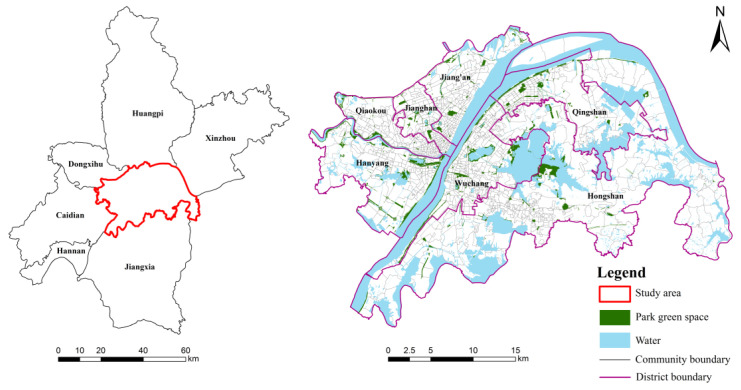
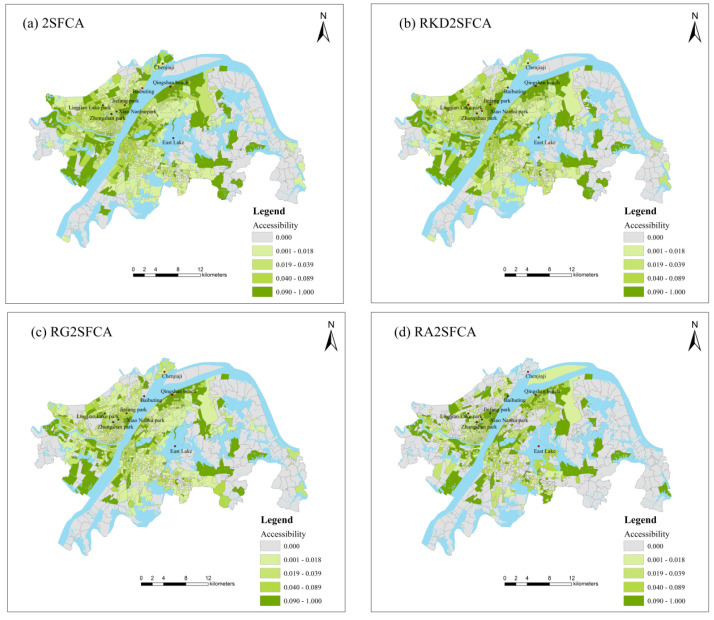
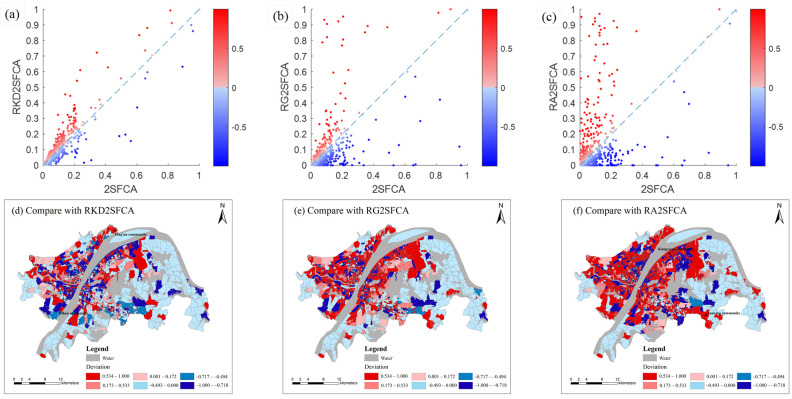
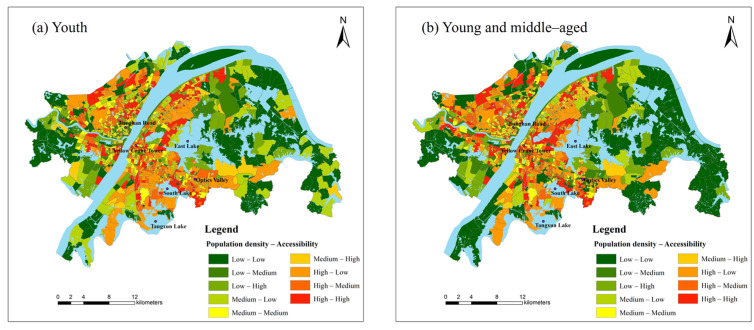
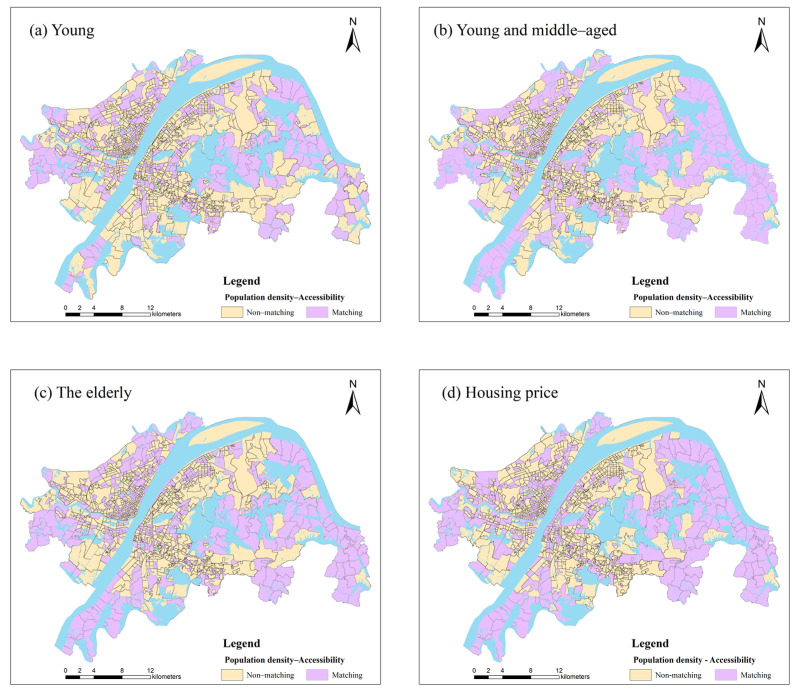
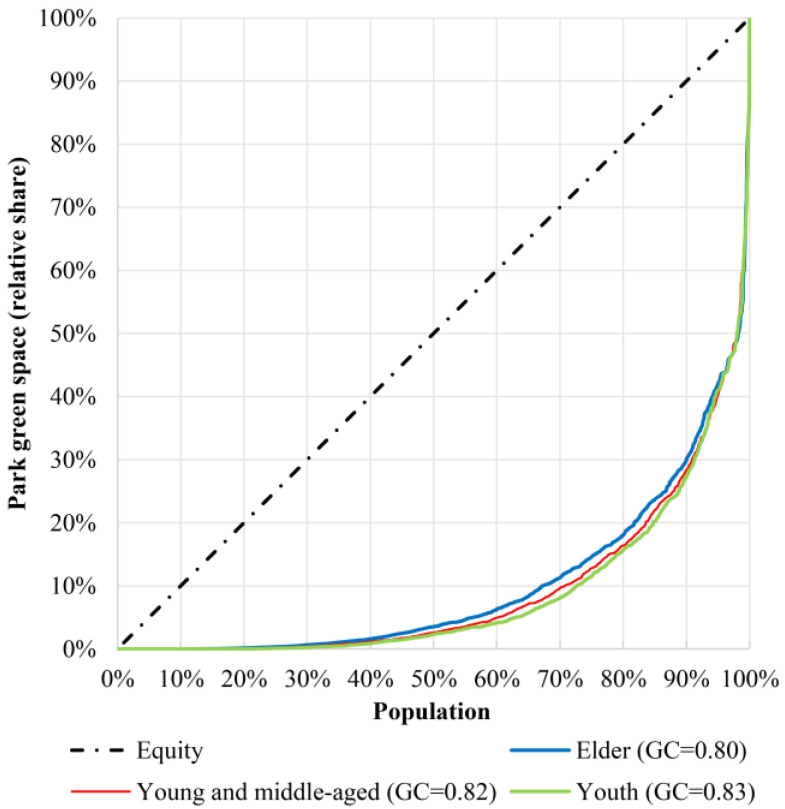
During the COVID-19 pandemic, people have seen the precious value of park green space for health. In the post-COVID-19 Era, it is essential to understand the different needs and expectations of different communities for the use of park green space. A myriad of previous studies focused on the whole city's demand for park green space, while few studies examined spatial equity from a supply-demand perspective. This paper aims to investigate the differences in park green space accessibility among people of different ages at a community scale. Specifically, to better evaluate the accessibility of park green space and account for the travel choice, we compared the effects of the two-step floating catchment area (2SFCA) method containing different distance decay functions (i.e., the improved 2SFCA methods) by considering the traffic network and the scale of park green space. In addition, we compared the improved 2SFCA methods with the traditional 2SFCA. This study investigated the spatial equity of park green space accessibility in 1184 communities with a total population of 6,468,612 in the central urban districts of Wuhan. The results showed that the high accessible communities were concentrated in the urban center along the Yangtze River. The improved 2SFCA methods outperformed the traditional 2SFCA, and presented smoother gradient information. It was revealed that over half of communities' park green space accessibility levels did not match their population density. Inequality of accessibility to park green space was found in people of different ages, especially for the youth (Gini coefficient was as high as 0.83). The difference in the accessibility of urban park green space among different age structures implies the need to integrate community green space planning into urban planning in the post-COVID-19 Era.
在新冠疫情期间,人们已经见识到公园绿地对健康的宝贵价值。在新冠疫情后的时代,了解不同社区对公园绿地使用的不同需求和期望至关重要。此前大量研究聚焦于整个城市对公园绿地的需求,而从供需角度考察空间公平性的研究较少。本文旨在探讨社区尺度下不同年龄段人群在公园绿地可达性方面的差异。具体而言,为了更好地评估公园绿地的可达性并考虑出行选择,我们通过考虑交通网络和公园绿地规模,比较了包含不同距离衰减函数的两步浮动 catchment 区域(2SFCA)方法(即改进的 2SFCA 方法)的效果。此外,我们还将改进的 2SFCA 方法与传统的 2SFCA 进行了比较。本研究调查了武汉市中心城区 1184 个社区、总人口 6468612 人的公园绿地可达性空间公平性。结果表明,高可达性社区集中在沿长江的市中心区域。改进的 2SFCA 方法优于传统的 2SFCA,且呈现出更平滑的梯度信息。研究发现,超过一半社区的公园绿地可达性水平与其人口密度不匹配。不同年龄段人群在公园绿地可达性方面存在不平等,尤其是年轻人(基尼系数高达 0.83)。不同年龄结构人群在城市公园绿地可达性上的差异意味着在新冠疫情后的时代,有必要将社区绿地规划纳入城市规划。