Du Qingyun, Liu Haowen, Yang Chengjiao, Chen Xiaoyu, Zhang Xiaoyuan
Department of Psychology, School of Public Health, Southern Medical University, Guangzhou, China.
Department of Psychiatry, Zhujiang Hospital, Southern Medical University, Guangzhou, China.
Front Psychiatry. 2022 May 9;13:854547. doi: 10.3389/fpsyt.2022.854547. eCollection 2022.
Few studies on anxiety in China have used the full version of the Spielberger State-Trait Anxiety Inventory (STAI) due to its length, despite its numerous advantages. The goal of this study was to develop a short Chinese version of the STAI and examine its reliability and validity among the general Chinese population and psychiatric patients diagnosed with anxiety.
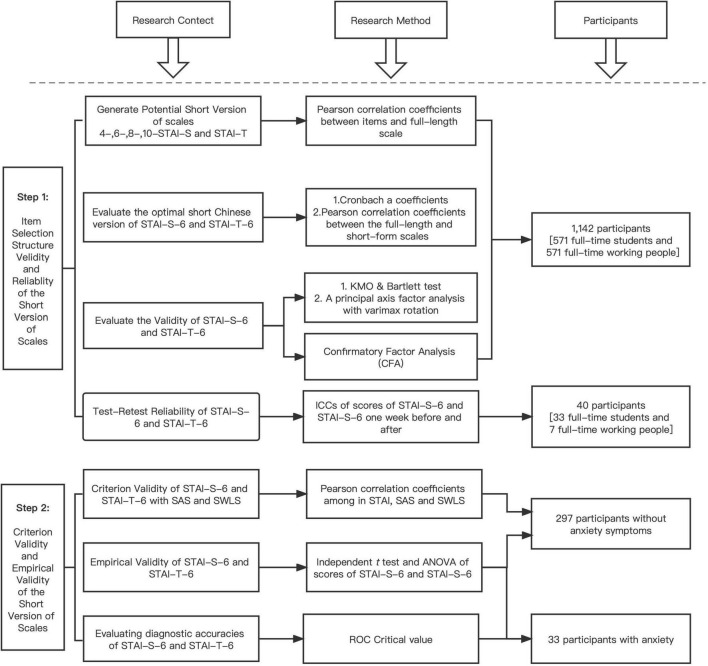
A total of 1,142 participants were invited to test the short Chinese version of the STAI; item analysis, validity testing and internal consistency reliability analysis were performed. Subsequently, 40 participants were enrolled to assess retest reliability 1 week later. Finally, 330 participants, including 33 psychiatric patients with anxiety, were used to assess the criterion and empirical validity. The Self-Rating Anxiety Scale (SAS) and Satisfaction with Life Scale (SWLS) were used as criteria, and receiver operating characteristic (ROC) analysis was conducted to evaluate the discrimination of the short version of the STAI between the groups with and without anxiety disorders.
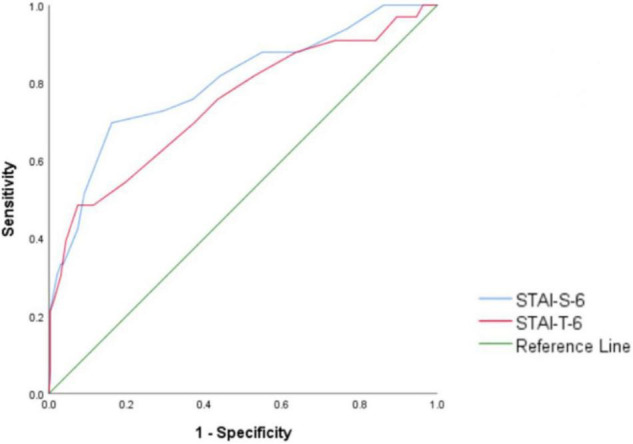
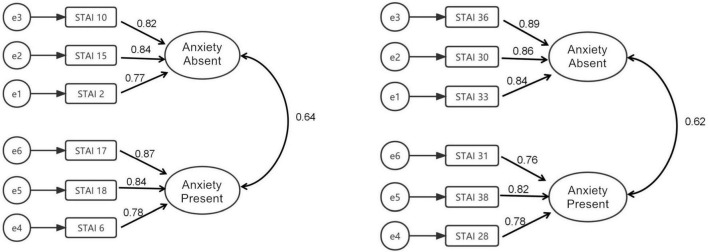
The short Chinese version of the STAI contains six items for each subscale (STAI-S-6 and STAI-T-6). The Pearson correlation coefficients between the two shortened Chinese versions of the STAI and the full-length STAI were 0.970 and 0.962, the Cronbach's α coefficients were 0.871 and 0.842, and the retest reliability values were 0.728 and 0.813 ( < 0.001). Confirmatory factor analysis showed that the 2-factor model achieved an adequate model fit: for the STAI-S-6, CFI = 0.986, TLI = 0.974, and RMSEA = 0.075, and for the STAI-T-6, CFI = 0.994, TLI = 0.988, and RMSEA = 0.052. The short Chinese version of the STAI had a significant positive correlation with the SAS score ( = 0.289, 0.313; < 0.001) and a negative correlation with the SWLS score ( = -0.476, 0.554; < 0.001). A significant difference in the level of anxiety was found between participants with and without anxiety disorders. The diagnostic accuracy of the STAI-S-6 and STAI-T-6 for major anxiety disorder was acceptable, with areas under the ROC curves of 0.798 and 0.745, respectively.
The short Chinese version of the STAI demonstrates sound psychometric properties and is applicable in evaluating the level of anxiety in Chinese populations.
尽管斯皮尔伯格状态-特质焦虑量表(STAI)有诸多优点,但由于篇幅较长,中国很少有关于焦虑的研究使用其完整版。本研究的目的是编制一份简短的中文版STAI,并在中国普通人群和被诊断为焦虑症的精神病患者中检验其信效度。
共邀请1142名参与者测试简短中文版STAI;进行项目分析、效度测试和内部一致性信度分析。随后,招募40名参与者在1周后评估重测信度。最后,330名参与者,包括33名患有焦虑症的精神病患者,被用于评估效标效度和实证效度。使用自评焦虑量表(SAS)和生活满意度量表(SWLS)作为效标,并进行ROC分析以评估简短版STAI在焦虑症患者组和非焦虑症患者组之间的区分度。
简短中文版STAI的每个分量表包含6个项目(STAI-S-6和STAI-T-6)。两个简短中文版STAI与完整版STAI之间的Pearson相关系数分别为0.970和0.962,Cronbach's α系数分别为0.871和0.842,重测信度值分别为0.728和0.813(P < 0.001)。验证性因素分析表明二因素模型拟合良好:对于STAI-S-6,CFI = 0.986,TLI = 0.974,RMSEA = 0.075;对于STAI-T-6,CFI = 0.994,TLI = 0.988,RMSEA = 0.052。简短中文版STAI与SAS得分呈显著正相关(r = 0.289,0.313;P < 0.001),与SWLS得分呈负相关(r = -0.476,0.554;P < 0.001)。在有焦虑症和无焦虑症的参与者之间发现焦虑水平存在显著差异。STAI-S-6和STAI-T-6对重度焦虑症的诊断准确性可以接受,ROC曲线下面积分别为0.798和0.745。
简短中文版STAI具有良好的心理测量学特性,适用于评估中国人群的焦虑水平。