• 文献检索
  • 文档翻译
  • 深度研究
  • 学术资讯
  • Suppr Zotero 插件Zotero 插件
  • 邀请有礼
  • 套餐&价格
  • 历史记录
应用&插件
Suppr Zotero 插件Zotero 插件浏览器插件Mac 客户端Windows 客户端微信小程序
定价
高级版会员购买积分包购买API积分包
服务
文献检索文档翻译深度研究API 文档MCP 服务
关于我们
关于 Suppr公司介绍联系我们用户协议隐私条款
关注我们

Suppr 超能文献

核心技术专利:CN118964589B侵权必究
粤ICP备2023148730 号-1Suppr @ 2026

文献检索

告别复杂PubMed语法,用中文像聊天一样搜索,搜遍4000万医学文献。AI智能推荐,让科研检索更轻松。

立即免费搜索

文件翻译

保留排版,准确专业,支持PDF/Word/PPT等文件格式,支持 12+语言互译。

免费翻译文档

深度研究

AI帮你快速写综述,25分钟生成高质量综述,智能提取关键信息,辅助科研写作。

立即免费体验

COVID-19大流行期间巴西严重急性呼吸道感染的流行病学概况:一项流行病学研究

Epidemiologic Profile of Severe Acute Respiratory Infection in Brazil During the COVID-19 Pandemic: An Epidemiological Study.

作者信息

Sansone Nathália Mariana Santos, Boschiero Matheus Negri, Marson Fernando Augusto Lima

机构信息

Laboratory of Cell and Molecular Tumor Biology and Bioactive Compounds, São Francisco University, Bragança Paulista, Brazil.

Laboratory of Human and Medical Genetics, São Francisco University, Bragança Paulista, Brazil.

出版信息

Front Microbiol. 2022 Jul 1;13:911036. doi: 10.3389/fmicb.2022.911036. eCollection 2022.

DOI:10.3389/fmicb.2022.911036
PMID:35854935
原文链接:https://pmc.ncbi.nlm.nih.gov/articles/PMC9288583/
Abstract

BACKGROUND

The COVID-19 is a significant public health issue, and monitoring confirmed cases and deaths is an essential epidemiologic tool. We evaluated the features in Brazilian hospitalized patients due to severe acute respiratory infection (SARI) during the COVID-19 pandemic in Brazil. We grouped the patients into the following categories: Influenza virus infection (G1), other respiratory viruses' infection (G2), other known etiologic agents (G3), SARS-CoV-2 infection (patients with COVID-19, G4), and undefined etiological agent (G5).

METHODS

We performed an epidemiological study using data from DataSUS (https://opendatasus.saude.gov.br/) from December 2019 to October 2021. The dataset included Brazilian hospitalized patients due to SARI. We considered the clinical evolution of the patients with SARI during the COVID-19 pandemic according to the SARI patient groups as the outcome. We performed the multivariate statistical analysis using logistic regression, and we adopted an Alpha error of 0.05.

RESULTS

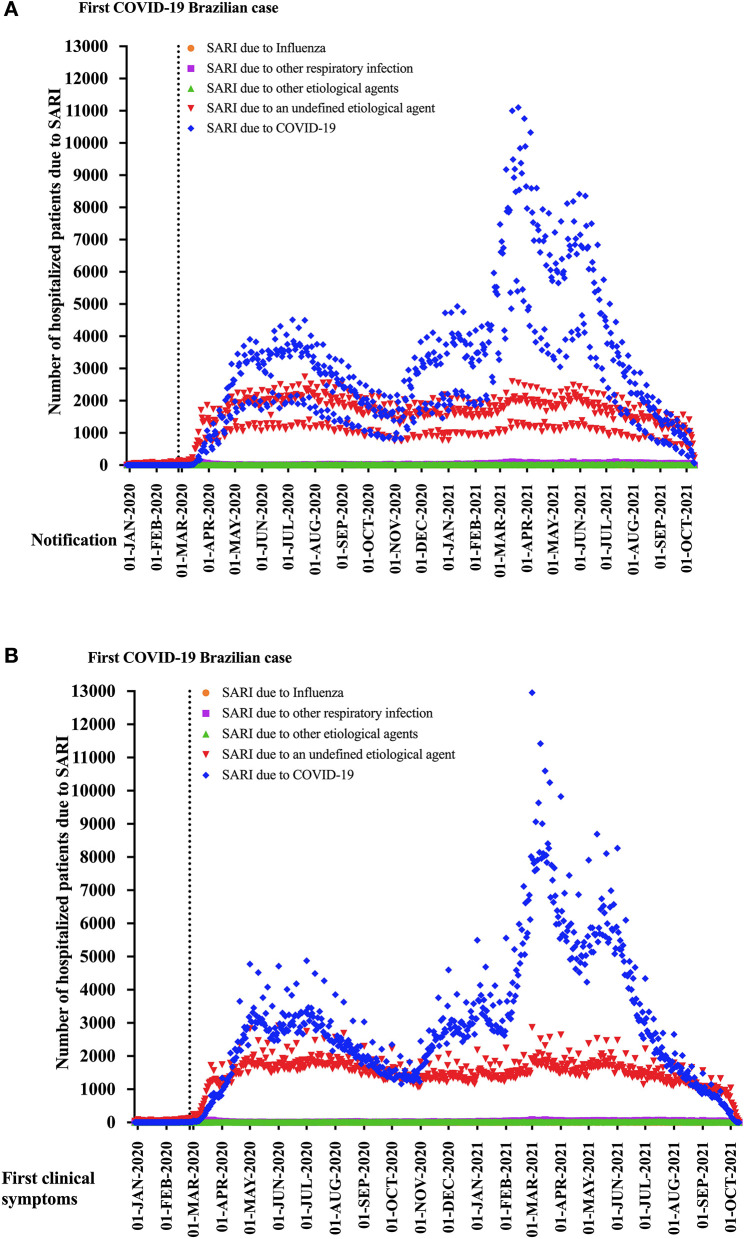
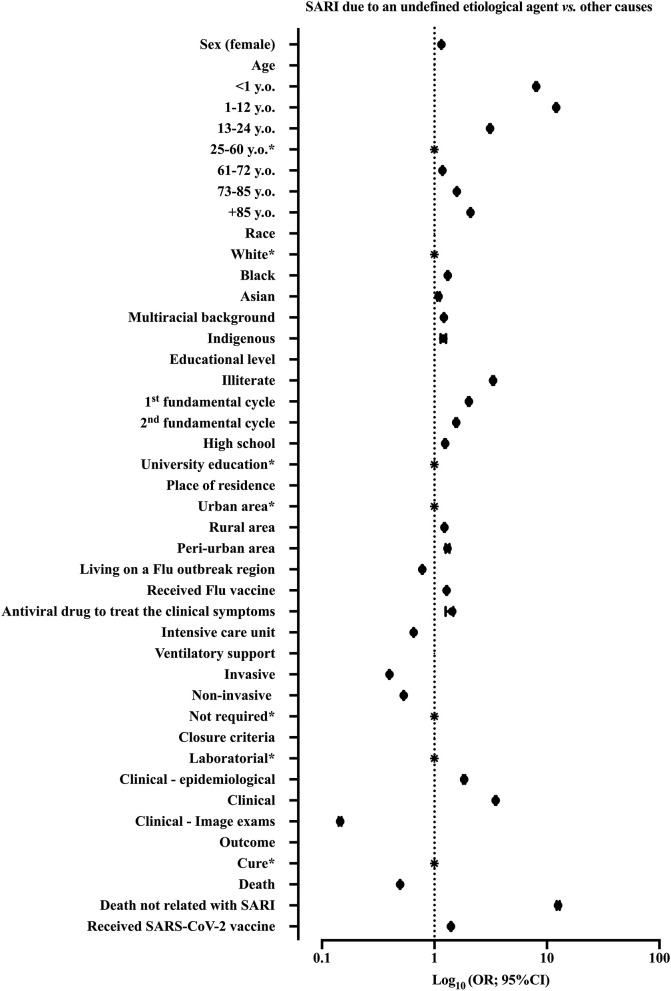
A total of 2,740,272 patients were hospitalized due to SARI in Brazil, being the São Paulo state responsible for most of the cases [802,367 (29.3%)]. Most of the patients were male (1,495,416; 54.6%), aged between 25 and 60 years (1,269,398; 46.3%), and were White (1,105,123; 49.8%). A total of 1,577,279 (68.3%) patients recovered from SARI, whereas 701,607 (30.4%) died due to SARI, and 30,551 (1.3%) did not have their deaths related to SARI. A major part of the patients was grouped in G4 (1,817,098; 66.3%) and G5 (896,207; 32.7%). The other groups account for <1% of our sample [G1: 3,474 (0.1%), G2: 16,627 (0.6%), and G3: 6,866 (0.3%)]. The deaths related to SARI were more frequent in G4 (574,887; 34.7%); however, the deaths not related to SARI were more frequent among the patients categorized into the G3 (1,339; 21.3%) and G5 (25,829; 4.1%). In the multivariate analysis, the main predictors to classify the patients in the G5 when compared with G4 or G1-G4 were female sex, younger age, Black race, low educational level, rural place of residence, and the use of antiviral to treat the clinical signs. Furthermore, several features predict the risk of death by SARI, such as older age, race (Black, Indigenous, and multiracial background), low educational level, residence in a flu outbreak region, need for intensive care unit, and need for mechanical ventilatory support.

CONCLUSIONS

The possible COVID-19 underreporting (G5) might be associated with an enhanced mortality rate, more evident in distinct social groups. In addition, the patients' features are unequal between the patients' groups and can be used to determine the risk of possible COVID-19 underreporting in our population. Patients with a higher risk of death had a different epidemiological profile when compared with patients who recovered from SARI, like older age, Black, Indigenous, and multiracial background races, low educational level, residence in a flu outbreak region, need for intensive care unit and need for mechanical ventilatory support.
https://cdn.ncbi.nlm.nih.gov/pmc/blobs/0393/9288583/27eee5626bfc/fmicb-13-911036-g0003.jpg
https://cdn.ncbi.nlm.nih.gov/pmc/blobs/0393/9288583/998df18672f9/fmicb-13-911036-g0001.jpg
https://cdn.ncbi.nlm.nih.gov/pmc/blobs/0393/9288583/64e812522140/fmicb-13-911036-g0002.jpg
https://cdn.ncbi.nlm.nih.gov/pmc/blobs/0393/9288583/27eee5626bfc/fmicb-13-911036-g0003.jpg
https://cdn.ncbi.nlm.nih.gov/pmc/blobs/0393/9288583/998df18672f9/fmicb-13-911036-g0001.jpg
https://cdn.ncbi.nlm.nih.gov/pmc/blobs/0393/9288583/64e812522140/fmicb-13-911036-g0002.jpg
https://cdn.ncbi.nlm.nih.gov/pmc/blobs/0393/9288583/27eee5626bfc/fmicb-13-911036-g0003.jpg
摘要

背景

新型冠状病毒肺炎(COVID-19)是一个重大的公共卫生问题,监测确诊病例和死亡情况是一项重要的流行病学工具。我们评估了巴西COVID-19大流行期间因严重急性呼吸道感染(SARI)住院患者的特征。我们将患者分为以下几类:流感病毒感染(G1)、其他呼吸道病毒感染(G2)、其他已知病原体(G3)、严重急性呼吸综合征冠状病毒2(SARS-CoV-2)感染(COVID-19患者,G4)和病原体未明(G5)。

方法

我们使用2019年12月至2021年10月巴西卫生部公开数据库(https://opendatasus.saude.gov.br/)的数据进行了一项流行病学研究。该数据集包括因SARI住院的巴西患者。我们将COVID-19大流行期间SARI患者的临床转归作为研究结果,根据SARI患者分组进行分析。我们采用逻辑回归进行多变量统计分析,设定α错误率为0.05。

结果

巴西共有2740272例患者因SARI住院,其中圣保罗州病例最多[802367例(29.3%)]。大多数患者为男性(1495416例;54.6%),年龄在25至60岁之间(1269398例;46.3%),且为白人(1105123例;49.8%)。共有1577279例(68.3%)患者从SARI中康复,701607例(30.4%)患者因SARI死亡,30551例(1.3%)患者的死亡与SARI无关。大部分患者分为G4组(1817098例;66.3%)和G5组(896207例;32.7%)。其他组占样本的比例不到1%[G1组:3474例(0.1%),G2组:16627例(0.6%),G3组:6866例(0.3%)]。与SARI相关的死亡在G4组中更为常见(574887例;34.7%);然而,与SARI无关的死亡在G3组(1339例;21.3%)和G5组(25829例;4.1%)的患者中更为常见。在多变量分析中,与G4组或G1-G4组相比,将患者分类为G5组的主要预测因素为女性、年龄较小、黑人种族、教育水平低、农村居住地以及使用抗病毒药物治疗临床症状。此外,一些特征可预测SARI导致的死亡风险,如年龄较大、种族(黑人、原住民和多民族背景)、教育水平低、居住在流感暴发地区、需要重症监护病房以及需要机械通气支持。

结论

可能存在的COVID-19报告不足(G5)可能与死亡率增加有关,在不同社会群体中更为明显。此外,患者组之间的特征存在差异,可用于确定我国人群中可能存在的COVID-19报告不足的风险。与从SARI中康复的患者相比,死亡风险较高的患者具有不同的流行病学特征,如年龄较大、黑人、原住民和多民族背景种族、教育水平低、居住在流感暴发地区、需要重症监护病房以及需要机械通气支持。

相似文献

1
Epidemiologic Profile of Severe Acute Respiratory Infection in Brazil During the COVID-19 Pandemic: An Epidemiological Study.COVID-19大流行期间巴西严重急性呼吸道感染的流行病学概况:一项流行病学研究
Front Microbiol. 2022 Jul 1;13:911036. doi: 10.3389/fmicb.2022.911036. eCollection 2022.
2
Severe Acute Respiratory Syndrome by SARS-CoV-2 Infection or Other Etiologic Agents Among Brazilian Indigenous Population: An Observational Study from the First Year of Coronavirus Disease (COVID)-19 Pandemic.巴西原住民中由严重急性呼吸综合征冠状病毒2感染或其他病原体引起的严重急性呼吸综合征:一项关于冠状病毒病(COVID)-19大流行第一年的观察性研究。
Lancet Reg Health Am. 2022 Apr;8:100177. doi: 10.1016/j.lana.2021.100177. Epub 2022 Jan 7.
3
Epidemiological Profile of Hospitalized Patients with Cystic Fibrosis in Brazil Due to Severe Acute Respiratory Infection during the COVID-19 Pandemic and a Systematic Review of Worldwide COVID-19 in Those with Cystic Fibrosis.巴西新冠疫情期间因严重急性呼吸道感染住院的囊性纤维化患者的流行病学概况及全球囊性纤维化患者新冠感染情况的系统评价
Healthcare (Basel). 2023 Jul 4;11(13):1936. doi: 10.3390/healthcare11131936.
4
Characterization of demographic data, clinical signs, comorbidities, and outcomes according to the race in hospitalized individuals with COVID-19 in Brazil: An observational study.根据巴西住院 COVID-19 患者的种族对人口统计学数据、临床症状、合并症和结局进行特征描述:一项观察性研究。
J Glob Health. 2022 Jul 25;12:05027. doi: 10.7189/jogh.12.05027.
5
Characterization of Clinical Features of Hospitalized Patients Due to the SARS-CoV-2 Infection in the Absence of Comorbidities Regarding the Sex: An Epidemiological Study of the First Year of the Pandemic in Brazil.关于性别,无合并症的 SARS-CoV-2 感染住院患者的临床特征描述:巴西大流行第一年的一项流行病学研究。
Int J Environ Res Public Health. 2022 Jul 22;19(15):8895. doi: 10.3390/ijerph19158895.
6
Clinical characteristics and comorbidities of COVID-19 in unvaccinated patients with Down syndrome: first year report in Brazil.未接种疫苗的唐氏综合征患者的 COVID-19 临床特征和合并症:巴西的首年报告。
Hum Genet. 2022 Dec;141(12):1887-1904. doi: 10.1007/s00439-022-02468-3. Epub 2022 Jun 28.
7
Clinical and Epidemiological Features of SARS-CoV-2 Patients in SARI Ward of a Tertiary Care Centre in New Delhi.新德里一家三级医疗中心SARI病房中新冠病毒患者的临床和流行病学特征
J Assoc Physicians India. 2020 Jul;68(7):19-26.
8
Clinical and epidemiological aspects of severe acute respiratory infection: before and during the first year of the COVID-19 pandemic in Brazil.严重急性呼吸道感染的临床和流行病学方面:在巴西 COVID-19 大流行的前一年和第一年。
Trans R Soc Trop Med Hyg. 2023 Mar 1;117(3):161-173. doi: 10.1093/trstmh/trac074.
9
COVID-19 and hospitalizations for SARI in Brazil: a comparison up to the 12th epidemiological week of 2020.2020 年第 12 周前的巴西新型冠状病毒肺炎和严重急性呼吸道感染住院情况比较。
Cad Saude Publica. 2020 Apr 22;36(4):e00070120. doi: 10.1590/0102-311X00070120. eCollection 2020.
10
Characteristics and outcomes of pregnant women with SARS-CoV-2 infection and other severe acute respiratory infections (SARI) in Brazil from January to November 2020.2020 年 1 月至 11 月期间巴西感染 SARS-CoV-2 病毒和其他严重急性呼吸道感染(SARI)的孕妇的特征和结局。
Braz J Infect Dis. 2021 Sep-Oct;25(5):101620. doi: 10.1016/j.bjid.2021.101620. Epub 2021 Sep 14.

引用本文的文献

1
Risk of Incidence and Lethality by Etiology of Severe Acute Respiratory Syndrome in Hospitalized Children Under 1 Year of Age in Brazil in 2024: A Cross-Sectional Study.2024年巴西1岁以下住院儿童严重急性呼吸综合征病因的发病率和致死率风险:一项横断面研究
Trop Med Infect Dis. 2025 Jun 14;10(6):168. doi: 10.3390/tropicalmed10060168.
2
Impact of Coronavirus Disease (COVID)-19 on the Indigenous Population of Brazil: A Systematic Review.冠状病毒病(COVID-19)对巴西原住民的影响:一项系统综述
J Racial Ethn Health Disparities. 2025 May 21. doi: 10.1007/s40615-025-02451-4.
3
Evaluation of the case fatality rate in 2 031 309 hospitalised Brazilian patients due to COVID-19: An observational study of the first 3 years of the pandemic in Brazil.

本文引用的文献

1
Impact of SARS-CoV-2 Gamma lineage introduction and COVID-19 vaccination on the epidemiological landscape of a Brazilian city.严重急性呼吸综合征冠状病毒2型(SARS-CoV-2)伽马谱系毒株的引入及2019冠状病毒病(COVID-19)疫苗接种对巴西一座城市流行病学态势的影响
Commun Med (Lond). 2022 Apr 13;2:41. doi: 10.1038/s43856-022-00108-5. eCollection 2022.
2
Analysis of sex-specific risk factors and clinical outcomes in COVID-19.新型冠状病毒肺炎(COVID-19)中性别特异性风险因素及临床结局分析
Commun Med (Lond). 2021 Jun 30;1:3. doi: 10.1038/s43856-021-00006-2. eCollection 2021.
3
Model-based estimation of transmissibility and reinfection of SARS-CoV-2 P.1 variant.
对2031309名因新冠肺炎住院的巴西患者的病死率评估:巴西大流行前三年的一项观察性研究。
BMJ Public Health. 2025 Mar 15;3(1):e000724. doi: 10.1136/bmjph-2023-000724. eCollection 2025 Jan.
4
Epidemiological profile of patients hospitalized with Crohn's disease due to severe acute respiratory infection during the COVID-19 pandemic: a 2-year report from Brazil.COVID-19大流行期间因严重急性呼吸道感染住院的克罗恩病患者的流行病学概况:来自巴西的一份两年期报告
Front Med (Lausanne). 2024 Oct 23;11:1440101. doi: 10.3389/fmed.2024.1440101. eCollection 2024.
5
Viral co-detection of influenza virus and other respiratory viruses in hospitalized Brazilian patients during the first three years of the coronavirus disease (COVID)-19 pandemic: an epidemiological profile.在冠状病毒病(COVID)-19大流行的头三年中,巴西住院患者流感病毒与其他呼吸道病毒的病毒共同检测情况:一项流行病学概况。
Front Microbiol. 2024 Oct 16;15:1462802. doi: 10.3389/fmicb.2024.1462802. eCollection 2024.
6
Efficacy of Ivermectin, Chloroquine/Hydroxychloroquine, and Azithromycin in Managing COVID-19: A Systematic Review of Phase III Clinical Trials.伊维菌素、氯喹/羟氯喹及阿奇霉素治疗新冠肺炎的疗效:III期临床试验的系统评价
Biomedicines. 2024 Sep 27;12(10):2206. doi: 10.3390/biomedicines12102206.
7
Safety of CoronaVac and ChAdOx1 vaccines against SARS-CoV-2 in patients with rheumatoid arthritis: data from the Brazilian multicentric study safer.CoronaVac 和 ChAdOx1 疫苗在类风湿关节炎患者中预防 SARS-CoV-2 的安全性:来自巴西多中心研究 safer 的数据。
Adv Rheumatol. 2024 Aug 12;64(1):58. doi: 10.1186/s42358-024-00397-5.
8
The determinants of COVID-19 case reporting across Africa.非洲各地 COVID-19 病例报告的决定因素。
Front Public Health. 2024 Jun 27;12:1406363. doi: 10.3389/fpubh.2024.1406363. eCollection 2024.
9
Overview of the Indigenous health of the Yanomami ethnic group in Brazil: A Public Health Emergency.巴西亚诺马米族原住民健康概述:一场公共卫生紧急事件。
J Racial Ethn Health Disparities. 2025 Jun;12(3):1458-1472. doi: 10.1007/s40615-024-01978-2. Epub 2024 Mar 26.
10
Factors associated with COVID-19 among hospitalized patients with severe acute respiratory infections in Serbia, 2022-2023: A test negative case-control study.2022-2023 年塞尔维亚严重急性呼吸道感染住院患者中与 COVID-19 相关的因素:一项阴性病例对照研究。
PLoS One. 2024 Mar 18;19(3):e0299210. doi: 10.1371/journal.pone.0299210. eCollection 2024.
基于模型对新冠病毒P.1变体的传播性和再感染情况的估计。
Commun Med (Lond). 2021 Nov 15;1:48. doi: 10.1038/s43856-021-00048-6. eCollection 2021.
4
Replacement of the Gamma by the Delta variant in Brazil: Impact of lineage displacement on the ongoing pandemic.巴西新冠病毒变异株由伽马株被德尔塔株取代:谱系替代对当前大流行的影响。
Virus Evol. 2022 Mar 18;8(1):veac024. doi: 10.1093/ve/veac024. eCollection 2022.
5
Severe Acute Respiratory Syndrome by SARS-CoV-2 Infection or Other Etiologic Agents Among Brazilian Indigenous Population: An Observational Study from the First Year of Coronavirus Disease (COVID)-19 Pandemic.巴西原住民中由严重急性呼吸综合征冠状病毒2感染或其他病原体引起的严重急性呼吸综合征:一项关于冠状病毒病(COVID)-19大流行第一年的观察性研究。
Lancet Reg Health Am. 2022 Apr;8:100177. doi: 10.1016/j.lana.2021.100177. Epub 2022 Jan 7.
6
Clinical features and mortality in COVID-19 SARI versus non COVID-19 SARI cases from Western Rajasthan, India.印度拉贾斯坦邦西部新冠病毒感染的严重急性呼吸道感染病例与非新冠病毒感染的严重急性呼吸道感染病例的临床特征及死亡率
J Family Med Prim Care. 2021 Sep;10(9):3240-3246. doi: 10.4103/jfmpc.jfmpc_14_21. Epub 2021 Sep 30.
7
First and second COVID-19 waves in Brazil: A cross-sectional study of patients' characteristics related to hospitalization and in-hospital mortality.巴西的第一波和第二波新冠疫情:一项关于与住院及院内死亡率相关患者特征的横断面研究。
Lancet Reg Health Am. 2022 Feb;6:100107. doi: 10.1016/j.lana.2021.100107. Epub 2021 Nov 1.
8
COVID-19 underreporting and its impact on vaccination strategies.COVID-19 漏报及其对疫苗接种策略的影响。
BMC Infect Dis. 2021 Oct 28;21(1):1111. doi: 10.1186/s12879-021-06780-7.
9
The emergence of novel SARS-CoV-2 variant P.1 in Amazonas (Brazil) was temporally associated with a change in the age and sex profile of COVID-19 mortality: A population based ecological study.巴西亚马孙地区新型严重急性呼吸综合征冠状病毒2(SARS-CoV-2)变异株P.1的出现与新冠肺炎死亡的年龄和性别分布变化在时间上相关:一项基于人群的生态学研究。
Lancet Reg Health Am. 2021 Sep;1:100021. doi: 10.1016/j.lana.2021.100021. Epub 2021 Jul 13.
10
The hindrances to perform the COVID-19 vaccination in Brazil.巴西实施 COVID-19 疫苗接种的障碍。
Hum Vaccin Immunother. 2021 Nov 2;17(11):3989-4004. doi: 10.1080/21645515.2021.1955607. Epub 2021 Aug 5.