Vasconcelos Giovani L, Pessoa Nathan L, Silva Natan B, Macêdo Antônio M S, Brum Arthur A, Ospina Raydonal, Tirnakli Ugur
Departamento de Física, Universidade Federal do Paraná, Curitiba, Paraná 81531-980 Brazil.
Departamento de Física, Universidade Federal de Pernambuco, Recife, Pernambuco 50670-901 Brazil.
Nonlinear Dyn. 2023;111(7):6855-6872. doi: 10.1007/s11071-022-08179-8. Epub 2022 Dec 23.
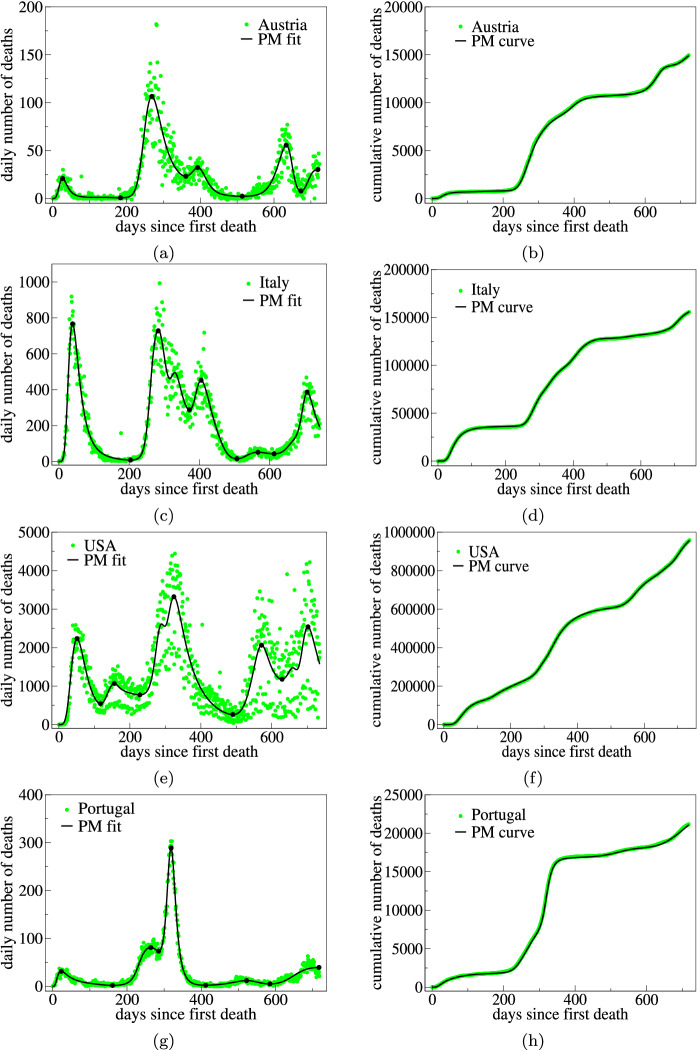
A generalized pathway model, with time-dependent parameters, is applied to describe the mortality curves of the COVID-19 disease for several countries that exhibit multiple waves of infections. The pathway approach adopted here is formulated explicitly in time, in the sense that the model's growth rate for the number of deaths or infections is written as an explicit function of time, rather than in terms of the cumulative quantity itself. This allows for a direct fit of the model to daily data (new deaths or new cases) without the need of any integration. The model is applied to COVID-19 mortality curves for ten selected countries and found to be in very good agreement with the data for all cases considered. From the fitted theoretical curves for a given location, relevant epidemiological information can be extracted, such as the starting and peak dates for each successive wave. It is argued that obtaining reliable estimates for such characteristic points is important for studying the effectiveness of interventions and the possible negative impact of their relaxation, as it allows for a direct comparison of the time of adoption/relaxation of control measures with the peaks and troughs of the epidemic curve.
一个具有随时间变化参数的广义路径模型被用于描述几个出现多波感染的国家的新冠肺炎疾病死亡率曲线。这里采用的路径方法在时间上有明确的表述,即模型中死亡人数或感染人数的增长率被写成时间的显式函数,而不是基于累积数量本身。这使得模型能够直接拟合每日数据(新增死亡或新增病例),而无需任何积分。该模型应用于十个选定国家的新冠肺炎死亡率曲线,发现与所有考虑的病例数据非常吻合。从给定地点的拟合理论曲线中,可以提取相关的流行病学信息,例如每一波疫情的起始日期和峰值日期。有人认为,获得这些特征点的可靠估计对于研究干预措施的有效性及其放松可能产生的负面影响很重要,因为它允许直接比较控制措施的采用/放松时间与疫情曲线的峰值和谷值。