Karlsruhe Institute of Technology (KIT), Institute of Nanotechnology (INT), Hermann-von-Helmholtz Platz 1, Eggenstein-Leopoldshafen 76344, Germany.
Department of Chemistry, Life Sciences and Environmental Sustainability, University of Parma, Parco Area delle Scienze 17/a, 43124 Parma, Italy.
J Am Chem Soc. 2023 Oct 25;145(42):22896-22902. doi: 10.1021/jacs.3c00393. Epub 2023 Sep 21.
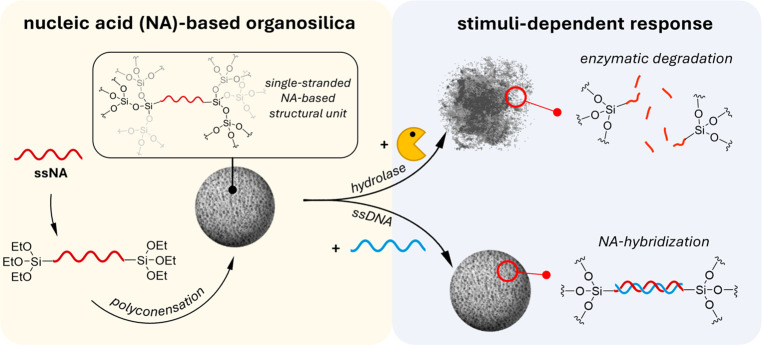
The development of smart nanoparticles (NPs) that encode responsive features in the structural framework promises to extend the applications of NP-based drugs, vaccines, and diagnostic tools. New nanocarriers would ideally consist of a minimal number of biocompatible components and exhibit multiresponsive behavior to specific biomolecules, but progress is limited by the difficulty of synthesizing suitable building blocks. Through a nature-inspired approach that combines the programmability of nucleic acid interactions and sol-gel chemistry, we report the incorporation of synthetic nucleic acids and analogs, as constitutive components, into organosilica NPs. We prepared different nanomaterials containing single-stranded nucleic acids that are covalently embedded in the silica network. Through the incorporation of functional nucleic acids into the organosilica framework, the particles respond to various biological, physical, and chemical inputs, resulting in detectable physicochemical changes. The one-step bottom-up approach used to prepare organosilica NPs provides multifunctional systems that combine the tunability of oligonucleotides with the stiffness, low cost, and biocompatibility of silica for different applications ranging from drug delivery to sensing.
智能纳米颗粒 (NPs) 的发展,在结构框架中编码响应特性,有望扩展基于 NP 的药物、疫苗和诊断工具的应用。理想情况下,新的纳米载体应由尽可能少的生物相容性成分组成,并对特定的生物分子表现出多响应行为,但由于难以合成合适的构建块,进展受到限制。通过结合核酸相互作用和溶胶-凝胶化学的可编程性的受自然启发的方法,我们报告了将合成核酸及其类似物作为组成成分掺入有机硅 NPs 中。我们制备了含有共价嵌入硅网络中的单链核酸的不同纳米材料。通过将功能核酸掺入有机硅骨架中,颗粒对各种生物、物理和化学输入做出响应,导致可检测的物理化学变化。用于制备有机硅 NPs 的一步自下而上方法提供了多功能系统,将寡核苷酸的可调性与二氧化硅的刚性、低成本和生物相容性相结合,适用于从药物输送到传感的各种应用。