Department of Statistics, Chinese University of Hong Kong, Hong Kong 999077, China.
School of Life Sciences, The Chinese University of Hong Kong, Hong Kong 999077, China.
Bioinformatics. 2023 Oct 3;39(10). doi: 10.1093/bioinformatics/btad642.
Recent rapid developments in spatial transcriptomic techniques at cellular resolution have gained increasing attention. However, the unique characteristics of large-scale cellular resolution spatial transcriptomic datasets, such as the limited number of transcripts captured per spot and the vast number of spots, pose significant challenges to current cell-type deconvolution methods.
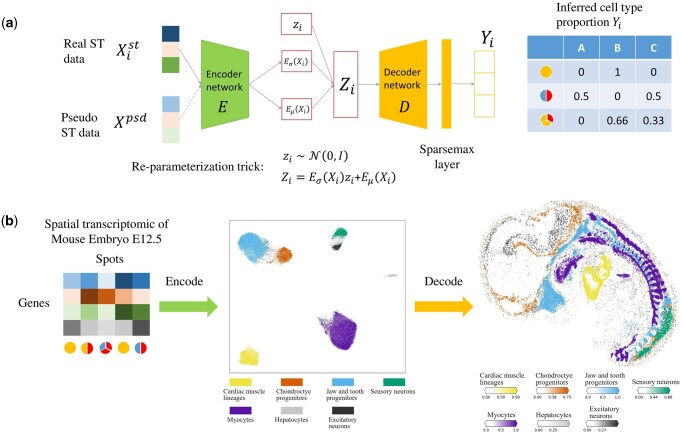
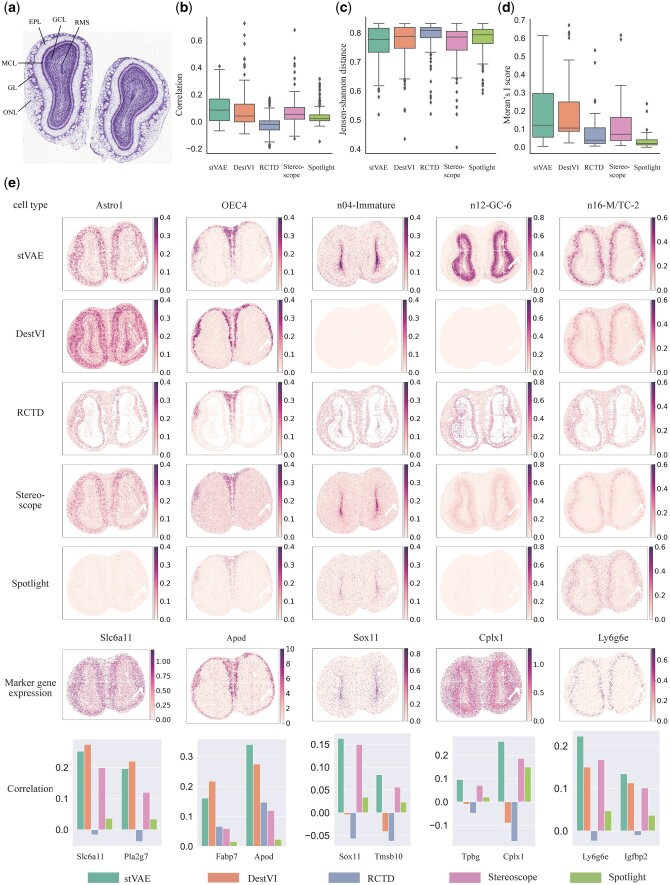
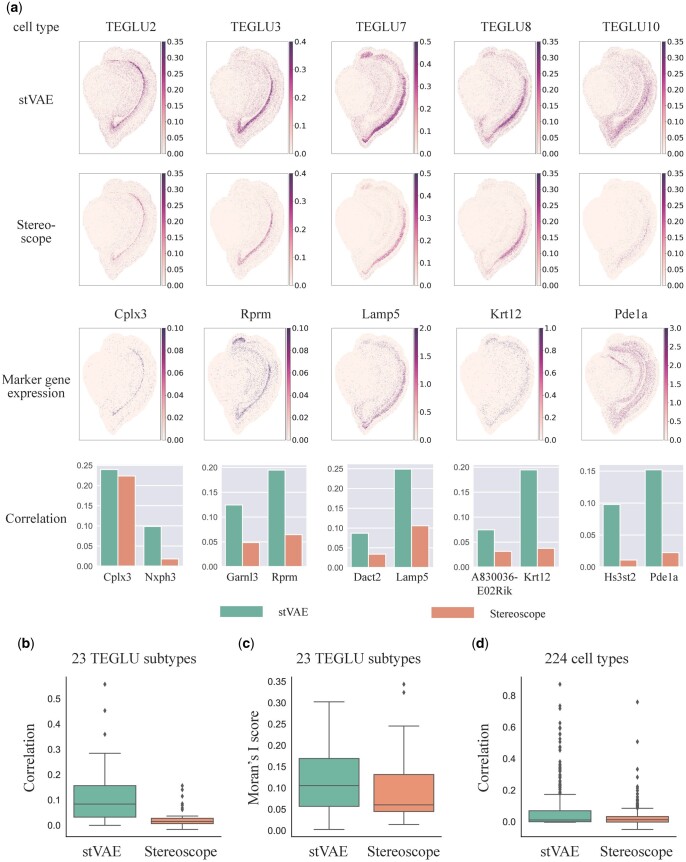
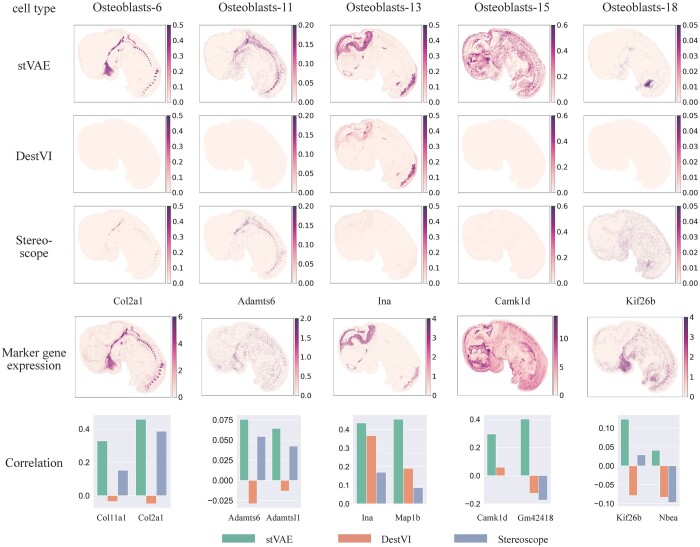
In this study, we introduce stVAE, a method based on the variational autoencoder framework to deconvolve the cell-type composition of cellular resolution spatial transcriptomic datasets. To assess the performance of stVAE, we apply it to five datasets across three different biological tissues. In the Stereo-seq and Slide-seqV2 datasets of the mouse brain, stVAE accurately reconstructs the laminar structure of the pyramidal cell layers in the cortex, which are mainly organized by the subtypes of telencephalon projecting excitatory neurons. In the Stereo-seq dataset of the E12.5 mouse embryo, stVAE resolves the complex spatial patterns of osteoblast subtypes, which are supported by their marker genes. In Stereo-seq and Pixel-seq datasets of the mouse olfactory bulb, stVAE accurately delineates the spatial distributions of known cell types. In summary, stVAE can accurately identify spatial patterns of cell types and their relative proportions across spots for cellular resolution spatial transcriptomic data. It is instrumental in understanding the heterogeneity of cell populations and their interactions within tissues.
stVAE is available in GitHub (https://github.com/lichen2018/stVAE) and Figshare (https://figshare.com/articles/software/stVAE/23254538).
最近在细胞分辨率的空间转录组技术方面的快速发展引起了越来越多的关注。然而,大规模细胞分辨率空间转录组数据集的独特特征,如每个点捕获的转录本数量有限和点的数量众多,对当前的细胞类型去卷积方法提出了重大挑战。
在这项研究中,我们引入了 stVAE,这是一种基于变分自动编码器框架的方法,用于去卷积细胞分辨率空间转录组数据集的细胞类型组成。为了评估 stVAE 的性能,我们将其应用于三个不同生物组织的五个数据集。在小鼠大脑的 Stereo-seq 和 Slide-seqV2 数据集,stVAE 准确地重建了皮质中锥体细胞层的层状结构,这些结构主要由前脑投射兴奋性神经元的亚型组织而成。在 E12.5 小鼠胚胎的 Stereo-seq 数据集,stVAE 解析了成骨细胞亚型的复杂空间模式,这些亚型由其标记基因支持。在小鼠嗅球的 Stereo-seq 和 Pixel-seq 数据集,stVAE 准确地描绘了已知细胞类型的空间分布。总之,stVAE 可以准确地识别细胞类型的空间模式及其在点之间的相对比例,适用于细胞分辨率的空间转录组数据。它对于理解细胞群体的异质性及其在组织内的相互作用具有重要意义。
stVAE 可在 GitHub(https://github.com/lichen2018/stVAE)和 Figshare(https://figshare.com/articles/software/stVAE/23254538)上获得。