Baltatu Madalina Simona, Vizureanu Petrica, Sandu Andrei Victor, Solcan Carmen, Hritcu Luminița Diana, Spataru Mihaela Claudia
Faculty of Materials Science and Engineering, "Gheorghe Asachi" Technical University of Iasi, 41 "D. Mangeron" Street, 700050 Iasi, Romania.
Technical Sciences Academy of Romania, Dacia Blvd 26, 030167 Bucharest, Romania.
Biomedicines. 2023 Nov 8;11(11):2997. doi: 10.3390/biomedicines11112997.
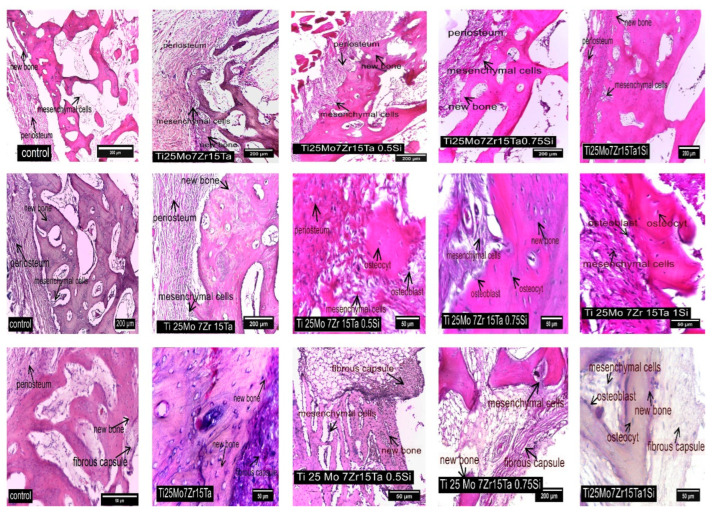
Biomaterials are currently a unique class of materials that are essential to improving the standard of human life and extending it. In the assent of the appearance of biomaterials that contain non-toxic elements, in this study, we examine a system of Ti25Mo7Zr15TaSi ( = 0, 0.5, 0.75, 1 wt.%) for future medical applications. The alloys were developed in a vacuum electric arc furnace and then studied from a structural, mechanical and in vivo assessment (on rabbits) perspective. The effect of the silicon addition was clearly seen in both the structural and the mechanical characteristics, standing out as beta alloys with a dendritic structure and lowering the mechanical properties as a result of the silicon addition. In experimental rabbits, the proliferation of mesenchymal stem cells was observed in the periosteum and peri-implant area, differentiating into osteoblasts and then into osteocytes. Osteoclasts were discovered within the cartilaginous islands that provide structural support to newly formed bone, playing a primary role in bone remodeling. The newly formed spongy tissue adhered to the fibrous capsule that surrounds the alloy, ensuring good osseointegration of metallic implants. The overexpression of Osteopontin, Metalloproteinase-2 (also known as gelatinase A), and Metallopeptidase-9 (also known as gelatinase B) underscores the processes of osteogenesis, bone mineralization, and normal bone remodeling.
生物材料是目前一类独特的材料,对于提高人类生活水平和延长寿命至关重要。随着含有无毒元素的生物材料的出现,在本研究中,我们研究了Ti25Mo7Zr15TaSi(= 0、0.5、0.75、1 wt.%)体系在未来医学应用中的情况。这些合金在真空电弧炉中制备,然后从结构、力学和体内评估(对兔子)的角度进行研究。硅添加的影响在结构和力学特性方面都清晰可见,表现为具有树枝状结构的β合金,并且由于硅的添加导致力学性能下降。在实验兔子中,观察到间充质干细胞在骨膜和种植体周围区域增殖,分化为成骨细胞,然后再分化为骨细胞。在为新形成的骨骼提供结构支持的软骨岛内发现了破骨细胞,其在骨重塑中起主要作用。新形成的海绵状组织附着在围绕合金的纤维囊上,确保金属植入物具有良好的骨整合。骨桥蛋白、金属蛋白酶 -2(也称为明胶酶A)和金属肽酶 -9(也称为明胶酶B)的过表达突出了骨生成、骨矿化和正常骨重塑的过程。