Department of Science and Technology, Affiliated Hospital of Nanjing University of Chinese Medicine, Nanjing, China.
Department of Gastroenterology, Nanjing University of Chinese Medicine, Nanjing, Jiangsu, China.
BMJ Open. 2024 Mar 7;14(3):e074659. doi: 10.1136/bmjopen-2023-074659.
Patients with inflammatory bowel disease (IBD) may experience comorbidities involving metabolic syndrome (MetS). However, this association remains controversial. Our objective was to estimate the prevalence of MetS in patients with IBD and assess whether MetS is more strongly associated with ulcerative colitis (UC) or Crohn's disease (CD).
Systematic review and meta-analysis.
PubMed, Cochrane Library, Web of Science, EMBASE and MEDLINE were searched from their inception to July 2022.
Observational studies reporting data regarding the rate of comorbid MetS among patients with IBD and published in English.
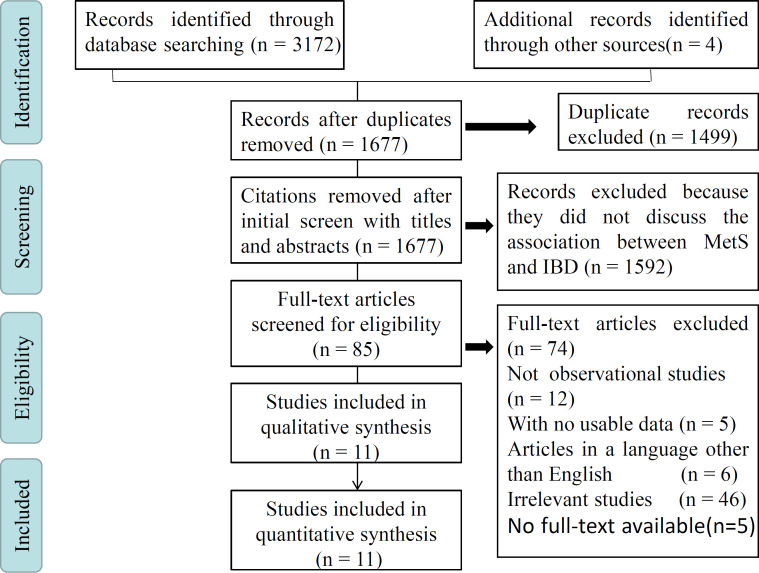
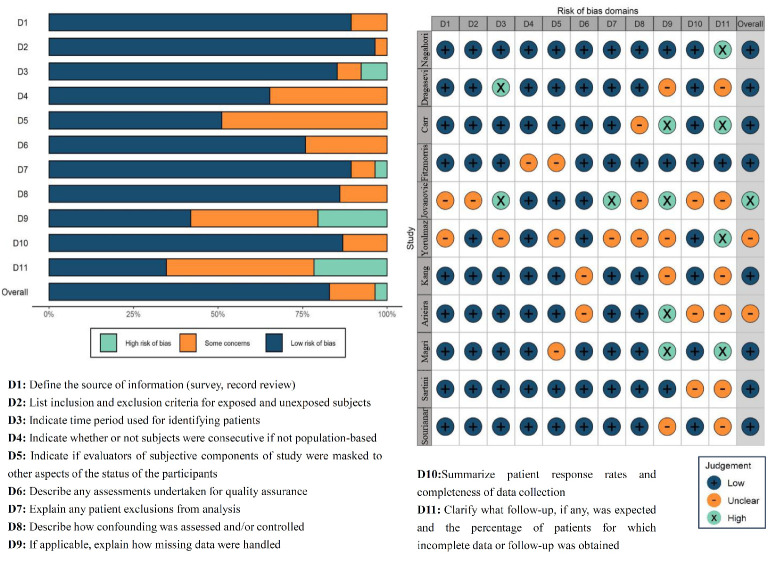
The Preferred Reporting Items for Systematic Reviews and Meta-Analyses and the Meta-analysis of Observational Studies in Epidemiology reporting guidelines were followed. Pooled prevalence, ORs and 95% CIs were calculated using random-effects models. The Newcastle-Ottawa Scale and the Agency for Healthcare Research and Quality checklist were used. Heterogeneity, sensitivity and stratified analyses were performed using R (V.4.2.1).
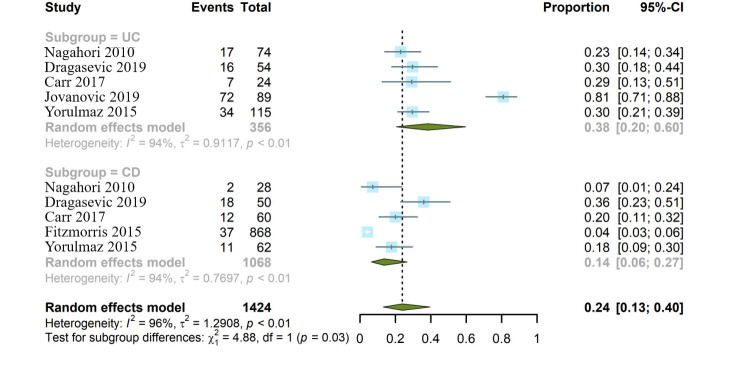
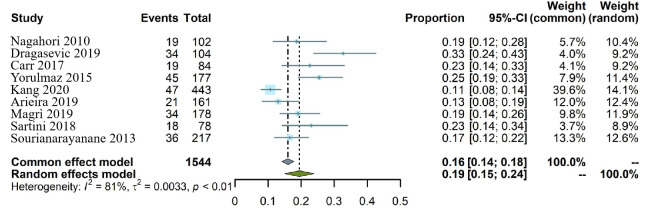
11 eligible studies involving 2501 patients were included. Of these studies, four reported MetS prevalence separately by IBD phenotype, and only one contained a non-IBD comparison group. Overall, the methodological quality of the included studies was moderate. The pooled prevalence of MetS in IBD was 19.4% (95% CI 15.1% to 23.8%), with a moderate heterogeneity (I=51.8%, Cochrane Q statistic=12.4, p=0.053). Stratified analyses demonstrated that the aggregate estimate of comorbid MetS was significantly higher in UC than in CD (38.2% vs 13.6%, χ=4.88, p=0.03). We found a positive association between MetS and UC compared with CD (OR=2.11, 95% CI 1.19 to 3.74, p=0.01). Additionally, four studies identified that higher age was a risk factor associated with the development of MetS.
MetS is not rare in IBD, especially in UC. However, longitudinal studies are needed to further clarify the relationship between IBD and MetS.
CRD42022346340.
炎症性肠病(IBD)患者可能会出现涉及代谢综合征(MetS)的合并症。然而,这种关联仍存在争议。我们的目的是估计 IBD 患者中 MetS 的患病率,并评估 MetS 是否与溃疡性结肠炎(UC)或克罗恩病(CD)的相关性更强。
系统评价和荟萃分析。
从成立到 2022 年 7 月,检索了 PubMed、Cochrane 图书馆、Web of Science、EMBASE 和 MEDLINE。
报告 IBD 患者合并 MetS 发生率数据的观察性研究,并以英文发表。
遵循系统评价和荟萃分析的首选报告项目以及观察性研究的荟萃分析流行病学报告指南。使用随机效应模型计算汇总患病率、OR 和 95%CI。使用纽卡斯尔-渥太华量表和医疗保健研究和质量评估清单。使用 R(V.4.2.1)进行异质性、敏感性和分层分析。
纳入了 11 项涉及 2501 名患者的合格研究。其中,4 项研究分别报告了 IBD 表型的 MetS 患病率,仅有 1 项研究包含非 IBD 对照组。总体而言,纳入研究的方法学质量为中等。IBD 患者的 MetS 总患病率为 19.4%(95%CI 15.1%至 23.8%),异质性较大(I=51.8%,Cochrane Q 统计量=12.4,p=0.053)。分层分析表明,UC 患者合并 MetS 的综合估计值明显高于 CD(38.2%比 13.6%,χ=4.88,p=0.03)。我们发现 MetS 与 UC 之间存在正相关,而与 CD 之间则没有(OR=2.11,95%CI 1.19 至 3.74,p=0.01)。此外,有 4 项研究确定,年龄较高是与 MetS 发展相关的一个危险因素。
MetS 在 IBD 中并不罕见,尤其是在 UC 中。然而,需要进行纵向研究以进一步阐明 IBD 和 MetS 之间的关系。
PROSPERO 注册号:CRD42022346340。