Hwang Stephen W, Tram Carolyn Q N, Knarr Nadia
Centre for Research on Inner City Health, St. Michael's Hospital, Toronto, Ontario, Canada.
BMC Fam Pract. 2005 Jun 16;6(1):26. doi: 10.1186/1471-2296-6-26.
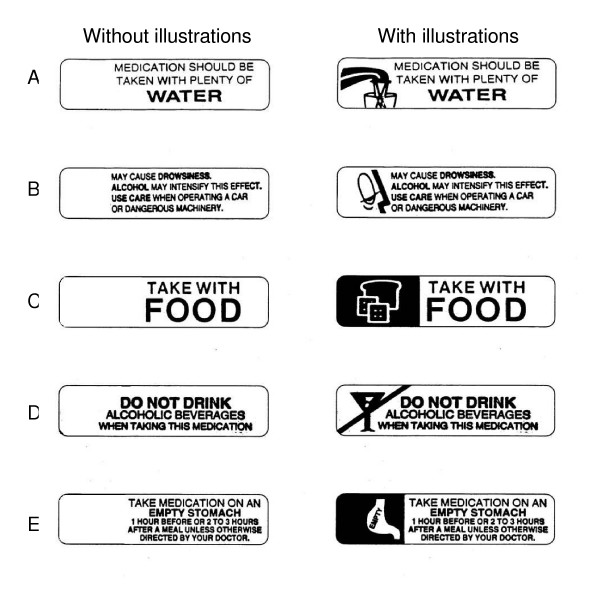
Labels with special instructions regarding how a prescription medication should be taken or its possible side effects are often applied to pill bottles. The goal of this study was to determine whether the addition of illustrations to these labels affects patient comprehension.
Study participants (N = 130) were enrolled by approaching patients at three family practice clinics in Toronto, Canada. Participants were asked to interpret two sets of medication instruction labels, the first with text only and the second with the same text accompanied by illustrations. Two investigators coded participants' responses as incorrect, partially correct, or completely correct. Health literacy levels of participants were measured using a validated instrument, the REALM test.
All participants gave a completely correct interpretation for three out of five instruction labels, regardless of whether illustrations were present or not. For the two most complex labels, only 34-55% of interpretations of the text-only version were completely correct. The addition of illustrations was associated with improved performance in 5-7% of subjects and worsened performance in 7-9% of subjects.
The commonly-used illustrations on the medication labels used in this study were of little or no use in improving patients' comprehension of the accompanying written instructions.
关于处方药服用方法或其可能的副作用的特殊说明标签通常贴在药瓶上。本研究的目的是确定在这些标签上添加插图是否会影响患者的理解。
通过在加拿大多伦多的三家家庭诊所接触患者招募研究参与者(N = 130)。要求参与者解读两组用药说明标签,第一组只有文字,第二组有相同文字并配有插图。两名研究人员将参与者的回答编码为不正确、部分正确或完全正确。使用经过验证的工具REALM测试来测量参与者的健康素养水平。
所有参与者对五个说明标签中的三个给出了完全正确的解读,无论是否有插图。对于两个最复杂的标签,仅文字版本的解读中只有34 - 55%是完全正确的。添加插图使5 - 7%的受试者表现有所改善,而7 - 9%的受试者表现变差。
本研究中使用的药瓶标签上的常用插图对提高患者对附带书面说明的理解几乎没有作用或根本没有作用。