Division of Psychosocial Research and Epidemiology, The Netherlands Cancer Institute, Amsterdam, The Netherlands.
Health Qual Life Outcomes. 2010 Mar 30;8:35. doi: 10.1186/1477-7525-8-35.
While modern electronic data collection methods (e.g., computer touch-screen or web-based) hold much promise, most current studies continue to make use of more traditional data collection techniques, including paper-and-pencil administration and telephone interviews. The present randomized trial investigated the measurement properties of the EORTC QLQ-C30 under three different modes of administration (MOA's).
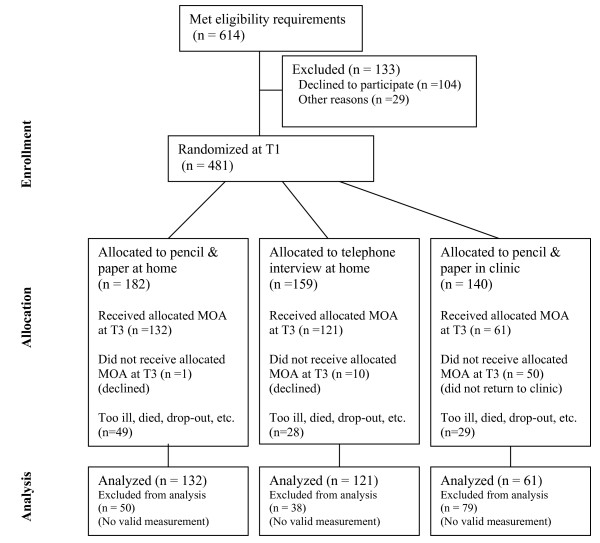
A heterogeneous sample of 314 cancer patients undergoing treatment at a specialized treatment center in Amsterdam were randomized to one of three MOA's for the QLQ-C30: paper-and-pencil at home via the mail, telephone interview, and paper-and-pencil at the hospital clinic. Group differences in internal consistency reliabilities (Cronbach's alpha coefficient) for the scale scores were compared. Differences in mean scale scores were also compared by means of ANOVA, with adjustment for potential confounders.
Only one statistically significant, yet minor, difference in Cronbach's alpha between the MOA groups was observed for the Role Functioning scale (all 3 alphas >0.80). Significant differences in group means -after adjustment- were found for the Emotional Functioning (EF) scale. Patients completing the written questionnaire at home had significantly lower levels of EF as compared to those interviewed via the telephone; EF scores of those completing the questionnaire at the clinic fell in-between those of the other two groups. These differences, however, were small in magnitude.
MOA had little effect on the reliability or the mean scores of the EORTC QLQ-C30, with the possible exception of the EF scale.
虽然现代电子数据采集方法(例如计算机触摸屏或基于网络的方法)具有很大的优势,但大多数当前的研究仍然使用更传统的数据采集技术,包括纸笔管理和电话访谈。本随机试验研究了 EORTC QLQ-C30 在三种不同管理模式(MOA)下的测量特性。
阿姆斯特丹一家专门治疗中心接受治疗的 314 名癌症患者被随机分配到三种 QLQ-C30 的 MOA 之一:通过邮件在家填写纸质问卷、电话访谈和在医院诊所填写纸质问卷。比较了量表得分的内部一致性信度(Cronbach's alpha 系数)的组间差异。通过方差分析比较了平均量表得分的差异,并对潜在的混杂因素进行了调整。
仅在角色功能量表(所有 3 个 alpha 值均>0.80)中观察到 MOA 组之间 Cronbach's alpha 略有统计学差异。在调整后,情感功能(EF)量表的组间均值存在显著差异。在家填写书面问卷的患者的 EF 水平明显低于通过电话访谈的患者;在诊所完成问卷的患者的 EF 评分介于其他两组之间。然而,这些差异的幅度很小。
MOA 对 EORTC QLQ-C30 的可靠性或平均得分影响不大,EF 量表除外。