The Wellcome Trust Centre for Neuroimaging, Institute of Neurology, University College London, London, UK.
Neuroimage. 2011 Jun 1;56(3):1202-21. doi: 10.1016/j.neuroimage.2010.12.039. Epub 2010 Dec 21.
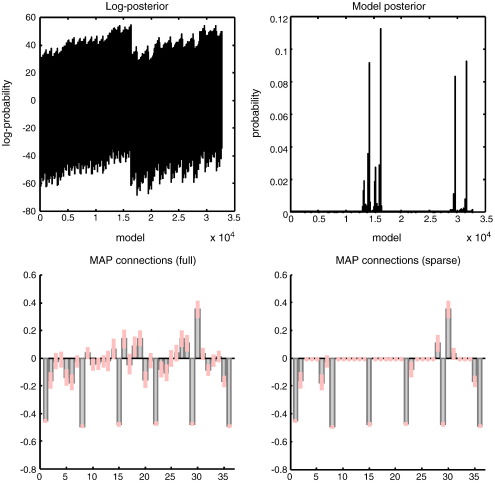
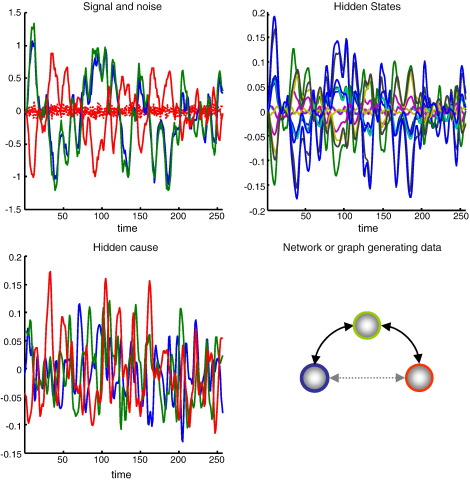
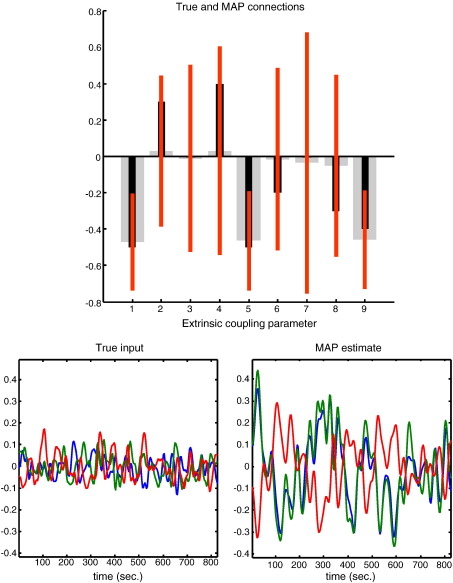
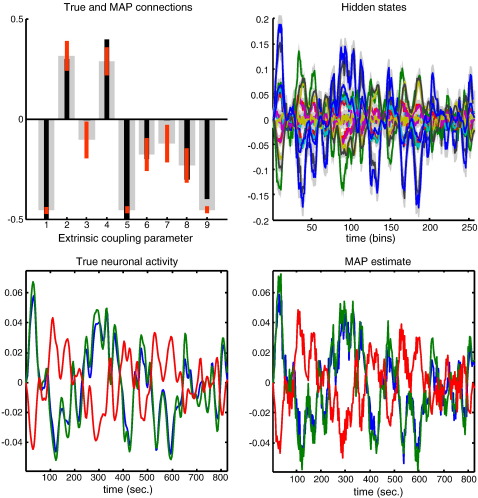
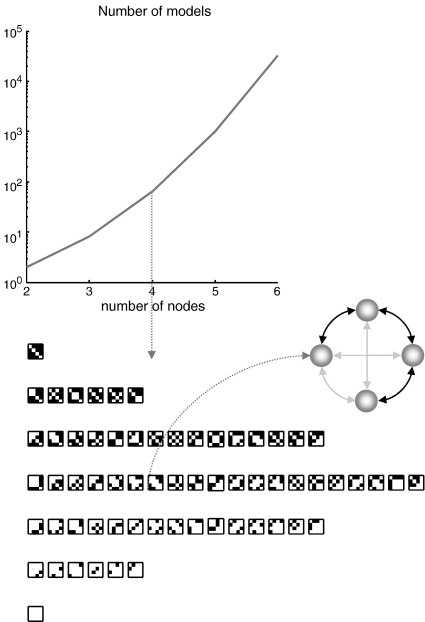
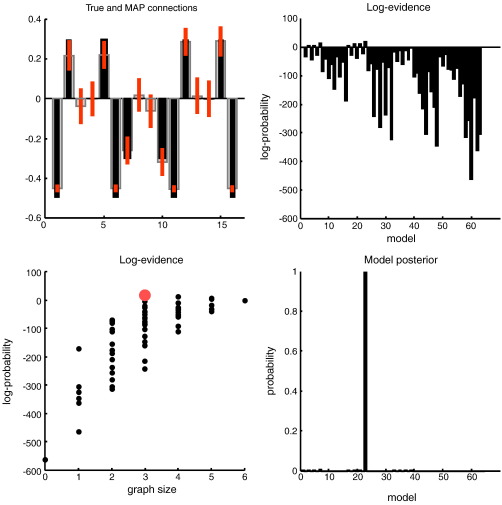
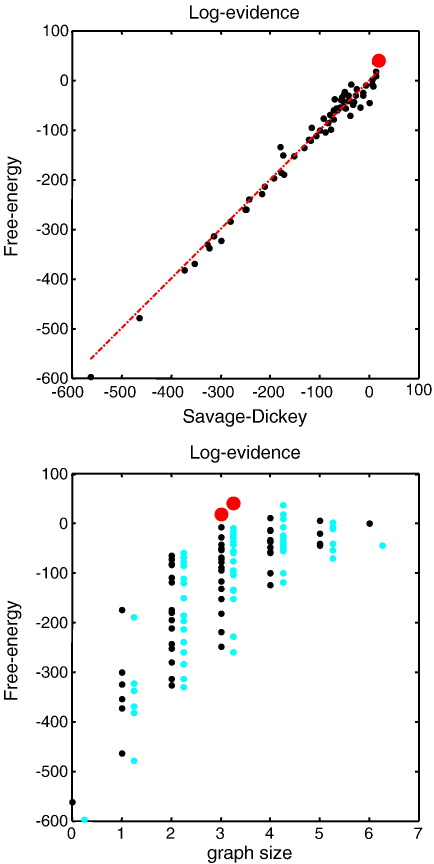
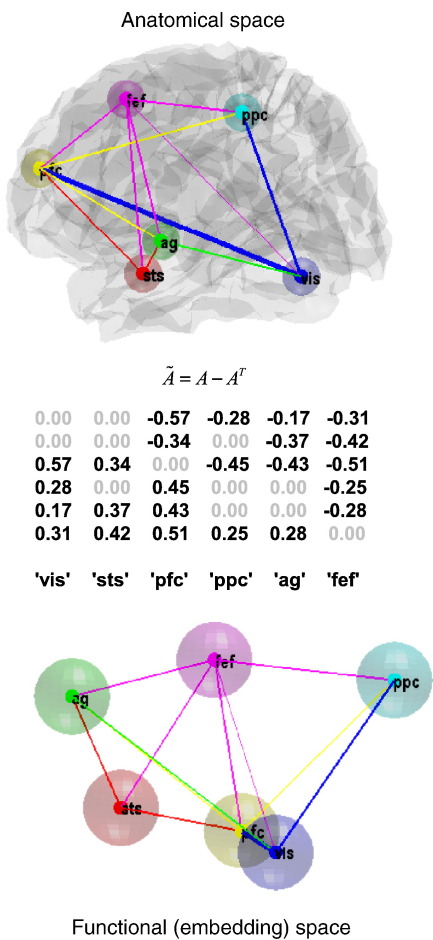
This paper is about inferring or discovering the functional architecture of distributed systems using Dynamic Causal Modelling (DCM). We describe a scheme that recovers the (dynamic) Bayesian dependency graph (connections in a network) using observed network activity. This network discovery uses Bayesian model selection to identify the sparsity structure (absence of edges or connections) in a graph that best explains observed time-series. The implicit adjacency matrix specifies the form of the network (e.g., cyclic or acyclic) and its graph-theoretical attributes (e.g., degree distribution). The scheme is illustrated using functional magnetic resonance imaging (fMRI) time series to discover functional brain networks. Crucially, it can be applied to experimentally evoked responses (activation studies) or endogenous activity in task-free (resting state) fMRI studies. Unlike conventional approaches to network discovery, DCM permits the analysis of directed and cyclic graphs. Furthermore, it eschews (implausible) Markovian assumptions about the serial independence of random fluctuations. The scheme furnishes a network description of distributed activity in the brain that is optimal in the sense of having the greatest conditional probability, relative to other networks. The networks are characterised in terms of their connectivity or adjacency matrices and conditional distributions over the directed (and reciprocal) effective connectivity between connected nodes or regions. We envisage that this approach will provide a useful complement to current analyses of functional connectivity for both activation and resting-state studies.
本文旨在使用动态因果建模(DCM)推断或发现分布式系统的功能架构。我们描述了一种使用观测到的网络活动来恢复(动态)贝叶斯依赖图(网络中的连接)的方案。这种网络发现使用贝叶斯模型选择来识别最佳解释观测到的时间序列的稀疏结构(无边缘或连接)。隐式邻接矩阵指定了网络的形式(例如,循环或非循环)及其图论属性(例如,度分布)。该方案使用功能磁共振成像(fMRI)时间序列来发现功能脑网络。至关重要的是,它可以应用于实验诱发的反应(激活研究)或无任务(静息状态) fMRI 研究中的内源性活动。与传统的网络发现方法不同,DCM 允许分析有向和循环图。此外,它避免了关于随机波动序列独立性的(不合理)马尔可夫假设。该方案提供了大脑中分布式活动的网络描述,相对于其他网络,它具有最大的条件概率,是最优的。网络的特征在于它们的连接性或邻接矩阵以及连接节点或区域之间有向(和互惠)有效连接的条件分布。我们设想,这种方法将为激活和静息状态研究的功能连接的当前分析提供有用的补充。