Department of Psychology, Pennsylvania State University, University Park PA, USA ; Center for Language Science, Pennsylvania State University, University Park PA, USA.
Front Psychol. 2013 May 30;4:278. doi: 10.3389/fpsyg.2013.00278. eCollection 2013.
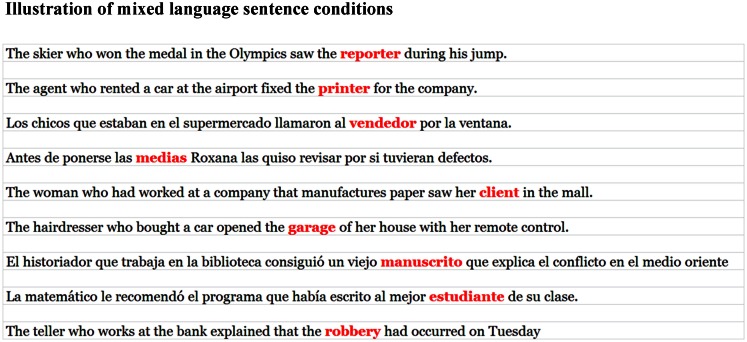
We report two experiments that investigate the effects of sentence context on bilingual lexical access in Spanish and English. Highly proficient Spanish-English bilinguals read sentences in Spanish and English that included a marked word to be named. The word was either a cognate with similar orthography and/or phonology in the two languages, or a matched non-cognate control. Sentences appeared in one language alone (i.e., Spanish or English) and target words were not predictable on the basis of the preceding semantic context. In Experiment 1, we mixed the language of the sentence within a block such that sentences appeared in an alternating run in Spanish or in English. These conditions partly resemble normally occurring inter-sentential code-switching. In these mixed-language sequences, cognates were named faster than non-cognates in both languages. There were no effects of switching the language of the sentence. In Experiment 2, with Spanish-English bilinguals matched closely to those who participated in the first experiment, we blocked the language of the sentences to encourage language-specific processes. The results were virtually identical to those of the mixed-language experiment. In both cases, target cognates were named faster than non-cognates, and the magnitude of the effect did not change according to the broader context. Taken together, the results support the predictions of the Bilingual Interactive Activation + Model (Dijkstra and van Heuven, 2002) in demonstrating that bilingual lexical access is language non-selective even under conditions in which language-specific cues should enable selective processing. They also demonstrate that, in contrast to lexical switching from one language to the other, inter-sentential code-switching of the sort in which bilinguals frequently engage, imposes no significant costs to lexical processing.
我们报告了两项实验,旨在研究句子语境对西班牙语和英语双语词汇通达的影响。高度熟练的西班牙语-英语双语者阅读西班牙语和英语句子,其中包含一个需要命名的标记词。该词在两种语言中的拼写和/或发音相似,为同形词,或者是匹配的非同形词对照。句子单独出现在一种语言中(即西班牙语或英语),目标词不能根据前面的语义语境进行预测。在实验 1 中,我们在一个块内混合句子的语言,使得句子以西班牙语或英语交替出现。这些条件部分类似于正常发生的句子间代码转换。在这些混合语言序列中,同形词在两种语言中都比非同形词命名更快。句子语言的转换没有影响。在实验 2 中,我们使用与参与第一个实验的双语者相匹配的西班牙语-英语双语者,将句子的语言分组,以鼓励语言特定的处理。结果几乎与混合语言实验相同。在这两种情况下,目标同形词的命名速度都快于非同形词,并且该效应的大小不会根据更广泛的语境而改变。总的来说,这些结果支持双语交互激活+模型(Dijkstra 和 van Heuven,2002)的预测,表明双语词汇通达是语言非选择性的,即使在语言特定线索应该能够进行选择性处理的情况下也是如此。它们还表明,与从一种语言到另一种语言的词汇转换相反,双语者经常进行的那种句子间的代码转换,不会给词汇处理带来显著的成本。