Ahmadizenouz Ghazaleh, Esmaeili Behnaz, Taghvaei Arnica, Jamali Zahra, Jafari Toloo, Amiri Daneshvar Farshid, Khafri Soraya
Assistant Professor, Department of Operative Dentistry, Faculty of Dentistry, Babol University of Medical Sciences, Babol, Iran.
Dental Student, Faculty of Dentistry, Babol University of Medical Sciences, Babol, Iran.
J Dent Res Dent Clin Dent Prospects. 2016 Winter;10(1):9-16. doi: 10.15171/joddd.2016.002. Epub 2016 Mar 16.
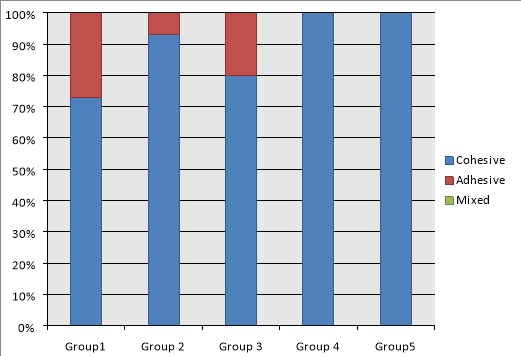
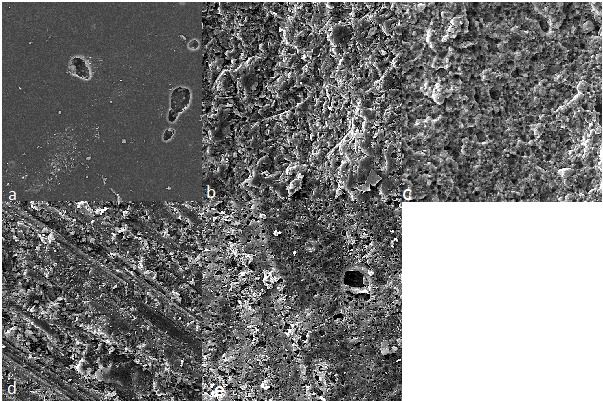
Background. Repairing aged composite resin is a challenging process. Many surface treatment options have been proposed to this end. This study evaluated the effect of different surface treatments on the shear bond strength (SBS) of nano-filled composite resin repairs. Methods. Seventy-five cylindrical specimens of a Filtek Z350XT composite resin were fabricated and stored in 37°C distilled water for 24 hours. After thermocycling, the specimens were divided into 5 groups according to the following surface treatments: no treatment (group 1); air abrasion with 50-μm aluminum oxide particles (group 2); irradiation with Er:YAG laser beams (group 3); roughening with coarse-grit diamond bur + 35% phosphoric acid (group 4); and etching with 9% hydrofluoric acid for 120 s (group 5). Another group of Filtek Z350XT composite resin samples (4×6 mm) was fabricated for the measurement of cohesive strength (group 6). A silane coupling agent and an adhesive system were applied after each surface treatment. The specimens were restored with the same composite resin and thermocycled again. A shearing force was applied to the interface in a universal testing machine. Data were analyzed using one-way ANOVA and post hoc Tukey tests (P < 0.05). Results. One-way ANOVA indicated significant differences between the groups (P < 0.05). SBS of controls was significantly lower than the other groups; differences between groups 2, 3, 4, 5 and 6 were not significant. Surface treatment with diamond bur + 35% phosphoric acid resulted in the highest bond strength. Conclusion. All the surface treatments used in this study improved the shear bond strength of nanofilled composite resin used.
背景。修复老化的复合树脂是一个具有挑战性的过程。为此已经提出了许多表面处理方法。本研究评估了不同表面处理对纳米填充复合树脂修复体剪切粘结强度(SBS)的影响。方法。制备75个Filtek Z350XT复合树脂圆柱形试件,并在37°C蒸馏水中储存24小时。热循环后,根据以下表面处理将试件分为5组:不处理(第1组);用50μm氧化铝颗粒进行空气喷砂(第2组);用Er:YAG激光束照射(第3组);用粗粒度金刚石车针打磨 + 35%磷酸处理(第4组);用9%氢氟酸蚀刻120秒(第5组)。制备另一组Filtek Z350XT复合树脂样品(4×6 mm)用于测量内聚强度(第6组)。每次表面处理后应用硅烷偶联剂和粘结系统。用相同的复合树脂修复试件并再次进行热循环。在万能试验机中对界面施加剪切力。使用单因素方差分析和事后Tukey检验分析数据(P < 0.05)。结果。单因素方差分析表明各组之间存在显著差异(P < 0.05)。对照组的SBS显著低于其他组;第2、3、4、5组和第6组之间的差异不显著。用金刚石车针 + 35%磷酸进行表面处理产生了最高的粘结强度。结论。本研究中使用的所有表面处理均提高了所用纳米填充复合树脂的剪切粘结强度。