Li Zheng, Commodore Adwoa, Hartinger Stella, Lewin Michael, Sjödin Andreas, Pittman Erin, Trinidad Debra, Hubbard Kendra, Lanata Claudio F, Gil Ana I, Mäusezahl Daniel, Naeher Luke P
Centers for Disease Control and Prevention, National Center for Environmental Health, Atlanta, USA; Agency for Toxic Substances and Disease Registry, Division of Toxicology and Human Health Sciences, Atlanta, USA.
Medical University of South Carolina, Charleston, USA.
Environ Int. 2016 Dec;97:195-203. doi: 10.1016/j.envint.2016.09.011. Epub 2016 Sep 24.
Household air pollution (HAP) from indoor biomass stoves contains harmful pollutants, such as polycyclic aromatic hydrocarbons (PAHs), and is a leading risk factor for global disease burden. We used biomonitoring to assess HAP exposure and association with self-reported symptoms in 334 non-smoking Peruvian women to evaluate the efficacy of a stove intervention program.
We conducted a cross-sectional study within the framework of a community randomized control trial. Using urinary PAH metabolites (OH-PAHs) as the exposure biomarkers, we investigated whether the intervention group (n=155, with new chimney-equipped stoves) were less exposed to HAP compared to the control group (n=179, with mostly open-fire stoves). We also estimated associations between the exposure biomarkers, risk factors, and self-reported health symptoms, such as recent eye conditions, respiratory conditions, and headache.
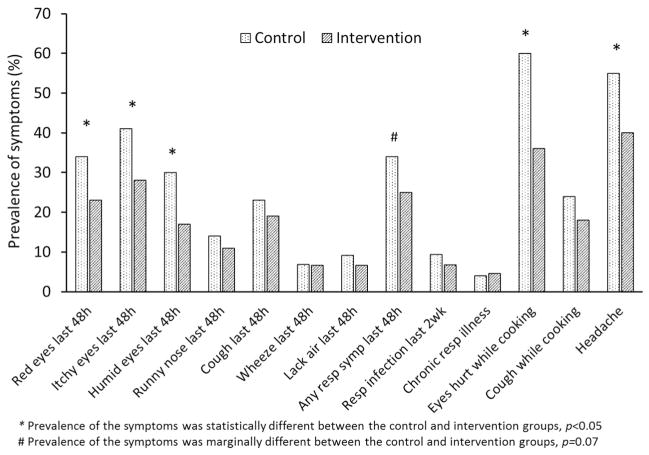
We observed reduced headache and ocular symptoms in the intervention group than the control group. Urinary 2-naphthol, a suggested biomarker for inhalation PAH exposure, was significantly lower in the intervention group (GM with 95% CI: 13.4 [12.3, 14.6] μg/g creatinine) compared to control group (16.5 [15.0, 18.0] μg/g creatinine). Stove type and/or 2-naphthol was associated with a number of self-reported symptoms, such as red eye (adjusted OR with 95% CI: 3.80 [1.32, 10.9]) in the past 48h.
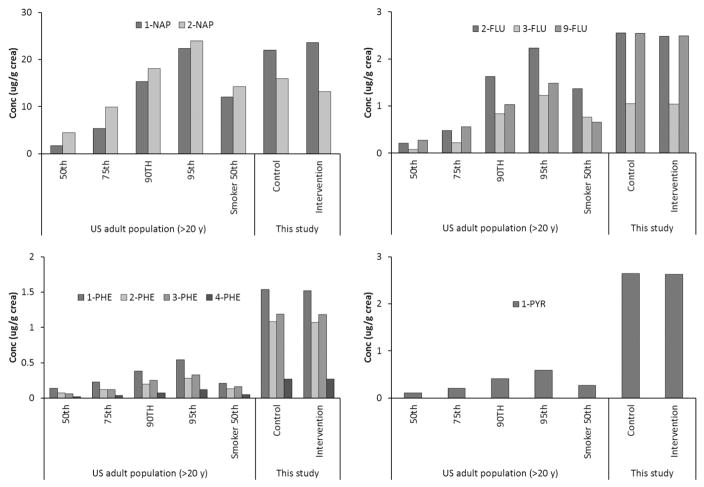
Even with the improved stoves, the biomarker concentrations in this study far exceeded those of the general populations and were higher than a no-observed-genotoxic-effect-level, indicating high exposure and a potential for increased cancer risk in the population.
室内生物质炉灶产生的家庭空气污染(HAP)含有多环芳烃(PAHs)等有害污染物,是全球疾病负担的主要风险因素。我们采用生物监测方法评估了334名不吸烟的秘鲁女性的HAP暴露情况及其与自我报告症状的关联,以评估炉灶干预项目的效果。
我们在一项社区随机对照试验的框架内进行了一项横断面研究。以尿中PAH代谢物(OH-PAHs)作为暴露生物标志物,我们调查了干预组(n = 155,使用新的带烟囱炉灶)与对照组(n = 179,大多使用明火炉灶)相比,HAP暴露是否更低。我们还估计了暴露生物标志物、风险因素与自我报告的健康症状之间的关联,如近期眼部状况、呼吸道状况和头痛。
我们观察到干预组的头痛和眼部症状比对照组有所减轻。尿中2-萘酚是吸入性PAH暴露的一种建议生物标志物,干预组(几何均值及其95%置信区间:13.4 [12.3, 14.6] μg/g肌酐)显著低于对照组(16.5 [15.0, 18.0] μg/g肌酐)。炉灶类型和/或2-萘酚与一些自我报告的症状相关,如过去48小时内出现红眼(校正比值比及其95%置信区间:3.80 [1.32, 10.9])。
即使使用了改良炉灶,本研究中的生物标志物浓度仍远远超过一般人群,且高于无观察到遗传毒性效应水平,表明该人群暴露水平高且存在癌症风险增加的可能性。