Sports Science School of Rio Maior-Polytechnic Institute of Santarém, Rio Maior, Portugal.
Research Centre in Sport Sciences, Health Sciences and Human Development, Vila Real, Portugal.
PLoS One. 2019 Apr 22;14(4):e0209393. doi: 10.1371/journal.pone.0209393. eCollection 2019.
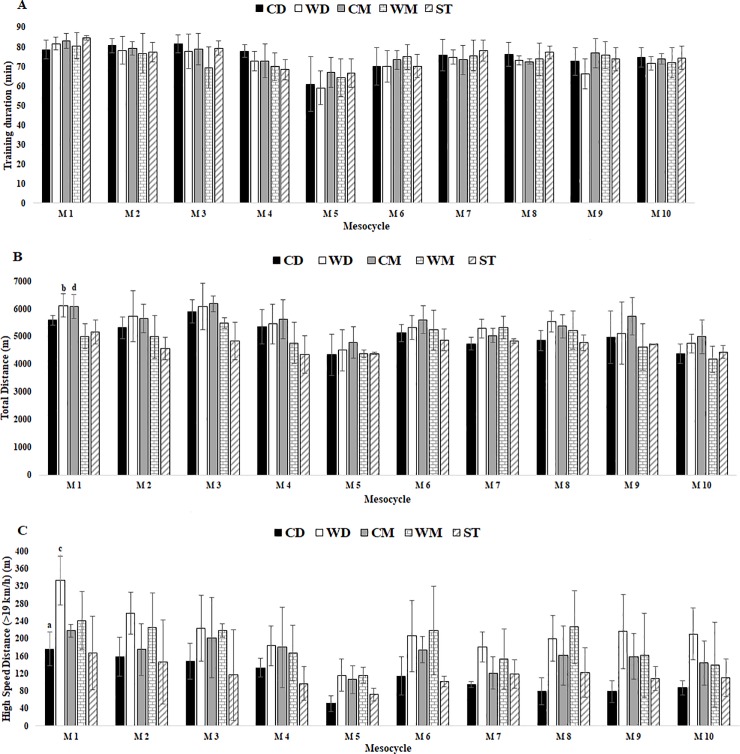
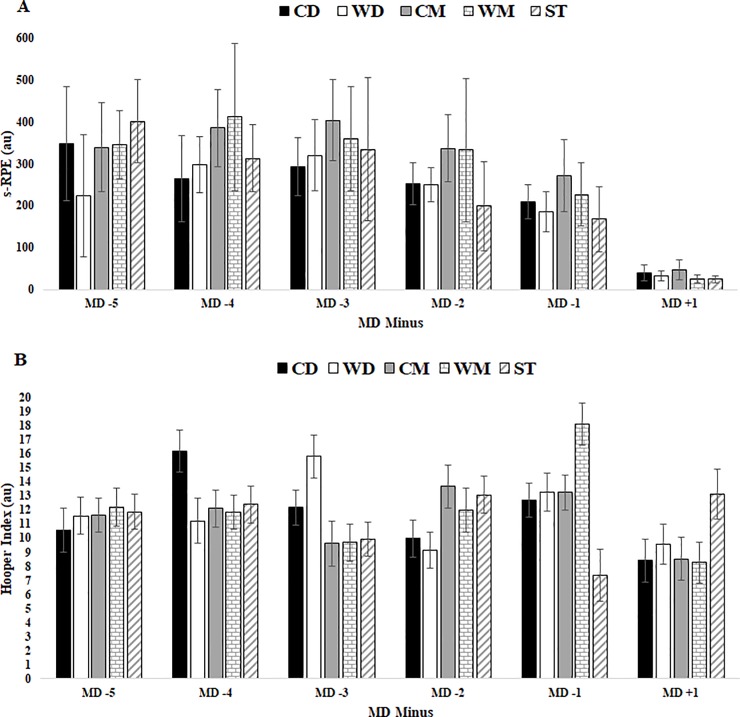
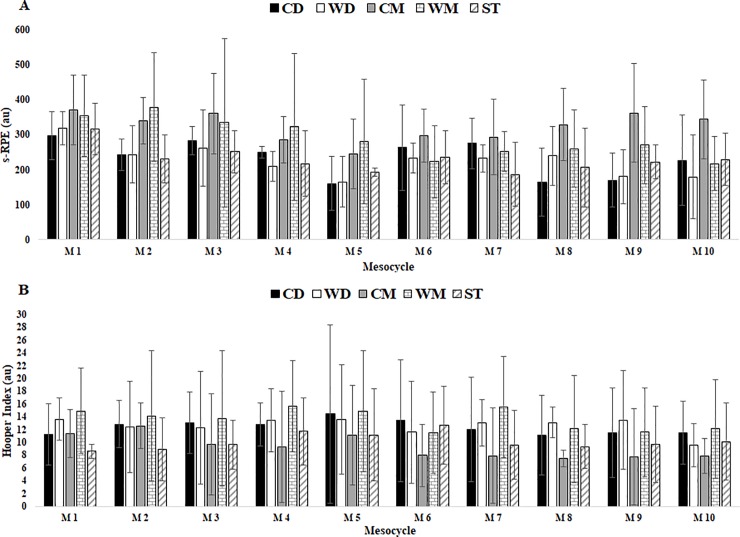
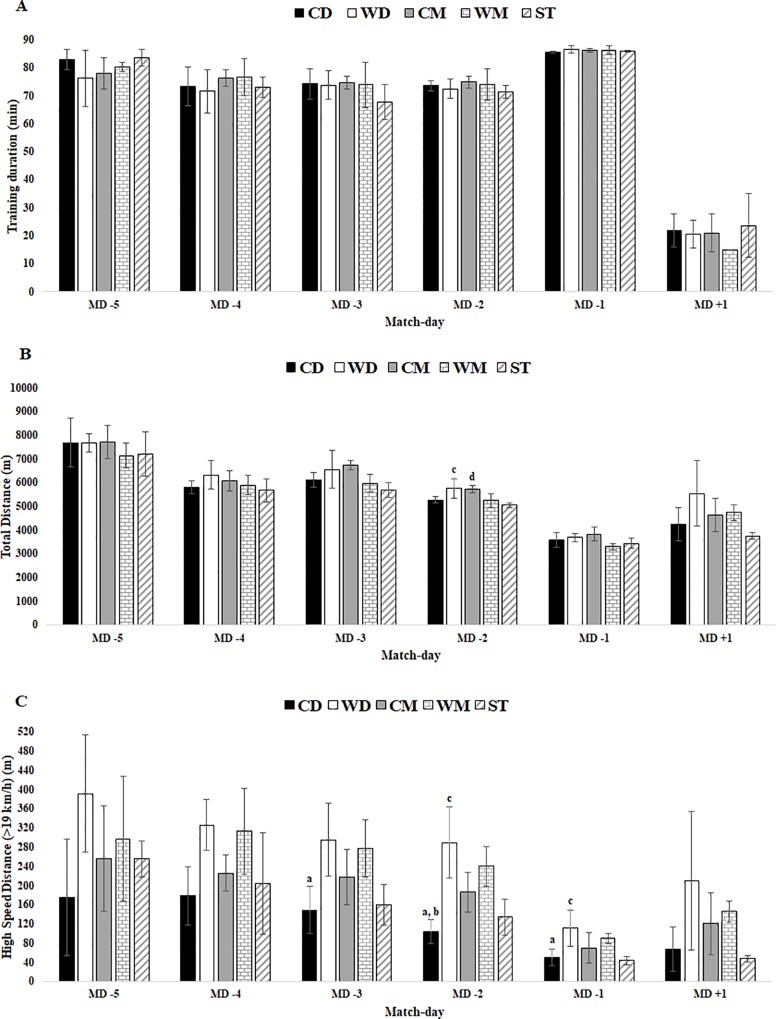
Elite soccer teams that participate in European competitions need to have players in the best physical and psychological status possible to play matches. As a consequence of congestive schedule, controlling the training load (TL) and thus the level of effort and fatigue of players to reach higher performances during the matches is therefore critical. Therefore, the aim of the current study was to provide the first report of seasonal internal and external training load that included Hooper Index (HI) scores in elite soccer players during an in-season period. Nineteen elite soccer players were sampled, using global position system to collect total distance, high-speed distance (HSD) and average speed (AvS). It was also collected session rating of perceived exertion (s-RPE) and HI scores during the daily training sessions throughout the 2015-2016 in-season period. Data were analysed across ten mesocycles (M: 1 to 10) and collected according to the number of days prior to a one-match week. Total daily distance covered was higher at the start (M1 and M3) compared to the final mesocycle (M10) of the season. M1 (5589m) reached a greater distance than M5 (4473m) (ES = 9.33 [12.70, 5.95]) and M10 (4545m) (ES = 9.84 [13.39, 6.29]). M3 (5691m) reached a greater distance than M5 (ES = 9.07 [12.36, 5.78]), M7 (ES = 6.13 [8.48, 3.79]) and M10 (ES = 9.37 [12.76, 5.98]). High-speed running distance was greater in M1 (227m), than M5 (92m) (ES = 27.95 [37.68, 18.22]) and M10 (138m) (ES = 8.46 [11.55, 5.37]). Interestingly, the s-RPE response was higher in M1 (331au) in comparison to the last mesocycle (M10, 239au). HI showed minor variations across mesocycles and in days prior to the match. Every day prior to a match, all internal and external TL variables expressed significant lower values to other days prior to a match (p<0.01). In general, there were no differences between player positions. Conclusions: Our results reveal that despite the existence of some significant differences between mesocycles, there were minor changes across the in-season period for the internal and external TL variables used. Furthermore, it was observed that MD-1 presented a reduction of external TL (regardless of mesocycle) while internal TL variables did not have the same record during in-season match-day-minus.
参加欧洲比赛的精英足球队需要球员保持最佳的身体和心理状态,以便参加比赛。由于比赛日程紧张,控制训练负荷(TL),从而控制球员的努力程度和疲劳程度,以在比赛中取得更高的成绩,因此至关重要。因此,本研究的目的是首次报告在赛季期间,包括精英足球运动员 Hooper 指数(HI)得分在内的季节性内部和外部训练负荷。使用全球定位系统收集总距离、高速距离(HSD)和平均速度(AvS),对 19 名精英足球运动员进行了采样。在整个 2015-2016 赛季的日常训练中,还记录了会话感知用力评分(s-RPE)和 HI 得分。数据跨 10 个中周期(M:1 至 10)进行分析,并根据距离下一比赛周的天数进行收集。与赛季的最后一个中周期(M10)相比,赛季开始时(M1 和 M3)的总日距离更高。M1(5589m)的距离大于 M5(4473m)(ES=9.33[12.70,5.95])和 M10(4545m)(ES=9.84[13.39,6.29])。M3(5691m)的距离大于 M5(ES=9.07[12.36,5.78])、M7(ES=6.13[8.48,3.79])和 M10(ES=9.37[12.76,5.98])。高速跑动距离在 M1(227m)中大于 M5(92m)(ES=27.95[37.68,18.22])和 M10(138m)(ES=8.46[11.55,5.37])。有趣的是,与最后一个中周期(M10,239au)相比,s-RPE 反应在 M1(331au)中更高。HI 在中周期之间和比赛日前几天表现出较小的变化。在比赛日前的每一天,所有内部和外部 TL 变量的值都显著低于比赛日前的其他天数(p<0.01)。一般来说,球员位置之间没有差异。结论:我们的结果表明,尽管中周期之间存在一些显著差异,但在整个赛季期间,内部和外部 TL 变量的变化很小。此外,观察到 MD-1 呈现出外部 TL 的减少(无论中周期如何),而内部 TL 变量在赛季比赛日-减期间没有相同的记录。