Xu Yong-Bing, Chen Gui-Lin, Guo Ming-Quan
Key Laboratory of Plant Germplasm Enhancement and Specialty Agriculture, Wuhan Botanical Garden, Chinese Academy of Sciences, Wuhan 430074, China.
Graduate University of Chinese Academy of Sciences, Beijing 100049, China.
Antioxidants (Basel). 2019 Aug 9;8(8):296. doi: 10.3390/antiox8080296.
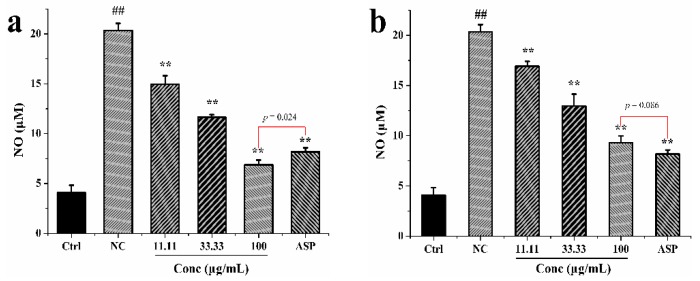
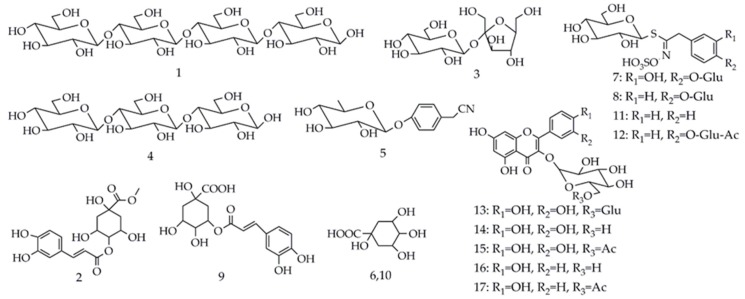
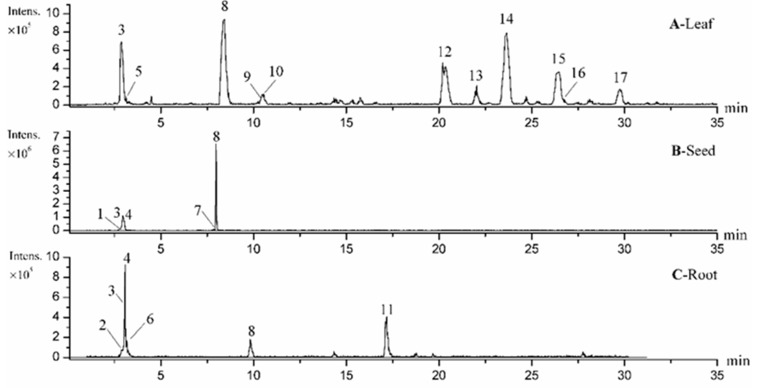
Lam. () is commonly distributed and utilized in tropical and sub-tropical areas. There has been a large number of reports on the antioxidant and anti-inflammatory activity of its leaves, but only a few about its seeds and roots. Hence, in this work we aimed to systematically compare the antioxidant and anti-inflammatory activities of the ethanol crude extracts of leaves, seeds, and roots of from Kenya, and further correlate the differential activities with the chemical constituents from these three parts. The antioxidant activities were measured by using three different assays (DPPH (2,2-diphenyl-1-picrylhydrazyl), ABTS (2,2'-azinobis-(3-ethylbenzthiazoline-6-sulfonic acid) and FRAP (Ferric-Reducing Antioxidant Power), respectively). Results showed that the leaf extracts displayed the highest DPPH radical scavenging and FRAP total reducing power activities with IC values of 1.02 ± 0.13 mg/mL and 0.99 ± 0.06 mM Fe/g, respectively; the leaf and root extracts exhibited potential ABTS radical scavenging activities with the IC values of 1.36 ± 0.02 and 1.24 ± 0.03 mg/mL. Meanwhile, the leaf and seed extracts (11.1-100 µg/mL) also exerted obvious anti-inflammatory activities, as indicated by the inhibition of NO production. To further reveal correlations between these differential activities with the chemical constituents in the three organs, the total flavonoids content (TFC) of the three different extracts were evaluated, and the TFC of leaves, seeds and roots were found to be 192.36 ± 2.96, 5.89 ± 0.65 and 106.79 ± 2.12 mg rutin equivalent (RE)/g, respectively. These findings indicated the important impacts of the total flavonoid contents on antioxidant and anti-inflammatory activities. Additionally, we further determined the phytochemical profiles of by HPLC-UV/ESI-MS/MS, and identified most of the chemical constituents of leaves as flavonoids. In summary, the leaves of are a better potential natural source of antioxidants and anti-inflammatory agents, and very promising for development into the health promoting dietary supplements.
某植物(此处原文未明确写出植物名称)在热带和亚热带地区广泛分布并被利用。关于其叶子的抗氧化和抗炎活性已有大量报道,但关于其种子和根的报道较少。因此,在本研究中,我们旨在系统比较来自肯尼亚的该植物叶、种子和根的乙醇粗提物的抗氧化和抗炎活性,并进一步将这些差异活性与这三个部位的化学成分相关联。抗氧化活性分别通过三种不同的测定方法(DPPH(2,2 - 二苯基 - 1 - 苦基肼)、ABTS(2,2'- 偶氮二异丁基咪啉二盐酸盐)和FRAP(铁还原抗氧化能力))进行测定。结果表明,叶提取物表现出最高的DPPH自由基清除能力和FRAP总还原能力,IC值分别为1.02±0.13mg/mL和0.99±0.06mM Fe/g;叶和根提取物表现出潜在的ABTS自由基清除活性,IC值分别为1.36±0.02和1.24±0.03mg/mL。同时,叶和种子提取物(11.1 - 100μg/mL)也表现出明显的抗炎活性,通过抑制NO产生得以表明。为了进一步揭示这些差异活性与三个器官中化学成分之间的相关性,评估了三种不同提取物的总黄酮含量(TFC),发现叶、种子和根的TFC分别为192.36±2.96、5.89±0.65和106.79±2.12mg芦丁当量(RE)/g。这些发现表明总黄酮含量对抗氧化和抗炎活性有重要影响。此外,我们通过HPLC - UV/ESI - MS/MS进一步测定了该植物的植物化学图谱,并确定叶的大部分化学成分是黄酮类化合物。总之,该植物的叶子是抗氧化剂和抗炎剂的更好潜在天然来源,非常有希望开发成促进健康的膳食补充剂。