Bartonjo Grace, Oundo Joseph, Ng'ang'a Zipporah
National Public Health Laboratory Services (NPHLS), Ministry of Health, Nairobi, Kenya.
Field Epidemiology and Laboratory Training Program, Kenya.
Pan Afr Med J. 2019 Sep 16;34:31. doi: 10.11604/pamj.2019.34.31.17885. eCollection 2019.
Unsafe transfusion practices can put millions of people at risk of Transfusion Transmissible Infections (TTIs). In Kenya the current blood transfusion scheme involves screening of blood for HIV, Hepatitis B virus (HBV), Hepatitis C virus (HCV) and syphilis. Malaria is also a blood-borne disease which is not currently screened for. In Kenya blood donor selection criteria were reviewed in 2009. Regular review of effectiveness of donor selection criteria can help reduce TTIs prevalence amongst donors and thus make the blood supply safer.
A cross sectional study was conducted between November 2011 to January 2012 among 594 blood donors in the Regional Blood Transfusion Center Nakuru and Tenwek Mission Hospital. Socio-demographic characteristics and associated risk factors were collected using a standard blood transfusion service questionnaire. Donors were obtained through systematic sampling. Each donor sample was screened, for HIV-1 and HIV-2, HBV, HCV, syphilis and malaria parasites.
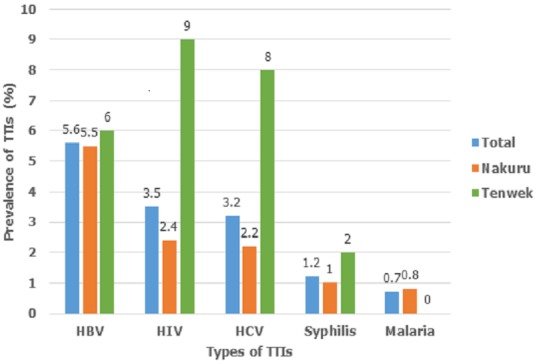
The overall prevalence of TTIs was 14.1%, which ranged from 0.7% for malaria to 5.6% for HBsAg. Blood donors who were married (P=0.0057), had non-formal or just primary education (P=0.0262), had multiple sexual partners (P=0.0144) and in informal occupation (P=0.0176) were at higher risk of HIV positivity. History of blood transfusion/blood products (P=0.0055), being married (P=0.0053) were high risk factors associated with positive syphilis. Being male (P=0.0479) was a high risk factor to HBV infection.
The prevalence of TTIs indicates a need to review the questionnaire and apply it strictly for donor selection. The 0.7% prevalence of malaria, poses a serious health risk to non-immune recipients of transfusion. Malaria should be included among mandatory TTI tests in Kenya.
不安全的输血操作会使数百万人面临输血传播感染(TTIs)的风险。在肯尼亚,当前的输血方案包括对血液进行艾滋病毒、乙型肝炎病毒(HBV)、丙型肝炎病毒(HCV)和梅毒的筛查。疟疾也是一种血液传播疾病,目前尚未进行筛查。肯尼亚在2009年对献血者选择标准进行了审查。定期审查献血者选择标准的有效性有助于降低献血者中输血传播感染的流行率,从而使血液供应更安全。
2011年11月至2012年1月,在纳库鲁地区输血中心和滕韦克教会医院对594名献血者进行了横断面研究。使用标准的输血服务问卷收集社会人口学特征和相关风险因素。通过系统抽样获取献血者。对每个献血者样本进行艾滋病毒-1和艾滋病毒-2、HBV、HCV、梅毒和疟原虫的筛查。
输血传播感染的总体流行率为14.1%,其中疟疾为0.7%,乙肝表面抗原(HBsAg)为5.6%。已婚(P = 0.0057)、接受过非正规教育或仅接受过小学教育(P = 0.0262)、有多个性伴侣(P = 0.0144)和从事非正规职业(P = 0.0176)的献血者感染艾滋病毒呈阳性的风险更高。有输血/血液制品史(P = 0.0055)、已婚(P = 0.0053)是梅毒呈阳性的高风险因素。男性(P = 0.0479)是感染HBV的高风险因素。
输血传播感染的流行率表明有必要审查问卷并严格将其应用于献血者选择。0.7%的疟疾流行率对非免疫输血接受者构成严重健康风险。疟疾应纳入肯尼亚强制性输血传播感染检测项目。