Aderghal Karim, Afdel Karim, Benois-Pineau Jenny, Catheline Gwénaëlle
Univ. Bordeaux, CNRS, Bordeaux INP, LaBRI, UMR 5800, F-33400, Talence, France.
LabSIV, Faculty of Sciences, Department of Computer Science, Ibn Zohr University, Agadir, Morocco.
Heliyon. 2020 Dec 10;6(12):e05652. doi: 10.1016/j.heliyon.2020.e05652. eCollection 2020 Dec.
Alzheimer's Disease (AD) is a neurodegenerative disease characterized by progressive loss of memory and general decline in cognitive functions. Multi-modal imaging such as structural MRI and DTI provide useful information for the classification of patients on the basis of brain biomarkers. Recently, CNN methods have emerged as powerful tools to improve classification using images.
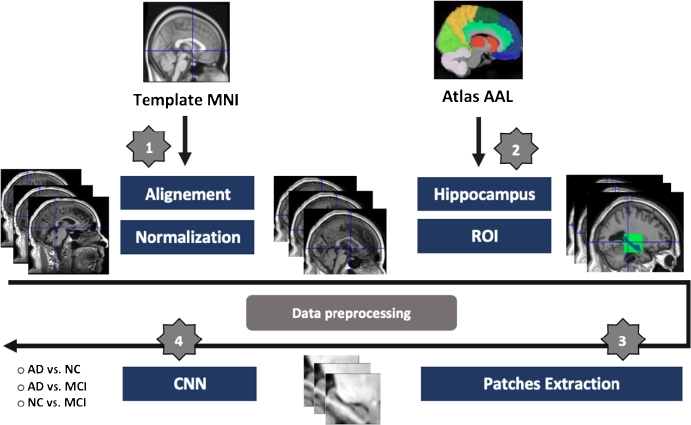
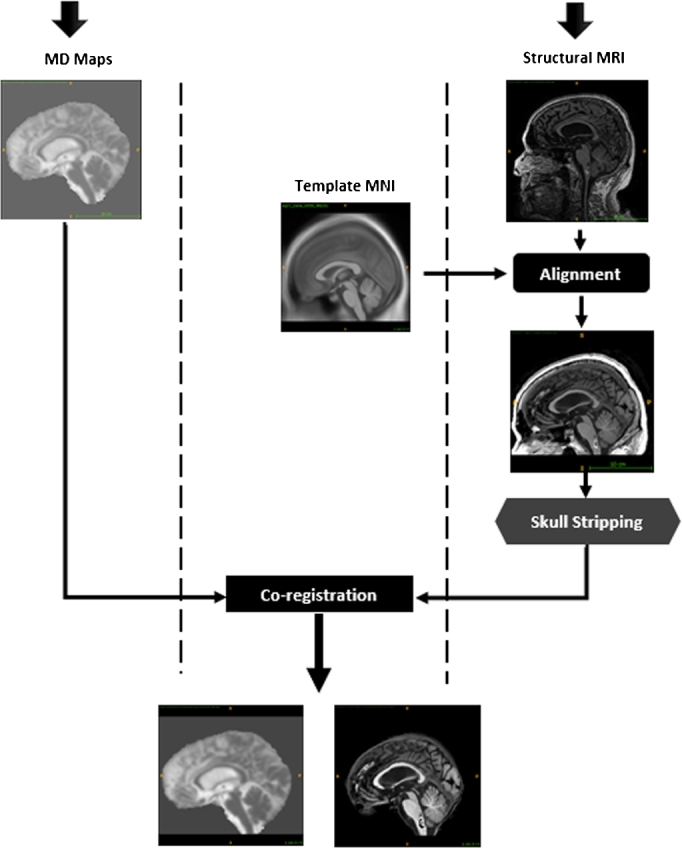
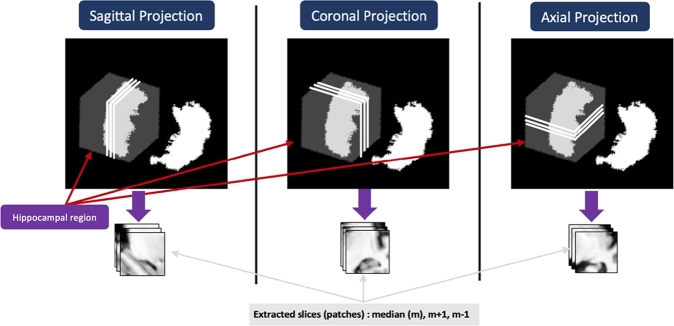
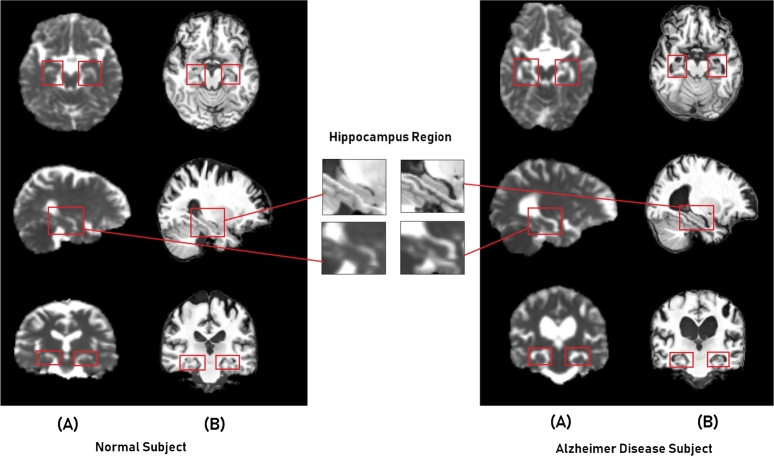
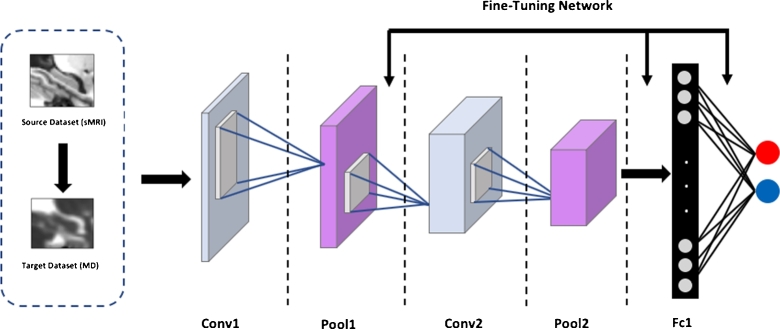
In this paper, we propose a transfer learning scheme using Convolutional Neural Networks (CNNs) to automatically classify brain scans focusing only on a small ROI: e.g. a few slices of the hippocampal region. The network's architecture is similar to a LeNet-like CNN upon which models are built and fused for AD stage classification diagnosis. We evaluated various types of transfer learning through the following mechanisms: (i) cross-modal (sMRI and DTI) and (ii) cross-domain transfer learning (using MNIST) (iii) a hybrid transfer learning of both types.
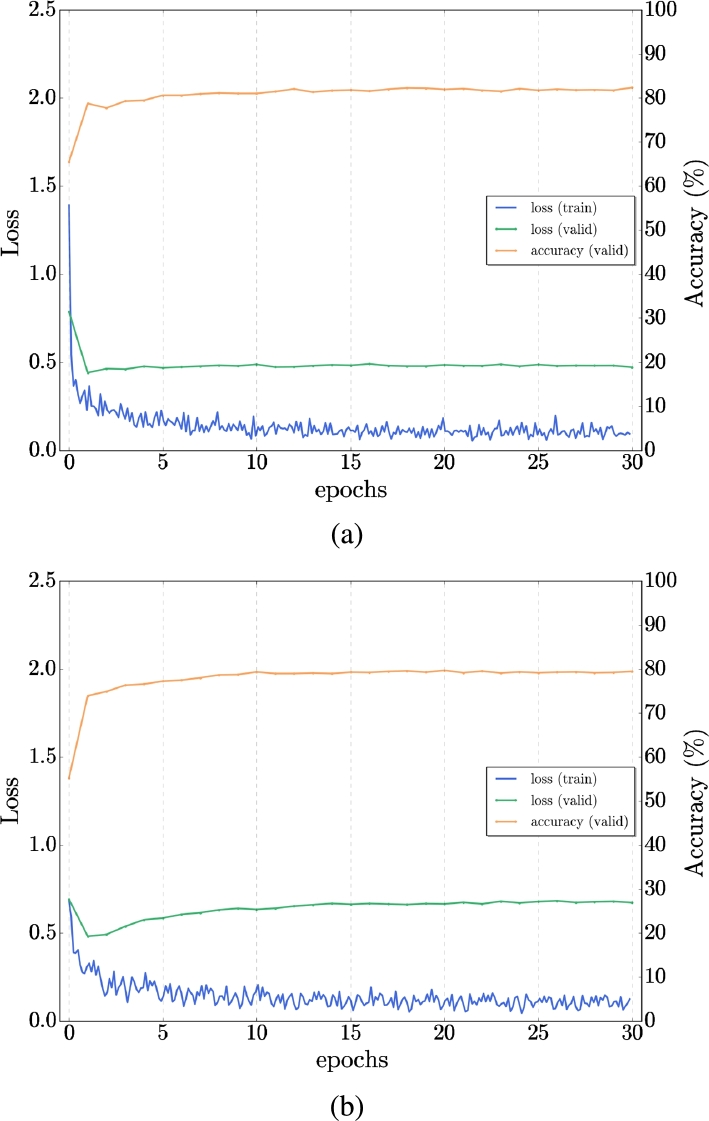
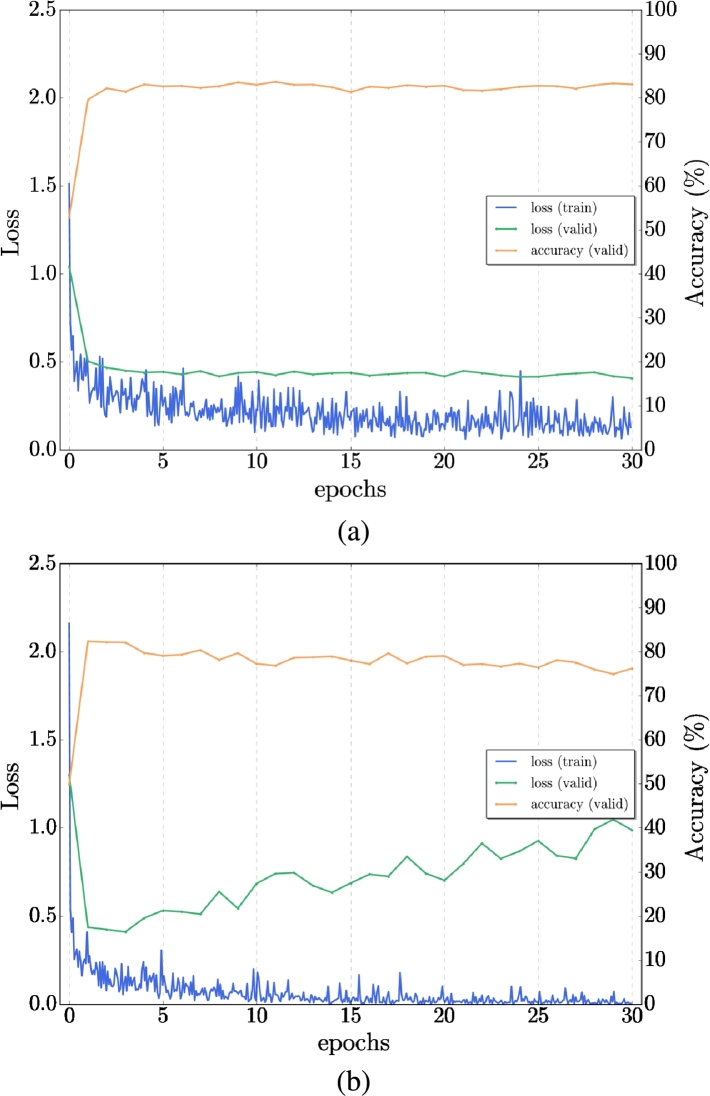
Our method shows good performances even on small datasets and with a limited number of slices of small brain region. It increases accuracy with more than 5 points for the most difficult classification tasks, i.e., AD/MCI and MCI/NC.
Our methodology provides good accuracy scores for classification over a shallow convolutional network. Besides, we focused only on a small region; i.e., the hippocampal region, where few slices are selected to feed the network. Also, we used cross-modal transfer learning.
Our proposed method is suitable for working with a shallow CNN network for low-resolution MRI and DTI scans. It yields to significant results even if the model is trained on small datasets, which is often the case in medical image analysis.
阿尔茨海默病(AD)是一种神经退行性疾病,其特征是记忆力逐渐丧失和认知功能普遍衰退。多模态成像,如结构磁共振成像(sMRI)和扩散张量成像(DTI),基于脑生物标志物为患者分类提供了有用信息。最近,卷积神经网络(CNN)方法已成为利用图像改进分类的强大工具。
在本文中,我们提出提出一种使用卷积神经网络(CNN)的迁移学习方案,仅聚焦于一个小的感兴趣区域(ROI)自动对脑部扫描进行分类,例如海马区的几片切片。该网络架构类似于一种类似LeNet的CNN,在此基础上构建模型并融合用于AD阶段分类诊断。我们通过以下机制评估了各种类型的迁移学习:(i)跨模态(sMRI和DTI)和(ii)跨域迁移学习(使用MNIST)(iii)两种类型的混合迁移学习。
我们的方法即使在小数据集以及小脑区域切片数量有限的情况下也表现出良好性能。对于最困难的分类任务,即AD/MCI和MCI/NC,其准确率提高了5个多百分点。
我们的方法在浅层卷积网络上进行分类时提供了良好的准确率分数。此外,我们仅关注一个小区域,即海马区,从中选择少量切片输入网络。而且,我们使用了跨模态迁移学习。
我们提出的方法适用于使用浅层CNN网络处理低分辨率MRI和DTI扫描。即使模型在小数据集上训练,它也能产生显著结果,而这在医学图像分析中经常是这样的情况。