Molly A. Sauer, MPH, is a Research Associate; Shaun Truelove, PhD, is an Assistant Scientist; Amelia K. Gerste, MSPH, is a Communications Specialist; and Rupali J. Limaye, PhD, MPH, MA, is an Associate Scientist and Director of Behavioral and Implementation Science (IVAC); all in the Department of International Health and the International Vaccine Access Center, Johns Hopkins Bloomberg School of Public Health, Baltimore, MD. Shaun Truelove is also an Assistant Scientist, Department of Epidemiology, and Rupali J. Limaye is also an Associate Scientist, Department of Epidemiology and Department of Health, Behavior, and Society; all at the Johns Hopkins Bloomberg School of Public Health, Baltimore, MD.
Health Secur. 2021 Jan-Feb;19(1):65-74. doi: 10.1089/hs.2020.0190.
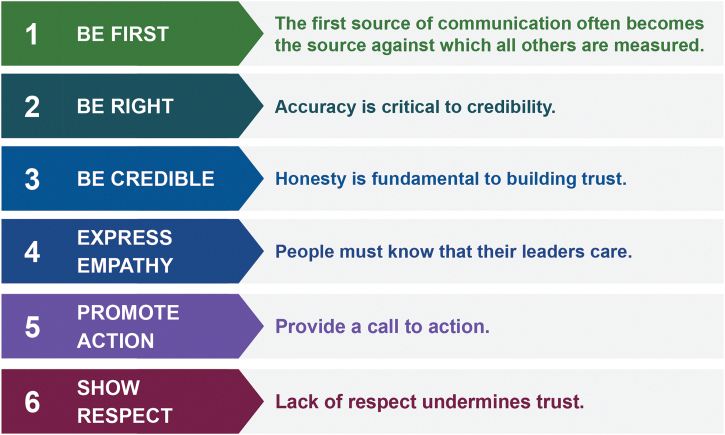
A pandemic, especially when caused by a novel virus, induces tremendous uncertainty, fear, and anxiety. To mitigate panic and encourage appropriate behavioral action, communication is critical. The US Centers for Disease Control and Prevention's Crisis and Emergency Risk Communication (CERC) guidance is designed to assist public health authorities, government officials, and other stakeholders in using risk communication during an emergency. For each of the 6 core communication principles outlined in the CERC guidance, we describe the use or nonuse of these principles at critical points during the coronavirus disease 2019 (COVID-19) pandemic by US public health and government officials. With the knowledge that the pandemic will continue to rage for some time and that new communication challenges will arise, including issues related to vaccination and treatment options, many lessons are to be learned and shared. To reduce fear and uncertainty among those living in the United States, COVID-19 communication should be rapid and accurate, while building credibility and trust and showcasing empathy-all with a unified voice.
大流行,特别是由新型病毒引起的大流行,会引起巨大的不确定性、恐惧和焦虑。为了减轻恐慌并鼓励采取适当的行为行动,沟通至关重要。美国疾病控制与预防中心的危机与紧急情况风险沟通(CERC)指南旨在帮助公共卫生当局、政府官员和其他利益相关者在紧急情况下使用风险沟通。对于 CERC 指南中概述的 6 项核心沟通原则中的每一项,我们都描述了在 2019 年冠状病毒病(COVID-19)大流行期间,美国公共卫生和政府官员在关键节点上使用或不使用这些原则的情况。鉴于大流行将持续一段时间,并且会出现新的沟通挑战,包括与疫苗接种和治疗选择相关的问题,因此有许多经验教训需要学习和分享。为了减少居住在美国的人们的恐惧和不确定性,COVID-19 的沟通应该快速准确,同时建立信誉和信任,并展示同理心——所有这些都需要统一的声音。