Department of Mathematics, Simon Fraser University, Burnaby, Canada V5A 1S6.
Department of Statistics and Actuarial Science, Simon Fraser University, Burnaby, Canada V5A 1S6.
J R Soc Interface. 2021 Apr;18(177):20210036. doi: 10.1098/rsif.2021.0036. Epub 2021 Apr 28.
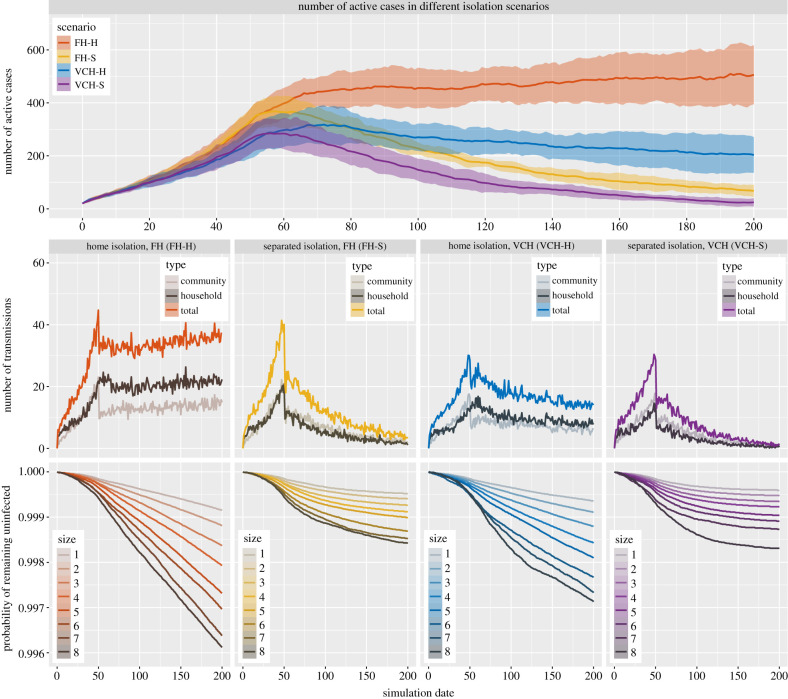
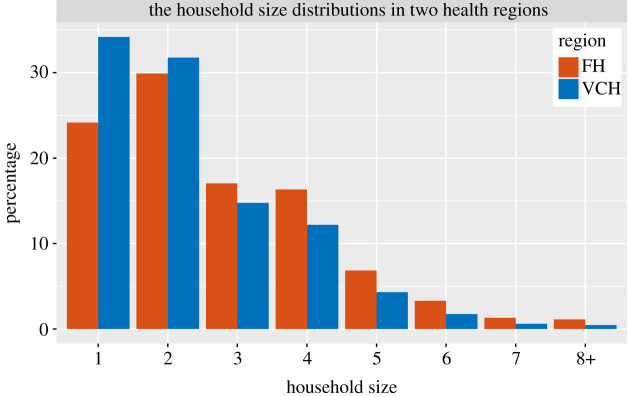
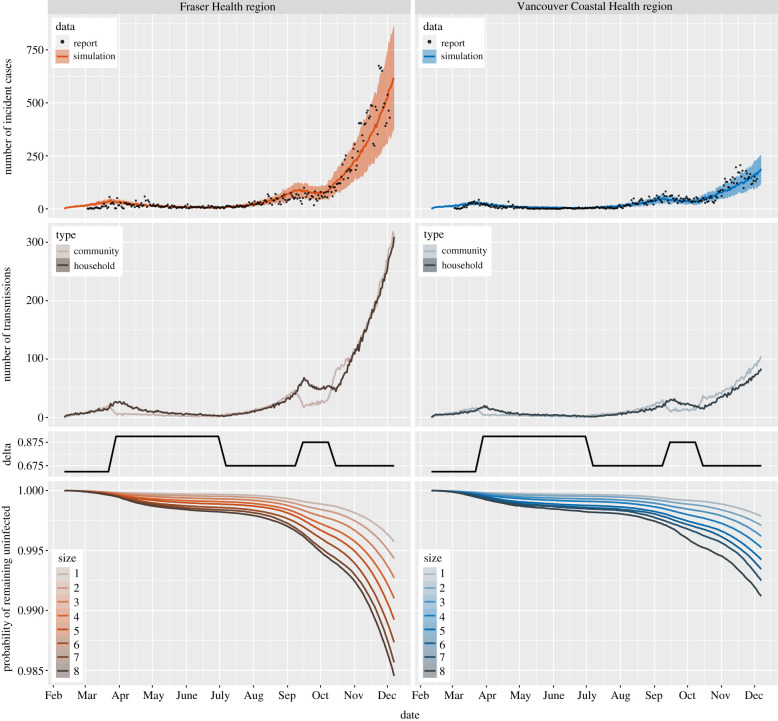
Under the implementation of non-pharmaceutical interventions such as social distancing and lockdowns, household transmission has been shown to be significant for COVID-19, posing challenges for reducing incidence in settings where people are asked to self-isolate at home and to spend increasing amounts of time at home due to distancing measures. Accordingly, characteristics of households in a region have been shown to relate to transmission heterogeneity of the virus. We introduce a discrete-time stochastic epidemiological model to examine the impact of the household size distribution in a region on the transmission dynamics. We choose parameters to reflect incidence in two health regions of the Greater Vancouver area in British Columbia and simulate the impact of distancing measures on transmission, with household size distribution the only different parameter between simulations for the two regions. Our result suggests that the dissimilarity in household size distribution alone can cause significant differences in incidence of the two regions, and the distributions drive distinct dynamics that match reported cases. Furthermore, our model suggests that offering individuals a place to isolate outside their household can speed the decline in cases, and does so more effectively where there are more larger households.
在实施非药物干预措施(如社交距离和封锁)的情况下,家庭传播已被证明对 COVID-19 具有重要意义,这给那些因隔离措施而被要求在家中自我隔离并在家中度过更多时间的地区减少发病率带来了挑战。因此,一个地区的家庭特征已被证明与病毒的传播异质性有关。我们引入了一个离散时间随机流行病学模型来研究该地区家庭规模分布对传播动态的影响。我们选择参数来反映不列颠哥伦比亚省大温哥华地区两个卫生区的发病率,并模拟隔离措施对传播的影响,两个区的模拟中唯一的不同参数是家庭规模分布。我们的结果表明,仅家庭规模分布的差异就可能导致两个地区发病率的显著差异,并且分布驱动着与报告病例相匹配的不同动态。此外,我们的模型表明,为个人提供在家庭之外隔离的场所可以加速病例的减少,而在有更多大家庭的情况下,这种效果更为明显。