Chair and Department of Biochemistry and Biotechnology, Medical University of Lublin, Chodzki 1 Street, 20-093 Lublin, Poland.
Supercritical Extraction Department, Łukasiewicz Research Network- New Chemical Syntheses Institute, Al. Tysiąclecia Państwa Polskiego 13a, 24-110 Puławy, Poland.
Molecules. 2021 Apr 19;26(8):2366. doi: 10.3390/molecules26082366.
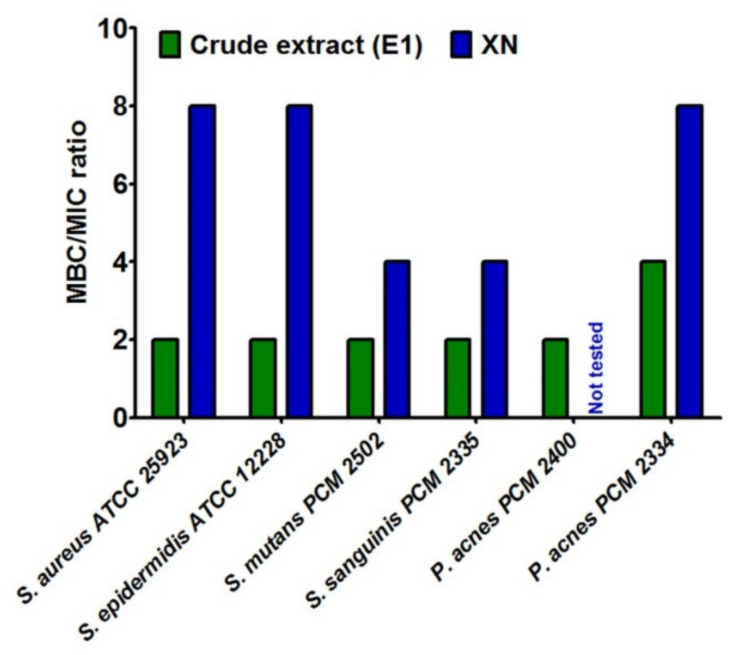
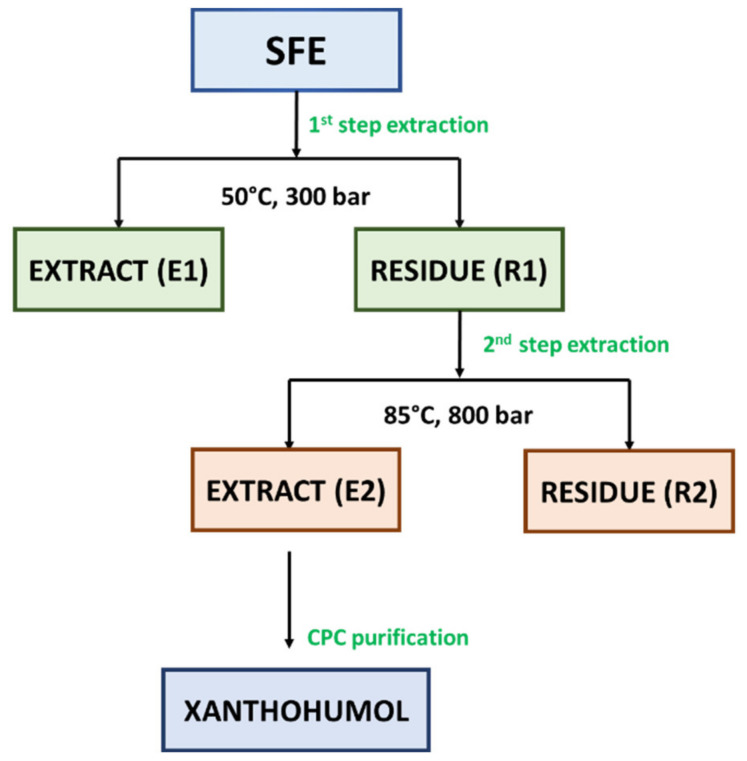
Given the health-beneficial properties of compounds from hop, there is still a growing trend towards developing successful extraction methods with the highest yield and also receiving the products with high added value. The aim of this study was to develop efficient extraction method for isolation of bioactive compounds from the Polish "Marynka" hop variety. The modified two-step supercritical fluid extraction allowed to obtain two hop samples, namely crude extract (E1), composed of α-acids, β-acids, and terpene derivatives, as well as pure xanthohumol with higher yield than that of other available methods. The post-extraction residues (R1) were re-extracted in order to obtain extract E2 enriched in xanthohumol. Then, both samples were subjected to investigation of their antibacterial (anti-acne, anti-caries), cytotoxic, and anti-proliferative activities in vitro. It was demonstrated that extract (E1) possessed more beneficial biological properties than xanthohumol. It exhibited not only better antibacterial activity against Gram-positive bacteria strains (MIC, MBC) but also possessed a higher synergistic effect with commercial antibiotics when compared to xanthohumol. Moreover, cell culture experiments revealed that crude extract neither inhibited viability nor divisions of normal skin fibroblasts as strongly as xanthohumol. In turn, calculated selectivity indexes showed that the crude extract had from slightly to significantly better selective anti-proliferative activity towards cancer cells in comparison with xanthohumol.
鉴于啤酒花化合物具有有益健康的特性,开发具有最高产量和高附加值的成功提取方法仍然是一个不断增长的趋势。本研究的目的是开发一种从波兰“玛丽娜克”啤酒花品种中分离生物活性化合物的有效提取方法。改进的两步超临界流体萃取法可以得到两种啤酒花样品,即粗提取物(E1),由α-酸、β-酸和萜烯衍生物组成,以及比其他可用方法产量更高的纯黄腐酚。对提取后的残渣(R1)进行再次提取,以获得富含黄腐酚的提取物 E2。然后,对这两种样品进行体外抗菌(抗粉刺、抗龋齿)、细胞毒性和抗增殖活性的研究。结果表明,提取物(E1)比黄腐酚具有更多有益的生物学特性。它不仅对革兰氏阳性菌菌株(MIC、MBC)具有更好的抗菌活性,而且与黄腐酚相比,与商业抗生素具有更高的协同作用。此外,细胞培养实验表明,粗提取物对正常皮肤成纤维细胞的活力和分裂的抑制作用不如黄腐酚强。相反,计算出的选择性指数表明,与黄腐酚相比,粗提取物对癌细胞的选择性抗增殖活性略有改善或明显改善。