Cheng Jiangbo, Wang Weimin, Zhang Deyin, Zhang Yukun, Song Qizhi, Li Xiaolong, Zhao Yuan, Xu Dan, Zhao Liming, Li Wenxin, Wang Jianghui, Zhou Bubo, Lin Changchun, Zhang Xiaoxue
College of Animal Science and Technology, Gansu Agricultural University, Lanzhou 730070, China.
The State Key Laboratory of Grassland Agro-Ecosystems, College of Pastoral Agriculture Science and Technology, Lanzhou University, Lanzhou 730020, China.
Animals (Basel). 2022 Mar 30;12(7):880. doi: 10.3390/ani12070880.
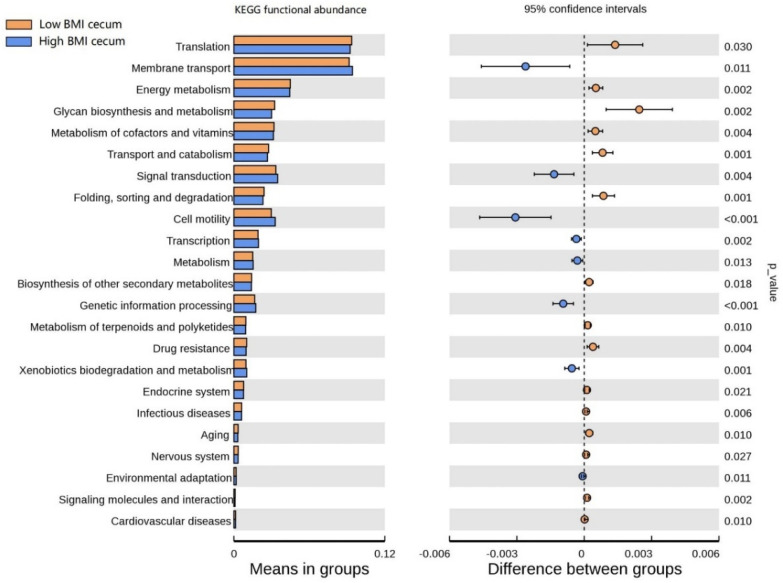
Fat deposition is the key factor affecting the efficiency of animal husbandry production. There are many factors affecting fat deposition, in which the gastrointestinal microbiota plays an important role. Therefore, the body mass index (BMI) was introduced into the evaluation of sheep fat deposition, and the different microbiota and functional pathways of the sheep gastrointestinal tract in different BMI groups were analyzed. We selected 5% of individuals with the highest and lowest BMI from a feed test population (357 in whole group). Microorganisms in 10 sites of the gastrointestinal tract in 36 individuals (18 in each group) were evaluated by 16S rRNA V3−V4 region sequencing. There were differences (p < 0.05) in fat deposition traits between different BMI groups. In the 10 parts of the gastrointestinal tract, the diversity and richness of cecal microflora in the high-BMI group were higher than those in low-BMI Hu sheep (p < 0.05). Principal coordinate analysis (PCoA) showed that there was separation of the cecum between groups, and there were differences in the cecal microbial community. Linear discriminant analysis effect size (LEfSe) showed that most biomarkers were in the cecum. On the basis of an indepth study of cecal microorganisms, 26 different bacterial genera were obtained (p < 0.05). Correlation analysis between them and the characteristics of fat deposition in sheep showed that Colidextribacter, Alloprevotella, and Succenivibrio were positively correlated with fat deposition, while Lachnospiraceae_ND3007_Group was negatively correlated (p < 0.05). The above results show that the cecum may be an important part leading to the difference of BMI in sheep, and its microorganisms may affect the level of fat deposition.
脂肪沉积是影响畜牧生产效率的关键因素。影响脂肪沉积的因素众多,其中胃肠道微生物群起着重要作用。因此,将体重指数(BMI)引入绵羊脂肪沉积的评价中,并分析了不同BMI组绵羊胃肠道的微生物群和功能通路差异。我们从一个饲料试验群体(全组357只)中选取了BMI最高和最低的5%个体。通过16S rRNA V3−V4区域测序评估了36只个体(每组18只)胃肠道10个部位的微生物。不同BMI组之间的脂肪沉积性状存在差异(p<0.05)。在胃肠道的10个部位中,高BMI组盲肠微生物群的多样性和丰富度高于低BMI的湖羊(p<0.05)。主坐标分析(PCoA)表明,组间盲肠存在分离,盲肠微生物群落存在差异。线性判别分析效应大小(LEfSe)表明,大多数生物标志物存在于盲肠中。在对盲肠微生物进行深入研究的基础上,获得了26个不同的细菌属(p<0.05)。它们与绵羊脂肪沉积特征的相关性分析表明,柯氏杆菌属、别普雷沃菌属和琥珀酸弧菌属与脂肪沉积呈正相关,而毛螺菌科_ND3007_组与脂肪沉积呈负相关(p<0.05)。上述结果表明,盲肠可能是导致绵羊BMI差异的重要部位,其微生物可能影响脂肪沉积水平。