Hadidi Naghmeh, Mohebbi Maryam
Department of Clinical Research and EM Microscope, Pasteur Institute of Iran (PII), Tehran P.O. Box 1316943551, Iran.
Microorganisms. 2022 Dec 9;10(12):2439. doi: 10.3390/microorganisms10122439.
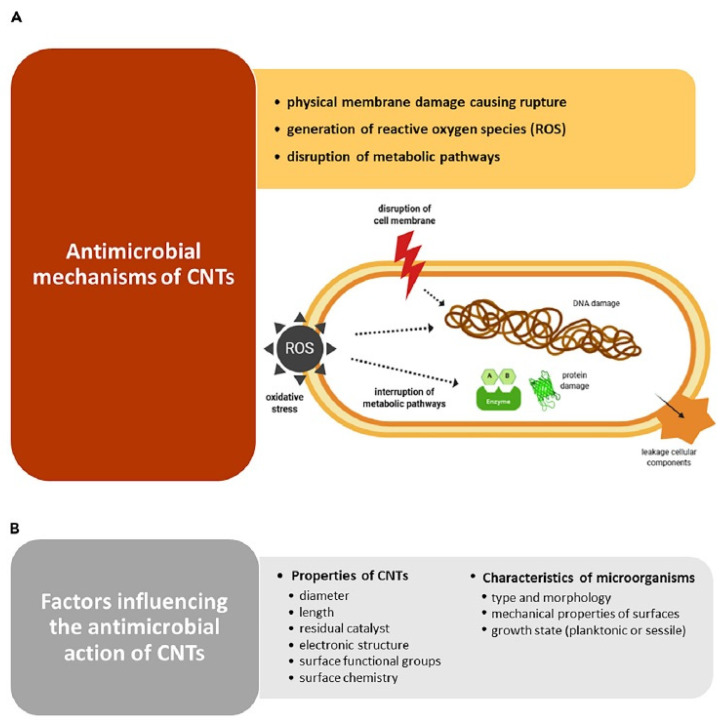
Recently, antimicrobial activities of various carbon-based nanomaterials against specific pathogens have become one of the most significant research interests in this field. Carbon nanotubes (CNTs) are promising multidisciplinary nanostructures in biomedicine, drug delivery, genetic engineering, biosensors, and artificial implants. However, the biomedical administration of CNTs is dependent on their solubility, toxicity, and biocompatibility, as well as novel drug-delivery applications through optimization of the drug's loading capacity, cellular absorption, and continuous release within the target cell. The usage of CNTs and Graphene materials as antimicrobial agents and nanocarriers for antibiotics delivery would possibly improve their bioavailability and facilitate better anti-infective therapy. However, it is worth mentioning that CNTs' antimicrobial activity and toxicity are highly dependent on their preparation and synthesis method. Various types of research have confirmed that diameter, length, residual catalyst, metal content, surface coating, electronic structure, and dispersibility would affect CNTs' toxicity toward bacteria and human cells. In this review article, a general study was performed on the antimicrobial properties of carbon-based nanomaterials, as well as their toxicity and applications in confronting different microorganisms. This study could be useful for researchers who are looking for new and effective drug delivery methods in the field of microbial resistance.
最近,各种碳基纳米材料对特定病原体的抗菌活性已成为该领域最重要的研究热点之一。碳纳米管(CNTs)在生物医学、药物递送、基因工程、生物传感器和人工植入物等多学科领域具有广阔前景。然而,碳纳米管的生物医学应用取决于其溶解性、毒性和生物相容性,以及通过优化药物负载能力、细胞吸收和在靶细胞内持续释放等实现新型药物递送应用。将碳纳米管和石墨烯材料用作抗菌剂和抗生素递送的纳米载体可能会提高它们的生物利用度,并促进更好的抗感染治疗。然而,值得一提的是,碳纳米管的抗菌活性和毒性高度依赖于其制备和合成方法。各类研究证实,直径、长度、残留催化剂、金属含量、表面涂层、电子结构和分散性都会影响碳纳米管对细菌和人类细胞的毒性。在这篇综述文章中,对碳基纳米材料的抗菌特性及其在对抗不同微生物方面的毒性和应用进行了全面研究。这项研究对于在微生物耐药领域寻找新的有效药物递送方法的研究人员可能会有所帮助。