Sarker Sunandita, Colton Adira, Wen Ziteng, Xu Xin, Erdi Metecan, Jones Anthony, Kofinas Peter, Tubaldi Eleonora, Walczak Piotr, Janowski Miroslaw, Liang Yajie, Sochol Ryan D
Department of Mechanical Engineering, University of Maryland, College Park, MD 20742, USA; Maryland Robotics Center, University of Maryland, College Park, MD 20742, USA; Institute for Systems Research, University of Maryland, College Park, MD 20742, USA.
Department of Mechanical Engineering, University of Maryland, College Park, MD 20742, USA.
Adv Mater Technol. 2023 Mar 10;8(5). doi: 10.1002/admt.202201641. Epub 2023 Feb 5.
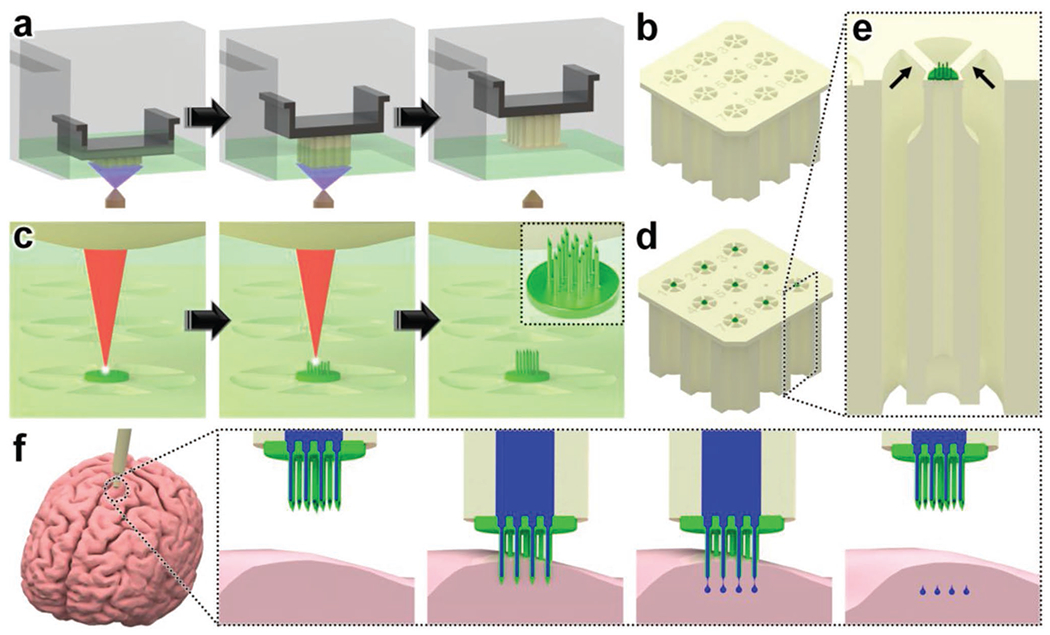
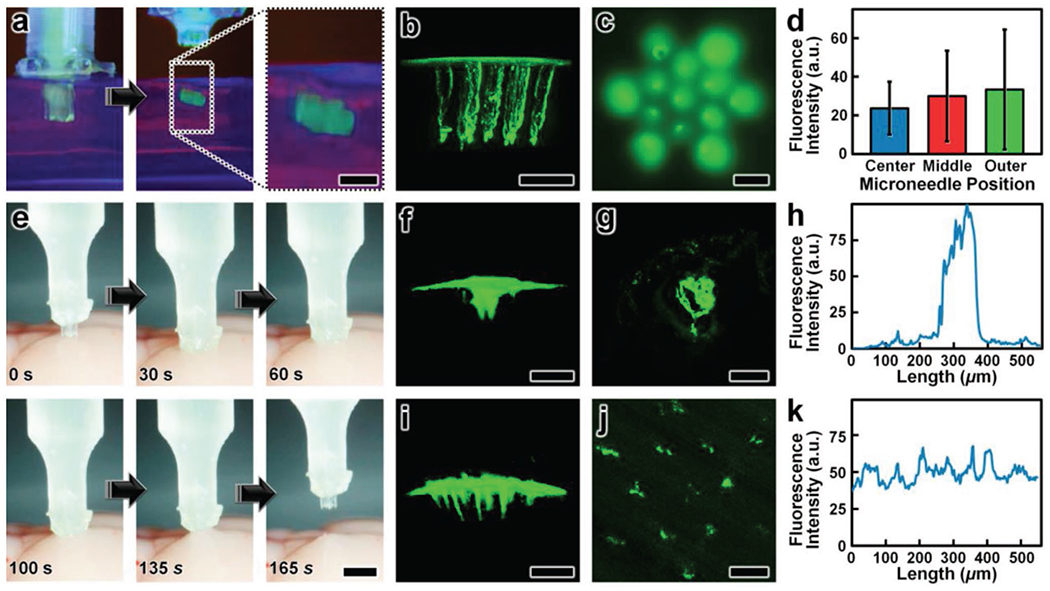
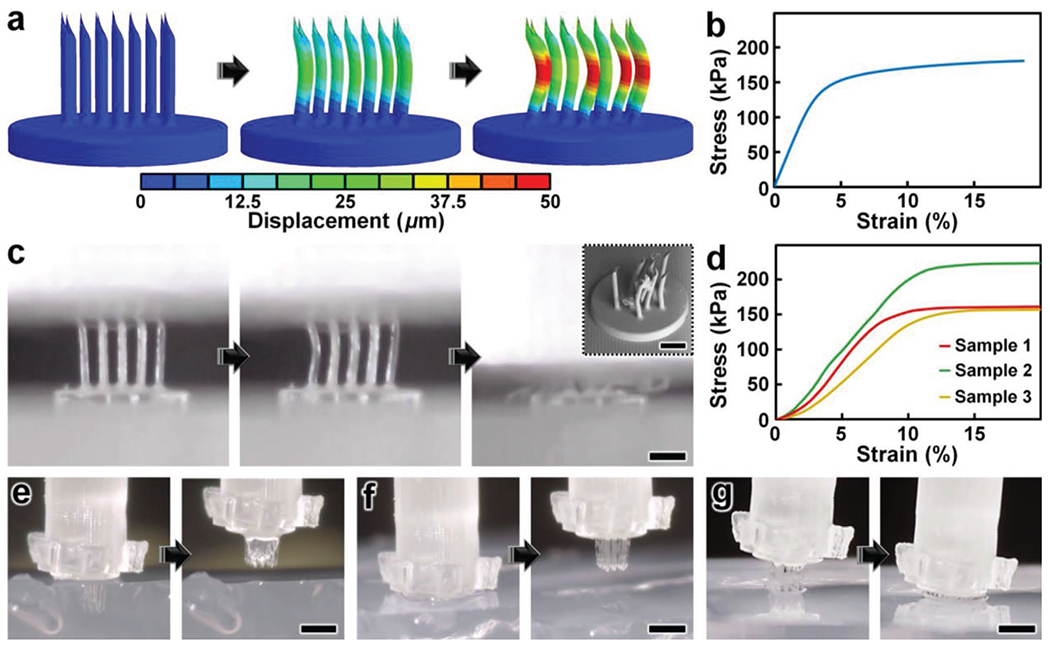
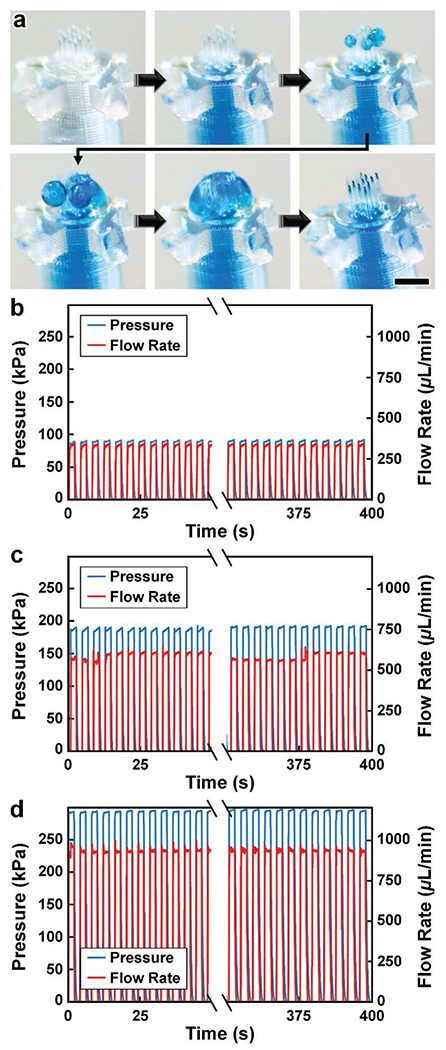
Microinjection protocols are ubiquitous throughout biomedical fields, with hollow microneedle arrays (MNAs) offering distinctive benefits in both research and clinical settings. Unfortunately, manufacturing-associated barriers remain a critical impediment to emerging applications that demand high-density arrays of hollow, high-aspect-ratio microneedles. To address such challenges, here, a hybrid additive manufacturing approach that combines digital light processing (DLP) 3D printing with "ex situ direct laser writing (DLW)" is presented to enable new classes of MNAs for fluidic microinjections. Experimental results for DLW-based 3D printing of arrays of high-aspect-ratio microneedles-with 30 μm inner diameters, 50 μm outer diameters, and 550 μm heights, and arrayed with 100 μm needle-to-needle spacing-directly onto DLP-printed capillaries reveal uncompromised fluidic integrity at the MNA-capillary interface during microfluidic cyclic burst-pressure testing for input pressures in excess of 250 kPa ( = 100 cycles). Ex vivo experiments perform using excised mouse brains reveal that the MNAs not only physically withstand penetration into and retraction from brain tissue but also yield effective and distributed microinjection of surrogate fluids and nanoparticle suspensions directly into the brains. In combination, the results suggest that the presented strategy for fabricating high-aspect-ratio, high-density, hollow MNAs could hold unique promise for biomedical microinjection applications.
显微注射技术在生物医学领域无处不在,中空微针阵列(MNAs)在研究和临床环境中都具有独特的优势。不幸的是,与制造相关的障碍仍然是新兴应用的关键阻碍,这些应用需要高密度的中空、高纵横比微针阵列。为了应对这些挑战,本文提出了一种混合增材制造方法,该方法将数字光处理(DLP)3D打印与“非原位直接激光写入(DLW)”相结合,以实现用于流体显微注射的新型MNAs。基于DLW的3D打印高纵横比微针阵列(内径30μm、外径50μm、高度550μm,针间距100μm)直接打印在DLP打印的毛细管上的实验结果表明,在超过250kPa(=100个循环)的输入压力下进行微流体循环爆破压力测试时,MNA-毛细管界面处的流体完整性不受影响。使用切除的小鼠大脑进行的体外实验表明,MNAs不仅在物理上能够承受刺入脑组织和从脑组织中缩回的过程,而且还能将替代流体和纳米颗粒悬浮液有效地分散微注射到大脑中。综合来看,这些结果表明,所提出的制造高纵横比、高密度、中空MNAs的策略在生物医学显微注射应用中可能具有独特的前景。