NSF Science of Learning Center on Visual Language and Visual Learning (VL2), Gallaudet University, Washington, DC, United States.
Cognition. 2011 Feb;118(2):286-92. doi: 10.1016/j.cognition.2010.11.006. Epub 2010 Dec 8.
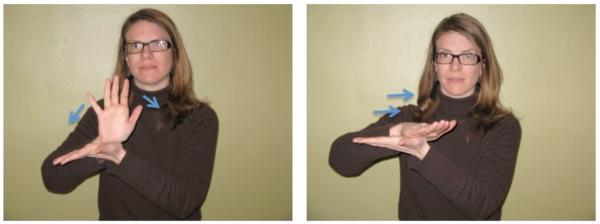
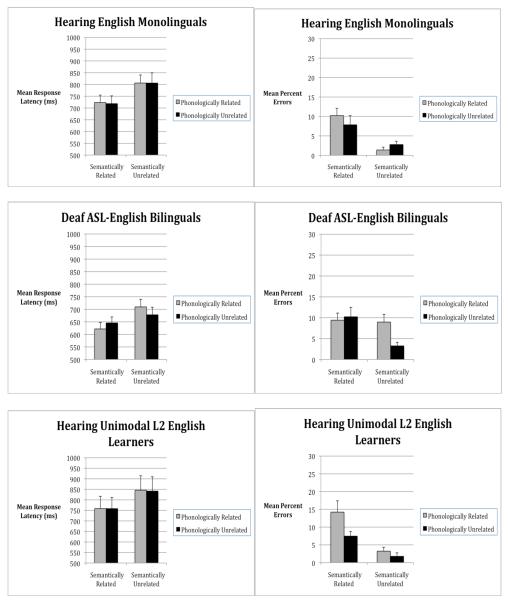
Deaf bilinguals for whom American Sign Language (ASL) is the first language and English is the second language judged the semantic relatedness of word pairs in English. Critically, a subset of both the semantically related and unrelated word pairs were selected such that the translations of the two English words also had related forms in ASL. Word pairs that were semantically related were judged more quickly when the form of the ASL translation was also similar whereas word pairs that were semantically unrelated were judged more slowly when the form of the ASL translation was similar. A control group of hearing bilinguals without any knowledge of ASL produced an entirely different pattern of results. Taken together, these results constitute the first demonstration that deaf readers activate the ASL translations of written words under conditions in which the translation is neither present perceptually nor required to perform the task.
失聪双语者以美国手语(ASL)作为第一语言,英语作为第二语言,他们判断英语单词对的语义相关性。关键的是,选择了语义相关和不相关的单词对的子集,使得两个英语单词的翻译在 ASL 中也有相关的形式。当 ASL 翻译的形式相似时,语义相关的单词对判断得更快,而当 ASL 翻译的形式相似时,语义不相关的单词对判断得更慢。一组没有任何 ASL 知识的听力双语者作为对照组,他们产生了完全不同的结果模式。总的来说,这些结果首次证明,在翻译既不是感知上存在的,也不需要完成任务的情况下,失聪读者会激活书面单词的 ASL 翻译。