
耐万古霉素的 vanB 型屎肠球菌分离株,表达不同水平的万古霉素耐药性,在单个 ICU 中的新生儿患者中高度流行。
Vancomycin-resistant vanB-type Enterococcus faecium isolates expressing varying levels of vancomycin resistance and being highly prevalent among neonatal patients in a single ICU.
机构信息
Unit FG13 Nosocomial Infections, Robert Koch-Institute Wernigerode, Wernigerode, Germany.
出版信息
Antimicrob Resist Infect Control. 2012 May 30;1(1):21. doi: 10.1186/2047-2994-1-21.
BACKGROUND
Vancomycin-resistant isolates of E. faecalis and E. faecium are of special concern and patients at risk of acquiring a VRE colonization/infection include also intensively-cared neonates. We describe here an ongoing high prevalence of VanB type E. faecium in a neonatal ICU hardly to identify by routine diagnostics.
METHODS
During a 10 months' key period 71 E. faecium isolates including 67 vanB-type isolates from 61 patients were collected non-selectively. Vancomycin resistance was determined by different MIC methods (broth microdilution, Vitek® 2) including two Etest® protocols (McFarland 0.5/2.0. on Mueller-Hinton/Brain Heart Infusion agars). Performance of three chromogenic VRE agars to identify the vanB type outbreak VRE was evaluated (BrillianceTM VRE agar, chromIDTM VRE agar, CHROMagarTM VRE). Isolates were genotyped by SmaI- and CeuI-macrorestriction analysis in PFGE, plasmid profiling, vanB Southern hybridisations as well as MLST typing.
RESULTS
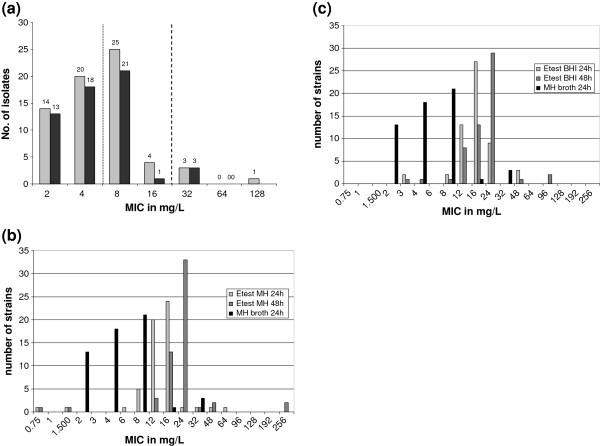
Majority of vanB isolates (n = 56, 79%) belonged to a single ST192 outbreak strain type showing an identical PFGE pattern and analyzed representative isolates revealed a chromosomal localization of a vanB2-Tn5382 cluster type. Vancomycin MICs in cation-adjusted MH broth revealed a susceptible value of ≤4 mg/L for 31 (55%) of the 56 outbreak VRE isolates. Etest® vancomycin on MH and BHI agars revealed only two vanB VRE isolates with a susceptible result; in general Etest® MIC results were about 1 to 2 doubling dilutions higher than MICs assessed in broth and values after the 48 h readout were 0.5 to 1 doubling dilutions higher for vanB VRE. Of all vanB type VRE only three, three and two isolates did not grow on BrillianceTM VRE agar, chromIDTM VRE agar and CHROMagarTM VRE, respectively. Permanent cross contamination via the patients' surrounding appeared as a possible risk factor for permanent VRE colonization/infection.
CONCLUSIONS
Low level expression of vanB resistance may complicate a proper routine diagnostics of vanB VRE and mask an ongoing high VRE prevalence. A high inoculum and growth on rich solid media showed the highest sensitivity in identifying vanB type resistance.
背景
粪肠球菌和屎肠球菌的万古霉素耐药分离株引起了特别关注,有感染风险的患者包括重症监护病房的新生儿。我们在此描述了一种持续存在的高水平耐万古霉素肠球菌(VanB 型),这在新生儿重症监护病房中很难通过常规诊断方法识别。
方法
在 10 个月的关键时期内,我们非选择性地收集了 61 名患者的 67 株 VanB 型屎肠球菌和 71 株屎肠球菌分离株。通过不同的 MIC 方法(肉汤微量稀释法、Vitek® 2 法)包括两种 Etest®方案(麦氏比浊度 0.5/2.0,在 Mueller-Hinton/Brain Heart Infusion 琼脂上)来确定万古霉素耐药性。评估了三种显色 VRE 琼脂对 VanB 型爆发性 VRE 的识别能力(BrillianceTM VRE 琼脂、chromIDTM VRE 琼脂、CHROMagarTM VRE)。通过 SmaI 和 CeuI 宏限制分析在 PFGE、质粒图谱、VanB Southern 杂交以及 MLST 分型中对分离株进行基因分型。
结果
大多数 VanB 分离株(n=56,79%)属于单一 ST192 爆发株类型,具有相同的 PFGE 模式,分析代表性分离株显示出一个 VanB2-Tn5382 簇类型的染色体定位。在阳离子调整的 MH 肉汤中的万古霉素 MIC 值显示,56 株爆发性 VRE 分离株中有 31 株(55%)的敏感值≤4mg/L。在 MH 和 BHI 琼脂上的 Etest®万古霉素仅显示两种 VanB VRE 分离株的敏感结果;一般来说,Etest®MIC 结果比肉汤中的 MIC 值高约 1 到 2 倍稀释度,而 48 小时后读取的结果对于 VanB VRE 高 0.5 到 1 倍稀释度。所有 VanB 型 VRE 中,只有三种、三种和两种分离株分别不能在 BrillianceTM VRE 琼脂、chromIDTM VRE 琼脂和 CHROMagarTM VRE 上生长。通过患者周围环境的持续交叉污染似乎是 VRE 持续定植/感染的一个可能风险因素。
结论
VanB 耐药性的低水平表达可能使 VanB VRE 的常规诊断复杂化,并掩盖了持续存在的高 VRE 流行率。高接种量和在富含固体培养基上的生长显示出对鉴定 VanB 型耐药性的最高敏感性。


 Zotero 插件