Lazarus Brendan H, Stewart Andrew M, White Kevin M, Rowell Amber E, Esmaeili Alireza, Hopkins William G, Aughey Robert J
Institute of Sport, Exercise and Active Living, Victoria University, Melbourne, VIC, Australia.
Collingwood Football Club, Melbourne, VIC, Australia.
Front Physiol. 2017 Nov 21;8:930. doi: 10.3389/fphys.2017.00930. eCollection 2017.
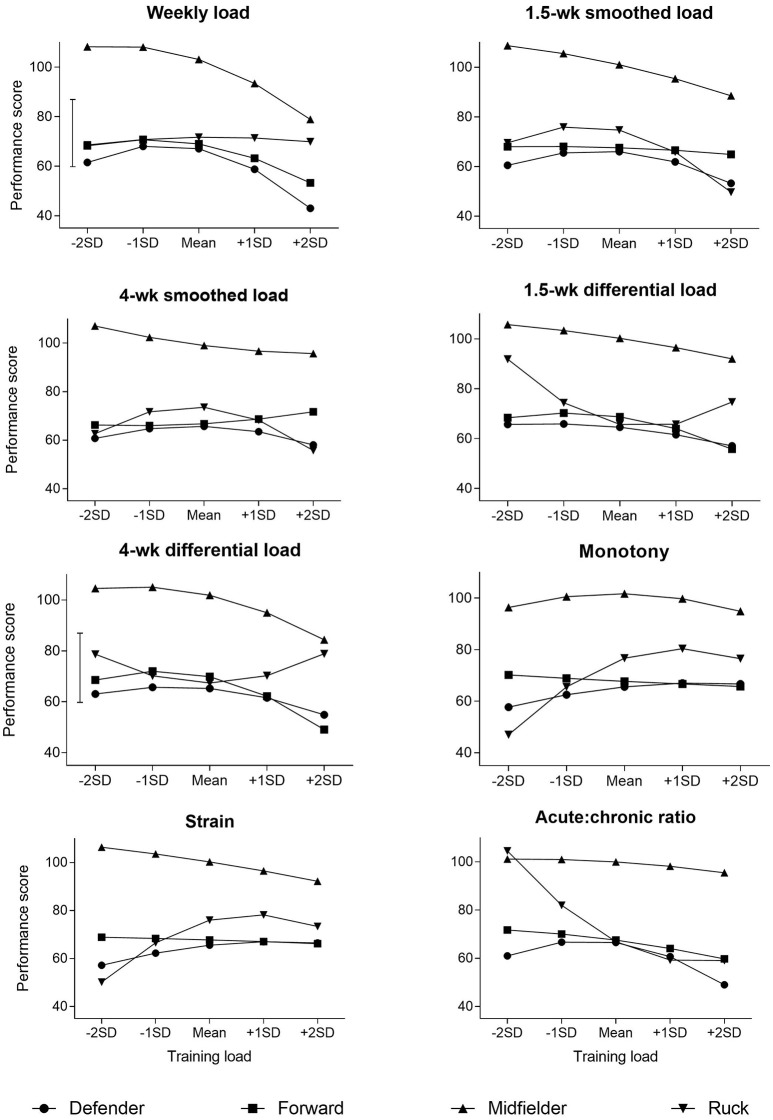
The use of external and internal load is an important aspect of monitoring systems in team sport. The aim of this study was to validate a novel measure of training load by quantifying the training-performance relationship of elite Australian footballers. The primary training measure of each of 36 players was weekly load derived from a weighted combination of Global Positioning System (GPS) data and perceived wellness over a 24-week season. Smoothed loads representing an exponentially weighted rolling average were derived with decay time constants of 1.5, 2, 3, and 4 weeks. Differential loads representing rate of change in load were generated in similar fashion. Other derived measures of training included monotony, strain and acute:chronic ratio. Performance was a proprietary score derived from match performance indicators. Effects of a 1 SD within-player change below and above the mean of each training measure were quantified with a quadratic mixed model for each position (defenders, forwards, midfielders, and rucks). Effects were interpreted using standardization and magnitude-based inferences. Performance was generally highest near the mean or ~1 SD below the mean of each training measure, and 1 SD increases in the following measures produced impairments: weekly load (defenders, forwards, and midfielders); 1.5-week smoothed load (midfielders); 4-week differential load (defenders, forwards, and midfielders); and acute:chronic ratio (defenders and forwards). Effects of other measures in other positions were either trivial or unclear. The innovative combination of load was sensitive to performance in this elite Australian football cohort. Periods of high acute load and sustained increases in load impaired match performance. Positional differences should be taken into account for individual training prescription.
在团队运动中,外部和内部负荷的运用是监测系统的一个重要方面。本研究的目的是通过量化澳大利亚精英足球运动员的训练 - 表现关系,来验证一种新的训练负荷测量方法。36名球员每人的主要训练测量指标是在24周赛季中,由全球定位系统(GPS)数据和自我感觉健康状况的加权组合得出的每周负荷。通过1.5、2、3和4周的衰减时间常数得出代表指数加权移动平均值的平滑负荷。以类似方式生成代表负荷变化率的差分负荷。其他训练衍生指标包括单调性、应变和急性:慢性比率。表现是根据比赛表现指标得出的专有分数。对于每个位置(后卫、前锋、中场和中锋),使用二次混合模型量化每个训练测量指标均值上下1个标准差的球员内部变化的影响。使用标准化和基于量级的推断来解释这些影响。表现通常在每个训练测量指标的均值附近或低于均值约1个标准差时最高,以下测量指标增加1个标准差会导致表现下降:每周负荷(后卫、前锋和中场);1.5周平滑负荷(中场);4周差分负荷(后卫、前锋和中场);以及急性:慢性比率(后卫和前锋)。其他位置的其他测量指标的影响要么微不足道,要么不明确。在这个澳大利亚精英足球群体中,负荷的创新组合对表现很敏感。高急性负荷期和负荷持续增加会损害比赛表现。在制定个人训练处方时应考虑位置差异。