Hu Zixin, Ge Qiyang, Li Shudi, Boerwinkle Eric, Jin Li, Xiong Momiao
State Key Laboratory of Genetic Engineering and Innovation Center of Genetics and Development, School of Life Sciences, Fudan University, Shanghai, China.
Human Phenome Institute, Fudan University, Shanghai, China.
Front Artif Intell. 2020 May 22;3:41. doi: 10.3389/frai.2020.00041. eCollection 2020.
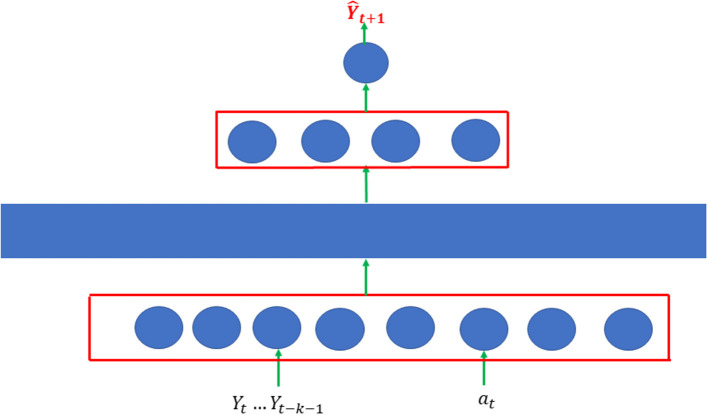
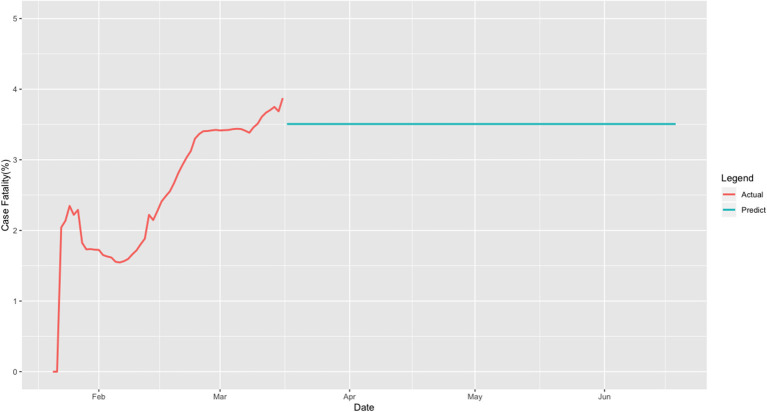
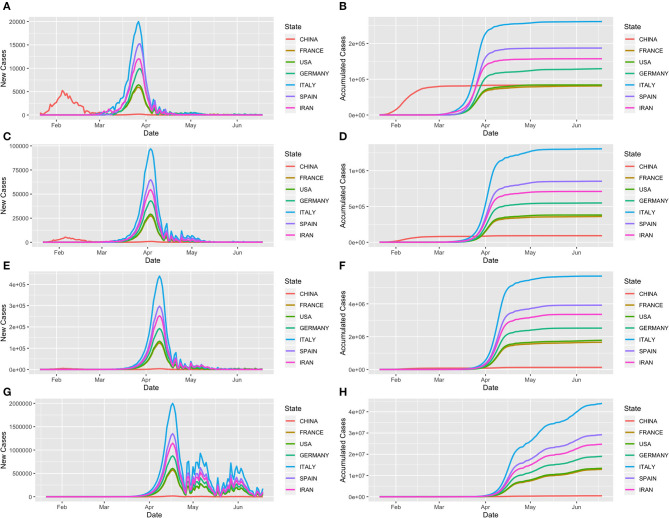
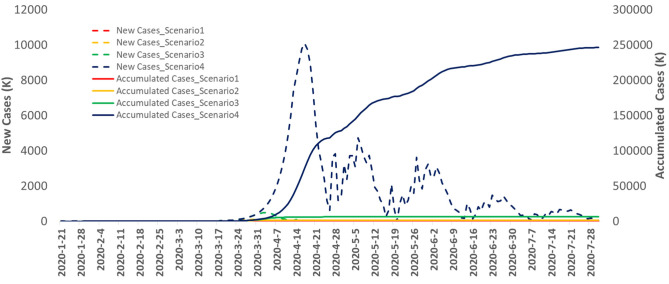
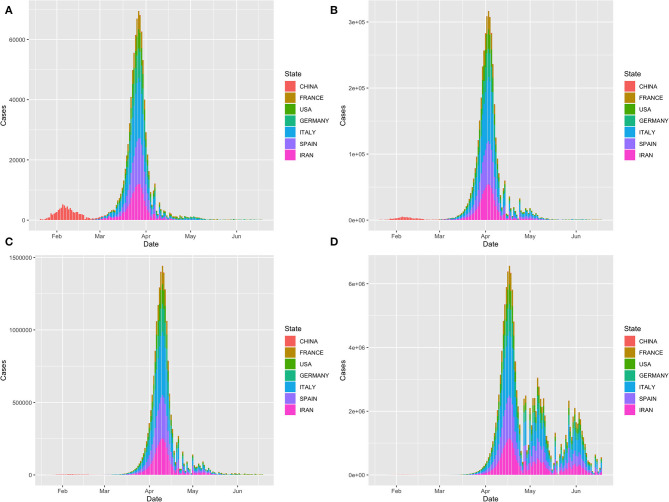
As the Covid-19 pandemic surges around the world, questions arise about the number of global cases at the pandemic's peak, the length of the pandemic before receding, and the timing of intervention strategies to significantly stop the spread of Covid-19. We have developed artificial intelligence (AI)-inspired methods for modeling the transmission dynamics of the epidemics and evaluating interventions to curb the spread and impact of COVID-19. The developed methods were applied to the surveillance data of cumulative and new COVID-19 cases and deaths reported by WHO as of March 16th, 2020. Both the timing and the degree of intervention were evaluated. The average error of five-step ahead forecasting was 2.5%. The total peak number of cumulative cases, new cases, and the maximum number of cumulative cases in the world with complete intervention implemented 4 weeks later than the beginning date (March 16th, 2020) reached 75,249,909, 10,086,085, and 255,392,154, respectively. However, the total peak number of cumulative cases, new cases, and the maximum number of cumulative cases in the world with complete intervention after 1 week were reduced to 951,799, 108,853 and 1,530,276, respectively. Duration time of the COVID-19 spread was reduced from 356 days to 232 days between later and earlier interventions. We observed that delaying intervention for 1 month caused the maximum number of cumulative cases reduce by -166.89 times that of earlier complete intervention, and the number of deaths increased from 53,560 to 8,938,725. Earlier and complete intervention is necessary to stem the tide of COVID-19 infection.
随着新冠疫情在全球范围内激增,人们对疫情高峰期的全球病例数、疫情消退前的持续时间以及大幅阻止新冠病毒传播的干预策略时机提出了疑问。我们开发了受人工智能启发的方法,用于对疫情传播动态进行建模,并评估遏制新冠病毒传播和影响的干预措施。所开发的方法应用于世界卫生组织截至2020年3月16日报告的新冠累计病例、新增病例和死亡病例的监测数据。对干预的时机和程度都进行了评估。五步预测的平均误差为2.5%。如果在比开始日期(2020年3月16日)晚4周实施全面干预,全球累计病例、新增病例的总峰值以及累计病例的最大数量分别达到75249909例、10086085例和255392154例。然而,如果在1周后实施全面干预,全球累计病例、新增病例的总峰值以及累计病例的最大数量分别降至951799例、108853例和1530276例。两次干预相比,新冠病毒传播的持续时间从356天缩短至232天。我们观察到,干预延迟1个月会使累计病例的最大数量减少至早期全面干预时的-166.89倍,死亡人数从53560人增加至8938725人。尽早并全面干预对于遏制新冠感染浪潮至关重要。