Karbhari Yash, Basu Arpan, Geem Zong-Woo, Han Gi-Tae, Sarkar Ram
Department of Information Technology, Pune Vidyarthi Griha's College of Engineering and Technology, Pune 411009, India.
Department of Computer Science and Engineering, Jadavpur University, Kolkata 700032, India.
Diagnostics (Basel). 2021 May 18;11(5):895. doi: 10.3390/diagnostics11050895.
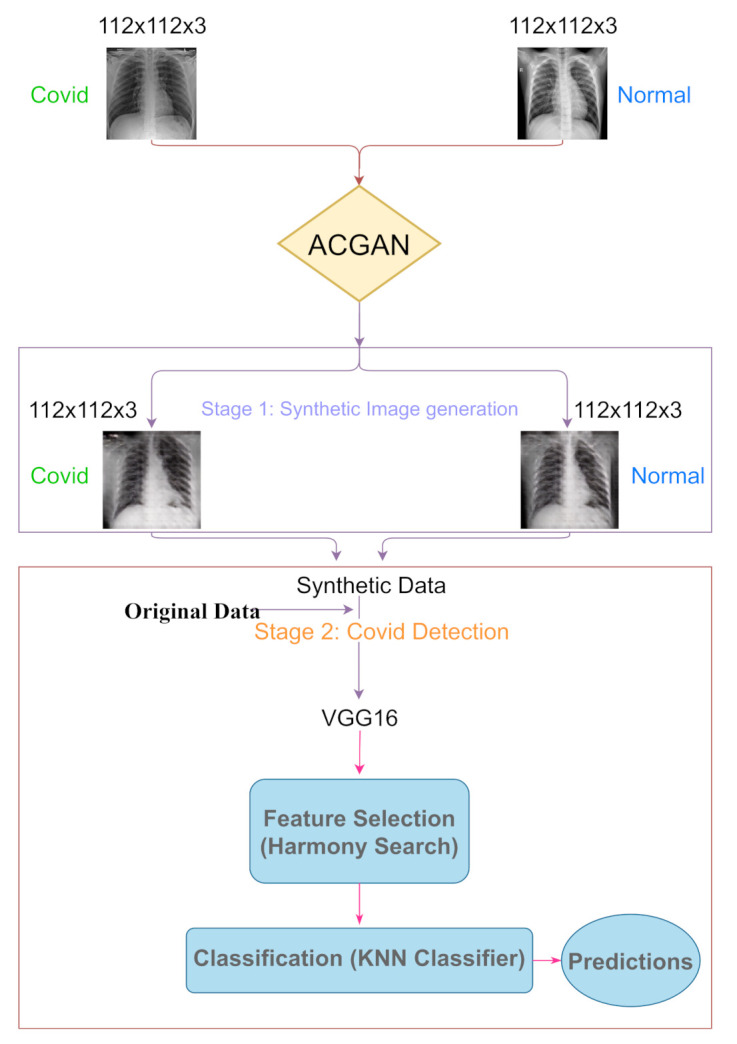
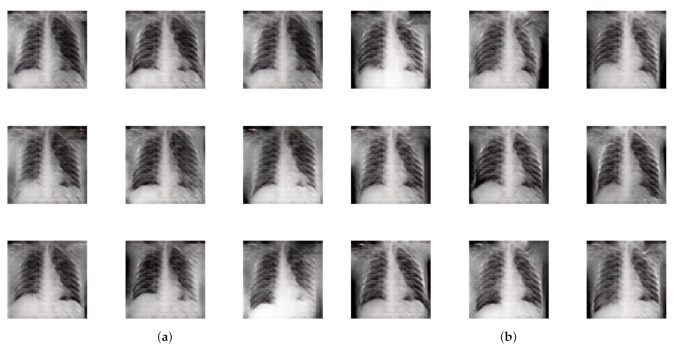
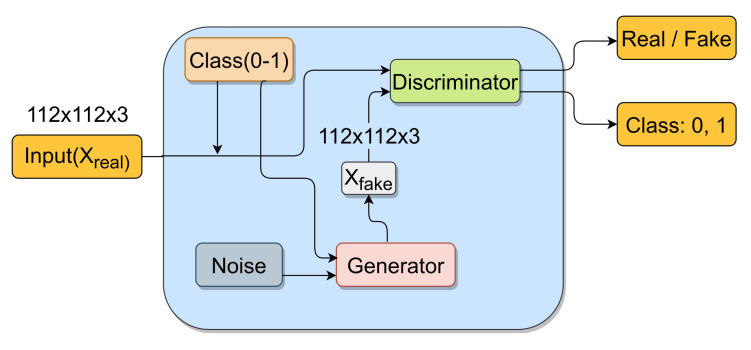
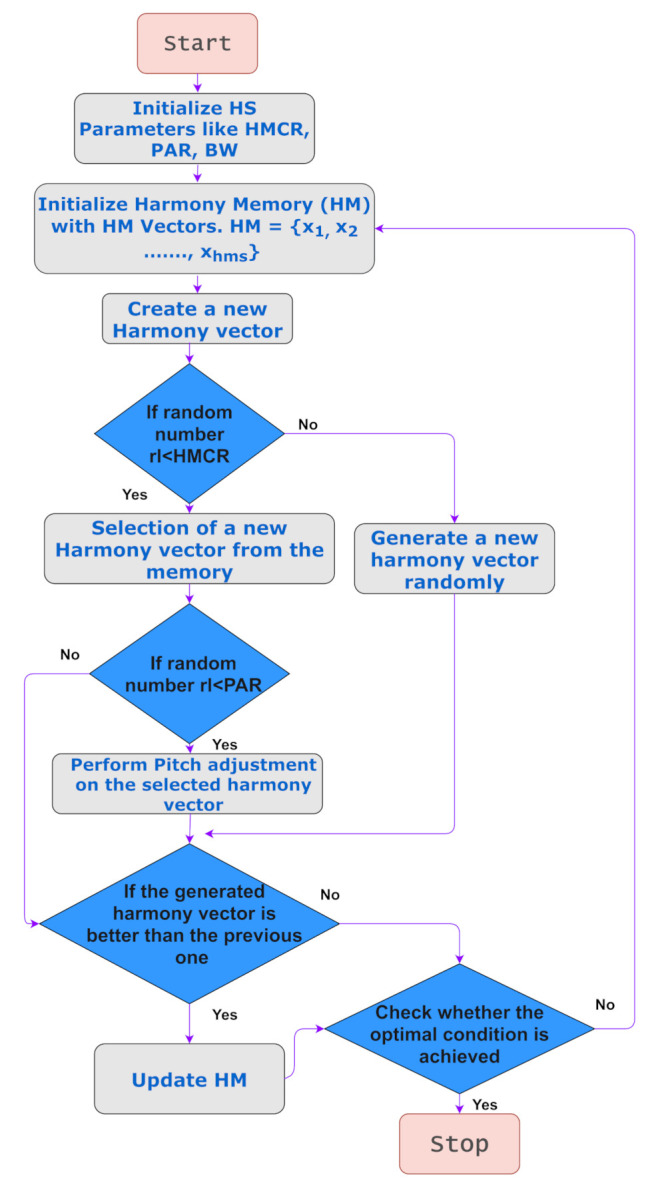
COVID-19 is a disease caused by the SARS-CoV-2 virus. The COVID-19 virus spreads when a person comes into contact with an affected individual. This is mainly through drops of saliva or nasal discharge. Most of the affected people have mild symptoms while some people develop acute respiratory distress syndrome (ARDS), which damages organs like the lungs and heart. Chest X-rays (CXRs) have been widely used to identify abnormalities that help in detecting the COVID-19 virus. They have also been used as an initial screening procedure for individuals highly suspected of being infected. However, the availability of radiographic CXRs is still scarce. This can limit the performance of deep learning (DL) based approaches for COVID-19 detection. To overcome these limitations, in this work, we developed an Auxiliary Classifier Generative Adversarial Network (ACGAN), to generate CXRs. Each generated X-ray belongs to one of the two classes COVID-19 positive or normal. To ensure the goodness of the synthetic images, we performed some experimentation on the obtained images using the latest Convolutional Neural Networks (CNNs) to detect COVID-19 in the CXRs. We fine-tuned the models and achieved more than 98% accuracy. After that, we also performed feature selection using the Harmony Search (HS) algorithm, which reduces the number of features while retaining classification accuracy. We further release a GAN-generated dataset consisting of 500 COVID-19 radiographic images.
COVID-19是一种由SARS-CoV-2病毒引起的疾病。当一个人与受感染个体接触时,COVID-19病毒就会传播。这主要是通过唾液或鼻涕飞沫传播。大多数受感染的人症状较轻,而有些人会发展为急性呼吸窘迫综合征(ARDS),这会损害肺部和心脏等器官。胸部X光(CXR)已被广泛用于识别有助于检测COVID-19病毒的异常情况。它们也被用作对高度怀疑感染的个体的初步筛查程序。然而,放射学胸部X光的可用性仍然稀缺。这可能会限制基于深度学习(DL)的COVID-19检测方法的性能。为了克服这些限制,在这项工作中,我们开发了一种辅助分类器生成对抗网络(ACGAN)来生成胸部X光。每个生成的X光属于COVID-19阳性或正常这两类中的一类。为了确保合成图像的质量,我们使用最新的卷积神经网络(CNN)对获得的图像进行了一些实验,以检测胸部X光中的COVID-19。我们对模型进行了微调,准确率达到了98%以上。之后,我们还使用和声搜索(HS)算法进行了特征选择,该算法在保留分类准确率的同时减少了特征数量。我们还发布了一个由500张COVID-19放射图像组成的GAN生成数据集。