Centre for Health Technology, University of Plymouth, Plymouth, UK.
Patient Experience Library, Macfin, UK.
Health Expect. 2022 Aug;25(4):1232-1245. doi: 10.1111/hex.13506. Epub 2022 May 8.
The importance of meaningfully involving patients and the public in digital health innovation is widely acknowledged, but often poorly understood. This review, therefore, sought to explore how patients and the public are involved in digital health innovation and to identify factors that support and inhibit meaningful patient and public involvement (PPI) in digital health innovation, implementation and evaluation.
Searches were undertaken from 2010 to July 2020 in the electronic databases MEDLINE, EMBASE, PsycINFO, CINAHL, Scopus and ACM Digital Library. Grey literature searches were also undertaken using the Patient Experience Library database and Google Scholar.
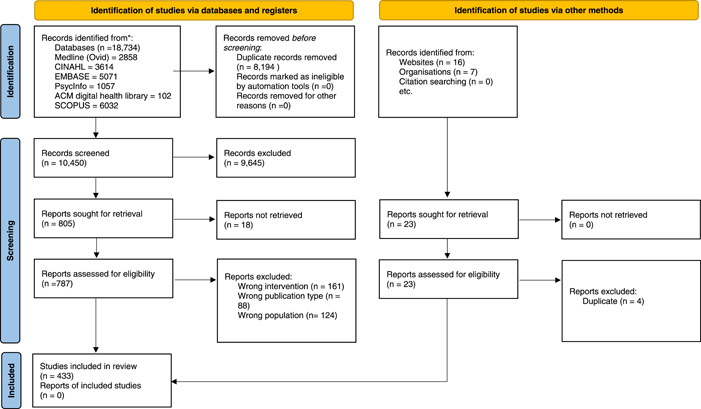
Of the 10,540 articles identified, 433 were included. The majority of included articles were published in the United States, United Kingdom, Canada and Australia, with representation from 42 countries highlighting the international relevance of PPI in digital health. 112 topic areas where PPI had reportedly taken place were identified. Areas most often described included cancer (n = 50), mental health (n = 43), diabetes (n = 26) and long-term conditions (n = 19). Interestingly, over 133 terms were used to describe PPI; few were explicitly defined. Patients were often most involved in the final, passive stages of an innovation journey, for example, usability testing, where the ability to proactively influence change was severely limited. Common barriers to achieving meaningful PPI included data privacy and security concerns, not involving patients early enough and lack of trust. Suggested enablers were often designed to counteract such challenges.
PPI is largely viewed as valuable and essential in digital health innovation, but rarely practised. Several barriers exist for both innovators and patients, which currently limits the quality, frequency and duration of PPI in digital health innovation, although improvements have been made in the past decade. Some reported barriers and enablers such as the importance of data privacy and security appear to be unique to PPI in digital innovation. Greater efforts should be made to support innovators and patients to become meaningfully involved in digital health innovations from the outset, given its reported benefits and impacts. Stakeholder consensus on the principles that underpin meaningful PPI in digital health innovation would be helpful in providing evidence-based guidance on how to achieve this.
This review has received extensive patient and public contributions with a representative from the Patient Experience Library involved throughout the review's conception, from design (including suggested revisions to the search strategy) through to article production and dissemination. Other areas of patient and public contributor involvement include contributing to the inductive thematic analysis process, refining the thematic framework and finalizing theme wording, helping to ensure relevance, value and meaning from a patient perspective. Findings from this review have also been presented to a variety of stakeholders including patients, patient advocates and clinicians through a series of focus groups and webinars. Given their extensive involvement, the representative from the Patient Experience Library is rightly included as an author of this review.
让患者和公众有意义地参与数字健康创新的重要性已被广泛认可,但往往理解不足。因此,本综述旨在探讨如何让患者和公众参与数字健康创新,并确定支持和阻碍患者和公众在数字健康创新、实施和评估中有意义参与的因素。
从 2010 年到 2020 年 7 月,在电子数据库 MEDLINE、EMBASE、PsycINFO、CINAHL、Scopus 和 ACM 数字图书馆中进行了检索。还通过患者体验图书馆数据库和谷歌学术进行了灰色文献检索。
在确定的 10540 篇文章中,有 433 篇被纳入。纳入的文章大多发表在美国、英国、加拿大和澳大利亚,来自 42 个国家的代表突出了患者在数字健康中的参与具有国际相关性。报道了 112 个已经发生患者参与的主题领域。描述最多的领域包括癌症(n=50)、心理健康(n=43)、糖尿病(n=26)和长期疾病(n=19)。有趣的是,有 133 多个术语被用来描述患者参与;很少有明确的定义。患者通常最参与创新之旅的最后、被动阶段,例如可用性测试,而主动影响变革的能力受到严重限制。实现有意义的患者参与的常见障碍包括数据隐私和安全问题、没有尽早让患者参与以及缺乏信任。建议的促进因素通常旨在克服这些挑战。
患者参与在数字健康创新中被广泛认为是有价值和必不可少的,但很少实际实施。创新者和患者都存在一些障碍,这目前限制了数字健康创新中患者参与的质量、频率和持续时间,尽管在过去十年中已经取得了一些进展。一些报道的障碍和促进因素,例如数据隐私和安全的重要性,似乎是数字创新中患者参与所特有的。鉴于其报告的益处和影响,应该更加努力地支持创新者和患者从一开始就有意义地参与数字健康创新。利益相关者就数字健康创新中患者参与的基本原则达成共识,将有助于提供基于证据的指导,说明如何实现这一目标。
本综述得到了患者和公众的广泛贡献,患者体验图书馆的代表从综述的构思、设计(包括对搜索策略的建议修改)到文章的制作和传播,都参与其中。患者和公众贡献者的其他参与领域包括参与归纳主题分析过程、改进主题框架和最终确定主题措辞,以确保从患者角度具有相关性、价值和意义。本综述的研究结果还通过一系列焦点小组和网络研讨会向包括患者、患者倡导者和临床医生在内的各种利益相关者进行了介绍。由于他们的广泛参与,患者体验图书馆的代表理所当然地被列为该综述的作者之一。