Jobke Sandra, Kasten Erich, Vorwerk Christian
Institute of Medical Psychology, Otto-von Guericke-University of Magdeburg, Leipziger Strasse 44, 39120 Magdeburg, Germany.
Clin Ophthalmol. 2008 Sep;2(3):601-7. doi: 10.2147/opth.s2836.
The prevalence rates of myopia vary between 5% in Australian Aborigines to 84% in Hong Kong and Taiwan, 30% in Norwegian adults, and 49.5% in Swedish schoolchildren. The aim of this study was to determine the prevalence of refractive errors in German children, adolescents, and adults.
The parents (aged 24-65 years) and their children (516 subjects aged 2-35 years) were asked to fill out a questionnaire about their refractive error and spectacle use. Emmetropia was defined as refractive status between +0.25D and -0.25D. Myopia was characterized as </=-0.5D and hyperopia as >/=+0.5D. All information concerning refractive error were controlled by asking their opticians.
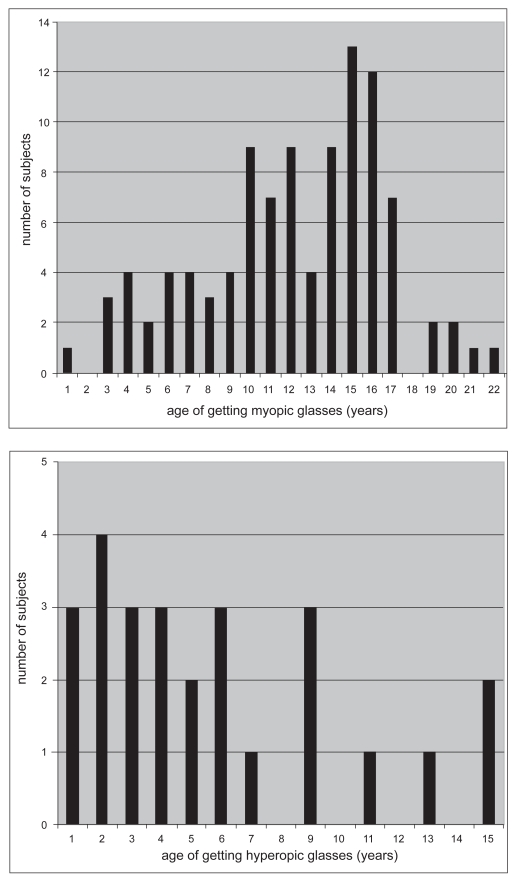
The prevalence rates of myopia differed significantly between all investigated age groups: it was 0% in children aged 2-6 years, 5.5% in children aged 7-11 years, 21.0% in adolescents (aged 12-17 years) and 41.3% in adults aged 18-35 years (Pearson's Chi-square, p = 0.000). Furthermore, 9.8% of children aged 2-6 years were hyperopic, 6.4% of children aged 7-11 years, 3.7% of adolescents, and 2.9% of adults (p = 0.380). The prevalence of myopia in females (23.6%) was significantly higher than in males (14.6%, p = 0.018). The difference between the self-reported and the refractive error reported by their opticians was very small and was not significant (p = 0.850).
In Germany, the prevalence of myopia seems to be somewhat lower than in Asia and Europe. There are few comparable studies concerning the prevalence rates of hyperopia.
近视患病率在澳大利亚原住民中为5%,在香港和台湾为84%,在挪威成年人中为30%,在瑞典学童中为49.5%。本研究的目的是确定德国儿童、青少年和成年人屈光不正的患病率。
要求父母(年龄在24 - 65岁之间)及其子女(516名年龄在2 - 35岁之间的受试者)填写一份关于他们屈光不正和眼镜使用情况的问卷。正视被定义为屈光状态在+0.25D至 - 0.25D之间。近视被定义为≤ - 0.5D,远视被定义为≥ + 0.5D。所有关于屈光不正的信息都通过询问他们的验光师进行核实。
在所有调查的年龄组中,近视患病率差异显著:2 - 6岁儿童为0%,7 - 11岁儿童为5.5%,青少年(12 - 17岁)为21.0%,18 - 35岁成年人中为41.3%(Pearson卡方检验,p = 0.000)。此外,2 - 6岁儿童中有9.8%为远视,7 - 11岁儿童中有6.4%,青少年中有3.7%,成年人中有2.9%(p = 0.380)。女性近视患病率(23.6%)显著高于男性(14.6%,p = 0.018)。自我报告的屈光不正与验光师报告的屈光不正之间的差异非常小,且无统计学意义(p = 0.850)。
在德国,近视患病率似乎略低于亚洲和欧洲。关于远视患病率的可比研究较少。